Nobody wants to be the person who rings a plumber at midnight for a drip. Plenty of people worry about that so much that they sit up with a bucket under a ceiling that is getting heavier by the hour. I have been to both, and the second one costs far more.
I have worked as a plumber across Ipswich and Suffolk for more than forty years, and a lot of my night calls start with the same sentence: “I don’t know if this is an emergency.” The honest answer is that most plumbing emergencies become much smaller once the water is off. So this guide does two jobs. It helps you decide how urgent your problem really is, and it shows you how to make it safe, whatever the answer turns out to be.
If you only read one part, read the five first steps below. They apply to almost every plumbing emergency, and doing them in the first few minutes is the difference between a mopped floor and a new ceiling.
What Counts as a Plumbing Emergency? The Three-Question Test
When someone rings me late at night, I am really asking three questions. If the answer to any of them is yes, treat it as an emergency and call straight away. If all three are no, it can almost always wait for a daytime visit.
Is water escaping, and you cannot stop it?
This is the big one. A leak you can turn off at a valve is a repair. A leak you cannot turn off, because the stopcock is stuck, missing or not working, or because the water is coming from a loft tank or hot water cylinder, is an emergency. Water keeps spreading under floors and into walls long after you stop seeing it.
Is anyone, or anything, at risk?
Water near electrics, a ceiling that is bulging or sagging, sewage inside the house, or scalding water from a cylinder or pipe all put people at risk. So does a leak in a flat that is pouring into the home below. Safety turns an inconvenience into an emergency.
Has the home lost something it cannot do without?
No water at all, no working toilet in the house, or drains that cannot take any water. One of these on its own may be a same-day job rather than a midnight one, but add a baby, an elderly relative, someone unwell or freezing weather and it moves up the list.
The Five First Steps in Any Plumbing Emergency
It is hard to think clearly with water coming through the kitchen ceiling. Work through these in order. Most take less than a minute, and they are the same steps I would talk you through on the phone while I am on my way.
Turn the water off at the stopcock
The internal stopcock is usually under the kitchen sink, but it can be in a downstairs toilet, an airing cupboard, under the stairs or under a floorboard by the front door. Turn it clockwise until it stops. If it will not move, do not force it with a long bar, as old stopcocks snap. There is usually an outside stop tap under a small cover in the pavement or front garden too.
Make the electrics safe
If water is near sockets, light fittings or the consumer unit, switch the affected circuits off, or the whole house if you are not sure. Only touch the consumer unit if you can reach it without standing in water. If you cannot, keep everyone out of that area.
Turn off the boiler and the immersion heater
With the cold supply off, a combi boiler or hot water cylinder can run dry or keep heating water that is leaking. Switch the boiler off at its switch or fused spur, and the immersion heater off too if you have one.
Drain the system and contain the water
Open the cold taps downstairs, and flush the toilets, to empty the pipes faster. Put buckets under drips, move rugs, furniture and electrical items away, and towel the worst of it. If a ceiling is bulging, keep out from under it and put a bucket underneath.
Take photos, then call
A few photos and a short video of the leak, the damage and the stopcock help your insurer later. Then ring a plumber. Tell them what you can see, what you have turned off, and whether the water has stopped. That tells them how fast they need to be with you.
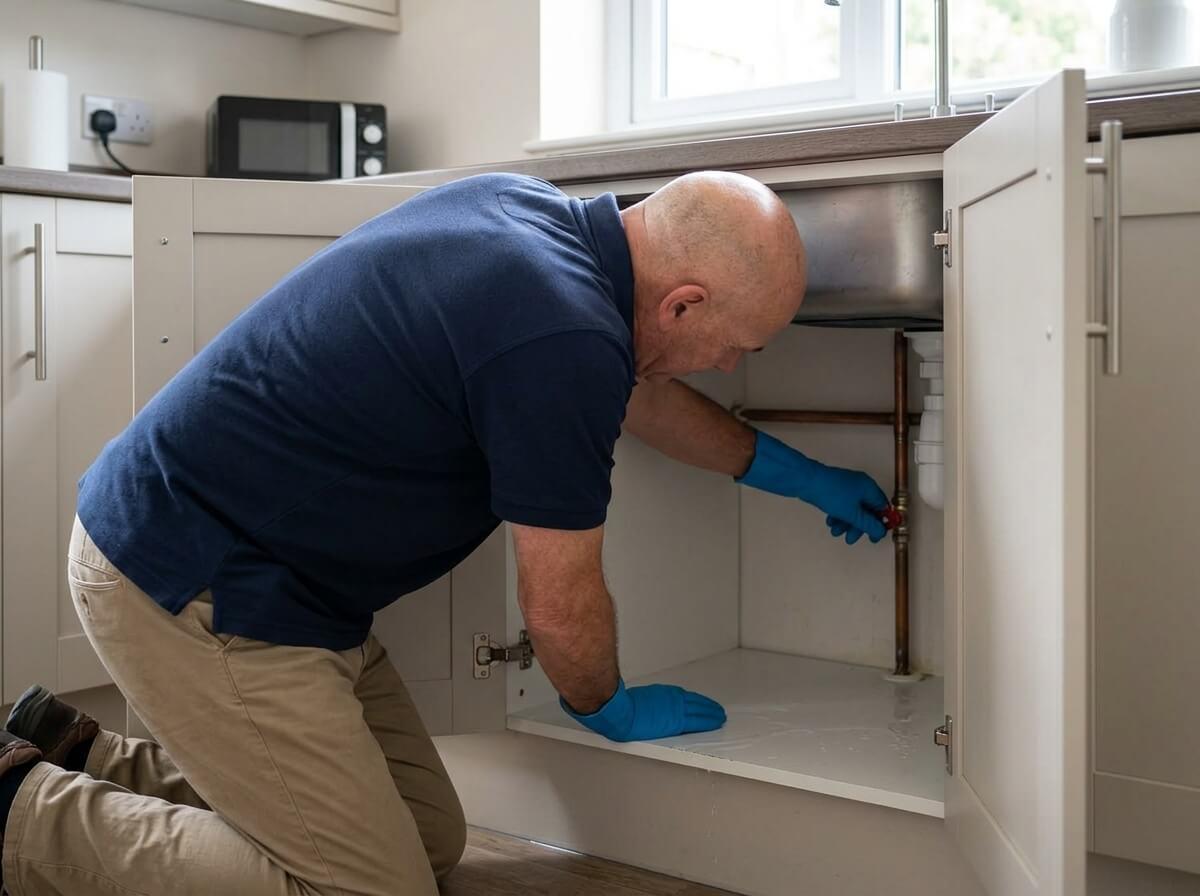
If you have never found your stopcock, do it today, while nothing is wrong. My guide on how to locate your stopcock shows all the usual hiding places, and if yours is stiff, the guide to a stuck or seized stopcock shows how to free it without breaking it.
Plumbing Emergency Triage: Call Now, Same Day, or Book In
This is the table I wish everyone had stuck on the fridge. Find the row closest to what is happening, check the urgency, and follow the link for the step-by-step guide to that problem.
| WHAT IS HAPPENING | WHY | HOW SOON |
|---|---|---|
| A burst pipe, or water spraying or pouring from a pipe or fitting What to do when a pipe bursts → | A 15mm pipe at mains pressure can let out a bathful of water in a few minutes. Turn the stopcock off first. | Call now, any hour |
| Water coming through the ceiling or a light fitting Water leaking through the ceiling → | Water and electrics together, plus the risk of a sagging ceiling coming down. Stopcock off, then the lighting circuit off. | Call now, any hour |
| A leak you cannot slow down, even with the stopcock off Stopcock leaking or not working → | Either the stopcock has failed or the water is coming from a tank or cylinder that the stopcock does not control. | Call now, any hour |
| Sewage or dirty water coming up the shower, bath, sink or toilet Sewage coming up the drains → | A health risk and it gets worse every time anyone uses water. Stop using all taps and toilets. | Call now, any hour |
| A toilet overflowing that will not stop when you turn the isolation valve off Toilet overflowing → | Either the valve has seized or the pan is backing up from a blocked drain. Both need sorting straight away. | Call now, any hour |
| A hot water cylinder leaking Hot water cylinder leaking → | Hot water, a large volume, and usually an immersion heater nearby. Switch the immersion and boiler off. | Call now, any hour |
| No water at all, and your neighbours still have theirs No water in the house → | Your supply pipe or stopcock is the likely cause, and a frozen or split pipe will start leaking once it thaws. | Call now, any hour |
| A tap that will not turn off Tap will not turn off → | Running water you cannot control. Turn it off at the isolation valve or stopcock and it becomes a same-day job. | Call now, any hour |
| Your only toilet blocked Unblock a toilet without a plunger → | Not dangerous, but a household cannot go long without one. Worse with young children or someone unwell. | Same day |
| A frozen pipe with no leak yet Frozen pipes → | The ice can split the pipe, and the leak starts when it thaws. Thaw it gently and keep an eye on it. | Same day |
| A leak under the sink, washing machine or radiator that you have isolated Leaking under the sink → | Once the water is off at the valve, the damage stops. It needs fixing, but it no longer needs a 2am call-out. | Same day |
| An outside drain or manhole overflowing Outside drain overflowing → | Unpleasant, and it can back up into the house. Stop using water and check if it is shared with neighbours. | Same day |
| Water meter turning with every tap off, or a damp patch that keeps growing Signs of a hidden water leak → | A hidden leak. Not usually a flood, but it is soaking into floors or walls all day and night. | Same day |
| A slow sink, bath or shower, or a gurgling toilet Why a sink keeps blocking → | An early warning of a blockage. Deal with it this week before it blocks fully. | Book in |
| An overflow pipe dripping outside Overflow pipe dripping → | A valve letting by in a cistern or tank. Water is being wasted, not escaping into the house. | Book in |
| A dripping tap, a running toilet, low pressure or banging pipes Banging pipes → | Annoying, and worth fixing, but nothing is getting damaged tonight. | Book in |
Notice how many problems drop from “call now” to “same day” once the water is off. A washing machine hose that has split is a flood. The same hose with the valve behind the machine turned off is a part to replace in the morning.
The Emergencies That Need a Plumber Straight Away
These are the calls I get out of bed for, and I would not want anyone to wait on them.
Burst pipes and leaks you cannot stop
A burst pipe is the classic plumbing emergency. Mains water does not run out, so it will keep coming until someone turns it off. If the stopcock works, it buys you time but you will have no water until the pipe is repaired. If the stopcock does not work, or the leak is fed from a loft tank, it keeps going. Water from a tank can be slowed by tying up the ball valve in the loft and running the bath taps to empty it. My burst pipe repair page explains what the repair itself involves.
Water coming through a ceiling or into electrics
Water through the ceiling usually means a leak in the bathroom or the pipework above. The danger is twofold: water running into light fittings, and plasterboard that holds water until it gives way. A ceiling that is bowing down can come down suddenly. Keep out from under it, and if it is bulging, a small hole made at the lowest point with a screwdriver, with a bucket underneath, lets the water out in a controlled way.
Sewage or wastewater coming back into the house
Sewage coming up a shower tray, bath or downstairs toilet means the drain below is blocked. It is a health risk, and it gets worse every time someone flushes or runs a tap. Stop using water completely, keep children and pets away, and check the manhole outside. My drain unblocking service clears your own drains, and if it turns out the blockage is in a shared drain or the sewer, Anglian Water clears it for free.
Leaking hot water cylinders, tanks and boilers
A hot water cylinder holds well over a hundred litres, and the water is hot enough to scald. A leak from the cylinder, its pipework or the cold tank above it will not stop at the main stopcock, because the cylinder is fed from the loft. Switch the immersion and boiler off, close the gate valve on the cold feed into the cylinder if you can find it, and call. A plumber can deal with water leaking from around a boiler, but if you suspect a gas problem, that is a job for a registered gas engineer.
No water at all
First check the neighbours and the water company’s website. If the whole street is off, it is their problem and calling a plumber will not help. If only your home has no water, the cause is on your side: a closed or failed stopcock, a frozen supply pipe, or a leak on the pipe between the meter and the house. In winter, a frozen pipe is the usual cause, and it is the one most likely to start leaking when it thaws.
When the Right Call Is Not a Plumber
Part of getting a plumbing emergency sorted quickly is knowing when someone else should be your first call. These are the numbers worth saving in your phone today.
| THE SITUATION | WHO TO CALL FIRST |
|---|---|
| You smell gas, or a gas appliance is making a rotten egg smell | The National Gas Emergency Service on 0800 111 999, free, 24 hours. Get everyone out, do not use switches or flames, and open doors and windows on the way. |
| The whole street has lost water, or water is coming up through the pavement or road | Your water company. Anglian Water, which supplies most of Ipswich, takes leak reports free on 0800 771 881. |
| Sewage is overflowing from a manhole shared with neighbours, or from the sewer in the road | Anglian Water on 03457 145 145. Shared drains and public sewers are theirs to clear, at no cost to you. |
| The power has gone off across the house or the street, not just one tripped circuit | Call 105, the free national power cut number, which puts you through to the local network operator. |
| Water has got into sockets, the consumer unit, or the electrics keep tripping after a leak | Keep the power off at the consumer unit and get a qualified electrician to check it before it goes back on. |
| The boiler has a gas fault, a fault code you cannot clear, or you think it is leaking gas | A registered gas engineer. A plumber can fix the water side, such as a leaking pipe or valve near the boiler. |
| Water is escaping from your pipes, tanks, toilets, taps or your own drain | A plumber. In Ipswich and the surrounding towns, that is me, on 07977 857224, day or night. |
What Makes a Plumbing Problem More Urgent
The same leak can be a morning job in one home and a midnight one in another. These are the things that make me tell people to call now rather than wait:
- ●Someone vulnerable in the house. A baby, an elderly person, or someone ill or disabled who cannot manage without water or a toilet.
- ●Freezing weather. No water or heating in a cold snap is harder on people, and frozen pipes can split in several places at once.
- ●A flat or terraced house. A leak in a flat is very often a leak in the flat below too. Let the neighbours know and tell the managing agent.
- ●An empty property. Holiday lets, homes between tenants and a relative’s empty house can leak for days before anyone notices.
- ●Water near electrics or a sagging ceiling. Both are safety risks, whatever the size of the leak.
- ●A stopcock that will not turn. Without it, you have no way of stopping the next problem either.
What Can Safely Wait Until the Morning
Plenty of plumbing problems feel urgent but are not, and I will tell you so if you ring. You can usually wait for a daytime visit if:
- ●The leak stops when you close a valve. Most sinks, toilets and appliances have a small isolation valve on the pipe, turned with a flat screwdriver. A quarter turn so the slot is across the pipe closes it.
- ●A tap is dripping. Put the plug in or a cloth in the basin so the noise does not keep you awake, and book it in.
- ●A toilet keeps running into the pan. Close the isolation valve on the cistern feed and fill the cistern from a jug to flush. See my guide to a toilet that will not flush for the common causes.
- ●A drain is slow but still going down. Use it as little as possible and book it in for the next day or two.
- ●You have one of several toilets blocked. Use another one, put a sign on the door, and call in the morning.
- ●Pressure is low, or the pipes bang. Irritating, but nothing is being damaged tonight.
The one thing to watch: a slow problem that is getting faster. A drip that turns into a trickle, or a damp patch that doubles in size in an hour, has moved up the table. Recheck it before you go to bed.
Emergency Fixes You Can Safely Do Yourself
You are not expected to repair anything in an emergency. But there are a few safe, temporary fixes that can hold a leak until the morning, especially if turning the stopcock off would leave a household with no water overnight.
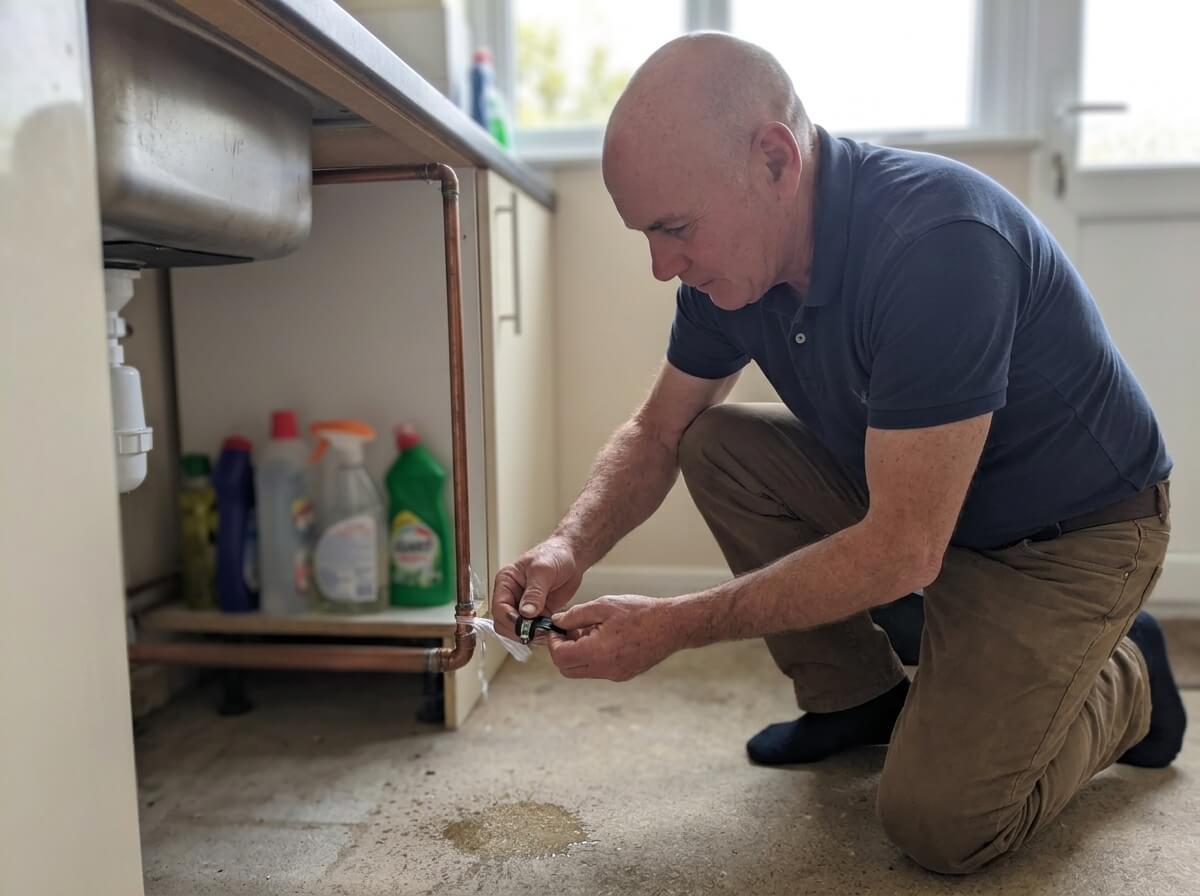
- ●Self-amalgamating tape. Stretched tightly round a pinhole leak on a pipe, with the water off, it bonds to itself and can hold for days.
- ●A pipe repair clamp. A rubber-lined clamp bolted over a split on a straight length of pipe. Cheap, and worth having in a drawer.
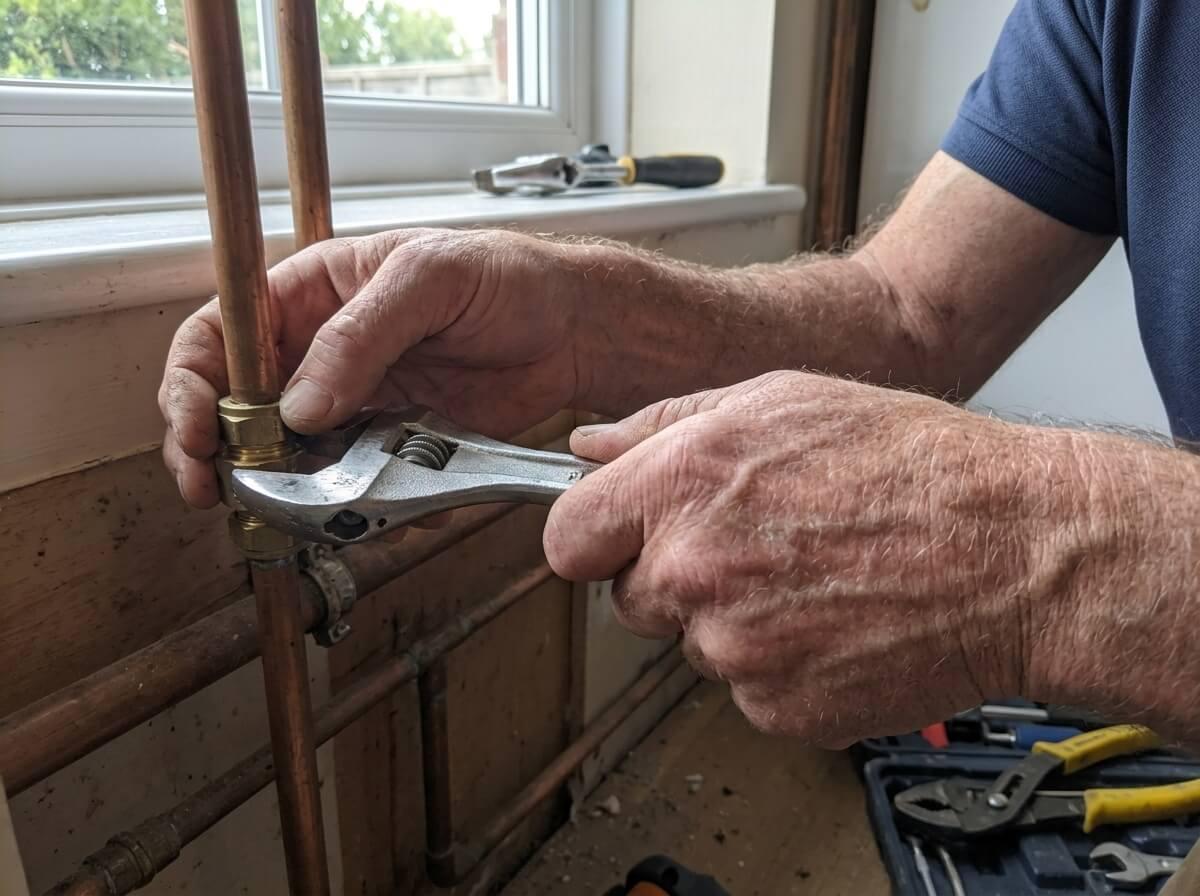
- ●Tightening a compression nut. A quarter turn on a weeping nut under a sink often stops a drip. Hold the fitting with a second spanner and do not overtighten.
- ●Isolating one fitting. Closing the valve on a toilet, tap or washing machine lets the rest of the house keep its water.
My guide on how to stop a leaking pipe covers these step by step. And just as important, here is what not to do:
- ✕Do not force a stuck stopcock with a long bar or a hammer. Old brass stopcocks snap, and then you have water you cannot stop at all.
- ✕Do not touch electrics while standing in water. If you cannot reach the consumer unit dry, leave it and keep everyone out.
- ✕Do not use a flame to thaw a frozen pipe. Use a hairdryer on a low setting or warm cloths, working from the tap end back.
- ✕Do not pour chemical cleaner down a drain that is backing up. It will not shift a main drain blockage, and it leaves caustic water sitting in the bath or shower.
- ✕Do not turn the water back on to see if it has stopped. If the leak is behind a wall or under a floor, you will not see it, but it will still be soaking in.
Your Plumbing Emergency Kit
Ten minutes now saves a lot of panic later. Every home I visit would be better off with these sorted before anything goes wrong:
- ●Know where the stopcock is, and check it turns. Tie a label on it so anyone in the house can find it.
- ●Know where the outside stop tap and water meter are, and keep a stop tap key if the cover is in the pavement.
- ●Find the isolation valves under the sinks, behind the toilets and the washing machine, and on the cold feed to the cylinder.
- ●A torch, a bucket and old towels in the same cupboard as the stopcock.
- ●A roll of self-amalgamating tape and a pipe repair clamp, both a few pounds from any merchant.
- ●A plunger for the toilet and one for the sinks. Not the same one.
- ●The phone numbers in the table above, plus a plumber you trust, saved in your phone and written down by the stopcock.
The Chartered Institute of Plumbing and Heating Engineering gives much the same advice: know your stopcock, turn the water off first, and keep the electrics safe.
How to Choose an Emergency Plumber When It Is Urgent
The worst time to choose a plumber is when water is coming through the ceiling, and that is when most people do it. A quick search at midnight throws up national call centres and agencies that pass the job to whoever is free, often from miles away, with prices you only find out about later. A few things worth checking, even in a hurry:
- ●Are they actually local? A real address and a local number usually mean a shorter wait.
- ●Will they tell you the price before they start? You should know what you are agreeing to before any work begins.
- ●Do the reviews mention emergencies? Look for reviews from people who called at night or at the weekend, not just planned jobs.
- ●Do they talk you through it on the phone? A good emergency plumber will help you stop the water before they even set off.
WaterSafe lists approved plumbers for water supply work, and my guides on finding a good plumber in Ipswich and what an emergency plumber costs go into more detail on what to ask.
What Happens When You Call Me
I answer the phone myself, day or night. I will ask what you can see, what you have turned off, and whether the water has stopped, and I will talk you through anything you have not managed yet. If it is a genuine emergency I set off straight away, and for most of Ipswich I am usually with you in about 30 minutes.
If it can safely wait, I will tell you, and explain how to keep it safe overnight. I will not turn a dripping tap into a midnight call-out. Either way, you get a fair price agreed before any work starts, and the repair is done properly, not patched to bring me back next week.
Plumbing Emergencies, Insurance and Who Pays
Most home insurance policies cover the damage caused by an escape of water, such as ruined ceilings, floors and carpets. Many do not cover the repair to the pipe or fitting itself, and few cover a leak that was slowly getting worse for months. Some policies also include “trace and access”, which pays for finding a hidden leak and opening up the floor or wall to reach it.
- ●Stop the water first. Insurers expect you to limit the damage. Turning the stopcock off promptly helps your claim.
- ●Photograph everything before you start clearing up, and keep any damaged parts the plumber removes.
- ●Ask for a written report and invoice describing the cause and the repair. I provide one as standard.
- ●Check for home emergency cover. It is often an add-on to your buildings policy, and some insurers will reimburse a plumber of your choice.
- ●Renting? Report it to your landlord or agent straight away, in writing. Landlords are responsible for keeping the water supply, pipes and sanitary fittings in repair, so the repair is usually theirs to arrange.
Winter Is When Most Plumbing Emergencies Happen
My phone rings most in the first proper cold snap of the year, and again when it thaws. Pipes in lofts, garages, outside walls and under suspended floors freeze, the ice splits them, and the leak starts when the temperature rises. A few things now make a big difference:
- ●Lag exposed pipes and the loft tank, but do not insulate under the tank, as the warmth from below helps stop it freezing.
- ●Keep the heating on low if you go away, rather than off.
- ●Fix dripping taps and overflows, as a slow trickle in an outside pipe freezes and blocks it.
- ●Turn off and drain the outside tap from its isolation valve indoors.
My guide to frozen pipes explains how to thaw one safely if it does happen.
Plumbing Emergency in Ipswich? Call Philip
A few points to take away, whatever the problem turns out to be:
- ●Water you cannot stop, a risk to safety, or no water or toilet at all: treat it as an emergency.
- ●Turn the stopcock off first, then the electrics near the water, then the boiler and immersion.
- ●Gas smell: 0800 111 999. Whole street off or a leak in the road: the water company.
- ●A leak you have isolated, a drip or a slow drain can usually wait until the morning.
- ●Find your stopcock and isolation valves today, while nothing is wrong.
If you are not sure, ring me on 07977 857224, 24 hours a day, seven days a week, and I will tell you honestly whether it needs me tonight. I cover Ipswich, Felixstowe, Woodbridge, Kesgrave, Martlesham, Stowmarket and the villages in between. Everything I handle is on the emergency plumbing services page, or you can request a callback.