You go to turn the tap off and it does not stop. Maybe the handle just keeps spinning. Maybe the lever is all the way down and water is still pouring out. Maybe it closed fine this morning and now it will only slow to a steady dribble. Either way, the water is running, the sink is filling, and you do not know how to make it stop.
I have been a plumber in Ipswich for more than forty years, and a tap that won’t turn off is one of the calls I get most often, usually late in the evening. The good news is that it is almost never a big job. The water is going down the drain, so you have a few minutes, and there is nearly always a valve close by that will stop it. The part people get stuck on is the hot tap, because on a lot of Suffolk homes the stopcock does not touch it. This guide shows you how to stop any tap in the house, what has gone wrong inside it, how to fix the common faults yourself, and when it is worth calling me.
Tap Won’t Turn Off? Do These 4 Things First
Pull the plug and stop forcing the handle
Take the plug out of the sink or bath so the water can drain away. Then stop turning the handle. If it is spinning or already tight, more force will strip the spindle, crush the washer or crack the tap body, and turn a cheap repair into a new tap.
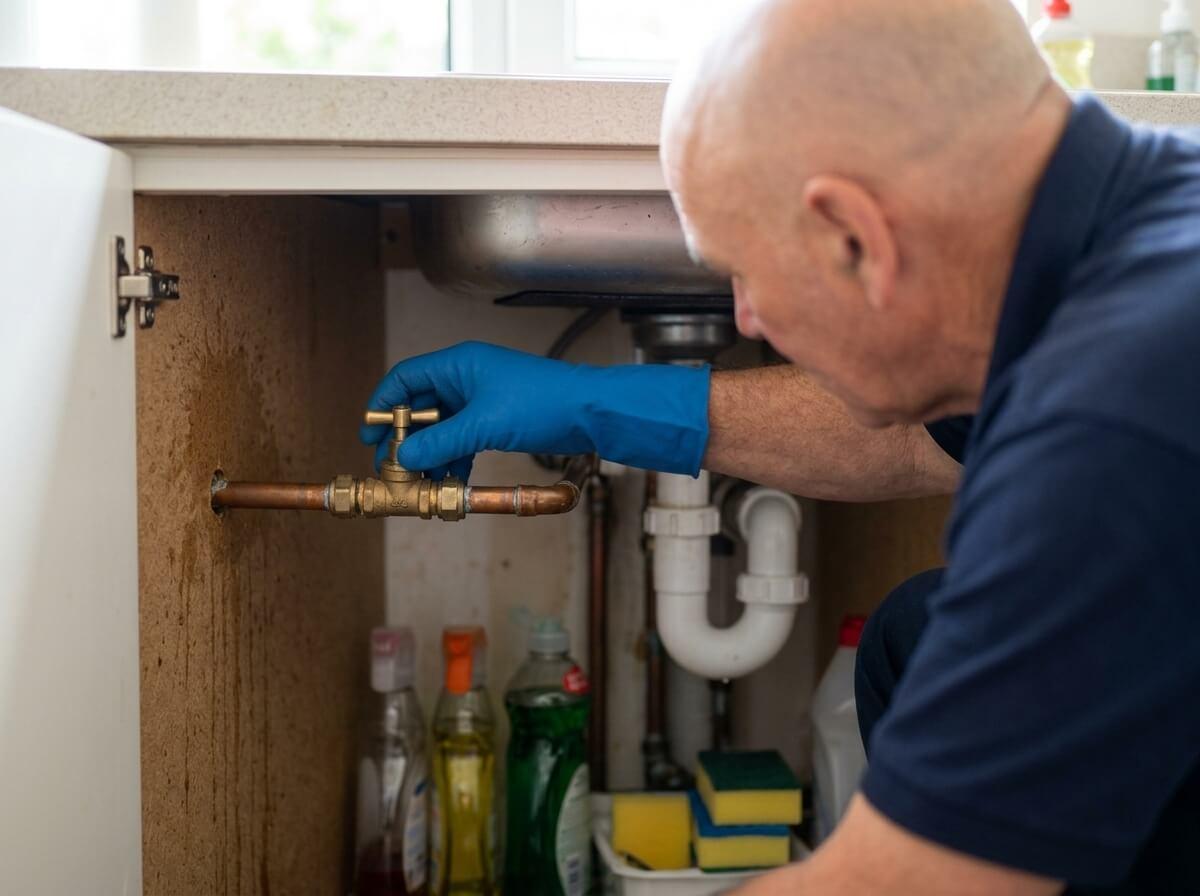
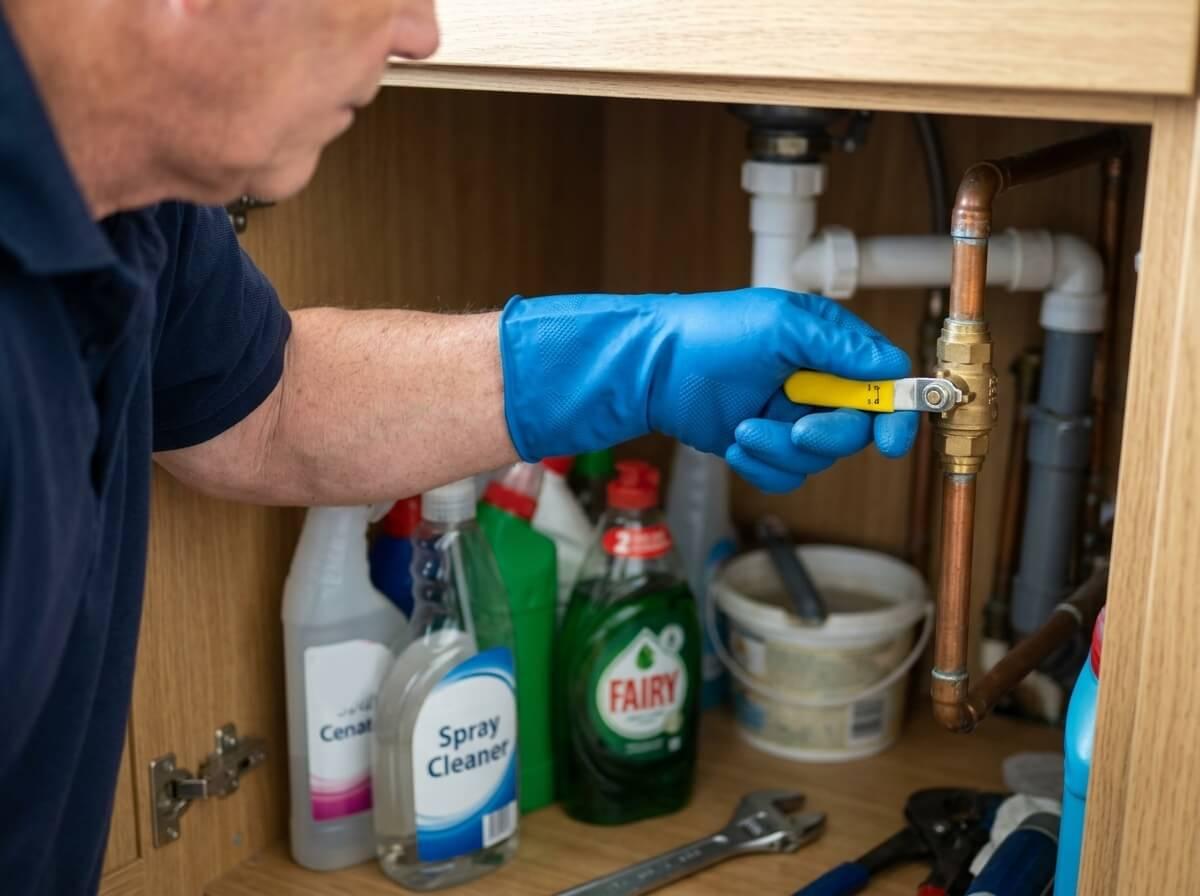
Find the isolation valve under the tap
Look on the pipes directly below the tap, inside the sink cupboard or behind the bath panel at the tap end. An isolation valve is a small brass or chrome fitting with a screwdriver slot or a little lever, often with a red or blue mark. Turn it a quarter turn so the slot or lever sits across the pipe. Hot is usually on the left. The water should stop straight away.
No valve? Turn off the main stopcock
Turn the stopcock clockwise until it stops. It is usually under the kitchen sink, but can be in a downstairs toilet, under the stairs or by the front door. This stops every cold tap fed from the mains, and the hot taps too on a combi boiler or unvented cylinder. If it will not move, see the stuck stopcock guide before you put your weight on it.
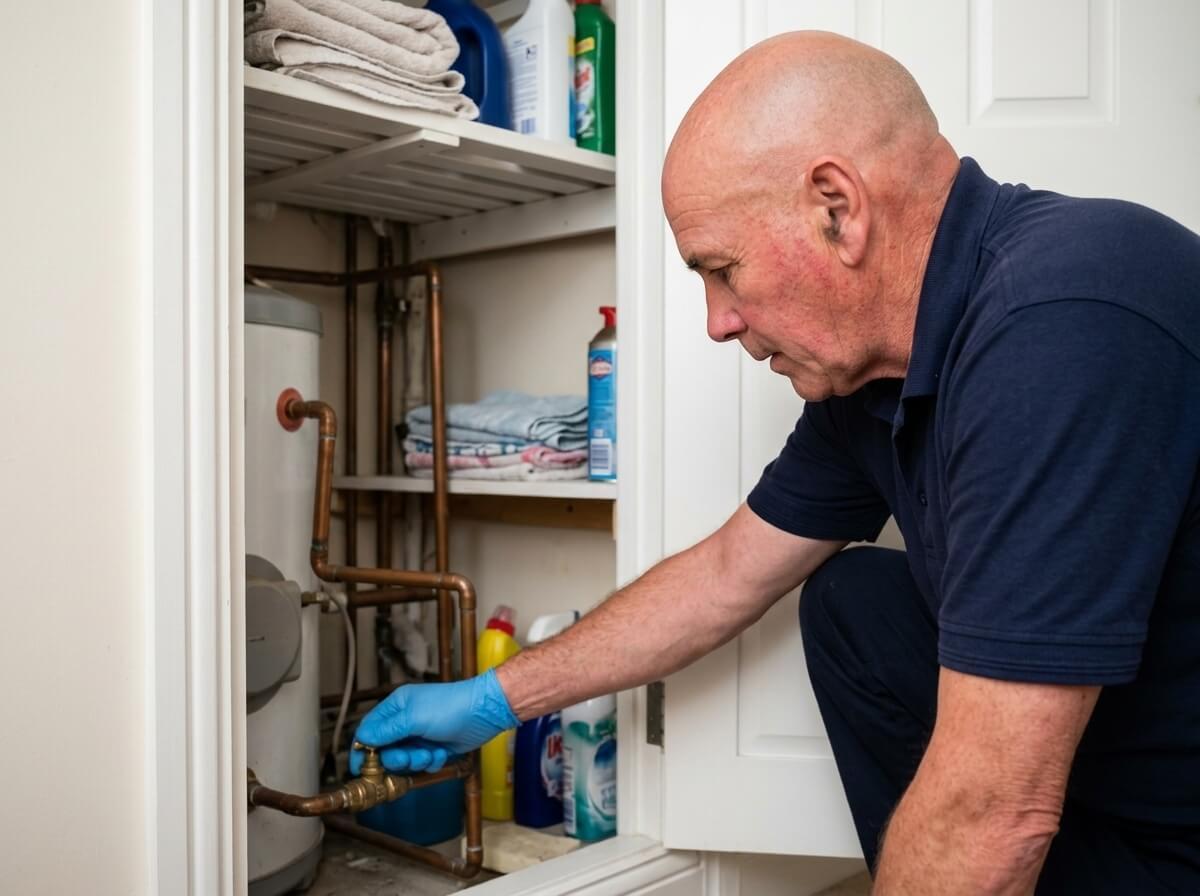
Hot tap still running? Close the cylinder feed
If the stopcock is off and the hot tap is still running, your hot water comes from a tank in the loft. Go to the airing cupboard and find the cold pipe going into the top of the hot water cylinder. It has a gate valve with a round wheel handle. Turn it clockwise until it stops. Switch the immersion heater off as a precaution, and leave the boiler alone.
Which Valve Stops Which Tap?
This is where most people come unstuck. Whether the stopcock will stop a tap depends on where that tap gets its water. Find your tap in the table, then try the first valve, then the backup.
| THE TAP | WHERE ITS WATER COMES FROM | TRY THIS VALVE FIRST | BACKUP |
|---|---|---|---|
| Kitchen cold tap | Always the mains, so it is safe to drink | Isolation valve on the cold pipe under the sink | Main stopcock, usually under the kitchen sink |
| Any hot tap with a combi boiler | The mains, heated as it passes through the boiler | Isolation valve under the tap | Main stopcock, or the cold inlet valve under the boiler |
| Any hot tap with an unvented cylinder (no loft tank) | The mains, stored under pressure in the cylinder | Isolation valve under the tap | Main stopcock, or the cold inlet valve on the cylinder |
| Any hot tap with a vented cylinder and a loft tank | The cold water tank in the loft, through the cylinder | Isolation valve under the tap, if fitted | Gate valve on the cold feed into the top of the cylinder, in the airing cupboard |
| Bathroom cold tap in an older house | Often the loft tank, not the mains | Isolation valve under the basin or behind the bath panel | Gate valve on the cold outlet from the loft tank |
| Outside tap | The mains | Isolation valve on the pipe inside the house, near where it goes through the wall | Main stopcock |
| Shower valve or bar mixer | Mains or tank, the same as the bath taps | Isolation valves on the inlet elbows, or behind an access panel | Stopcock for cold, cylinder feed valve for tank-fed hot |
Not sure which hot water system you have? If there is a boiler and no hot water cylinder, it is a combi. If there is a cylinder and a large tank in the loft, it is vented and tank-fed. If there is a cylinder, no loft tank, and a white or blue expansion vessel and a tundish nearby, it is unvented and runs off the mains.
What Type of Tap Do You Have?
The fix depends on what is inside the tap, and you can tell from how the handle moves. There are four types in most British homes.
- ●Washered (compression) tap. The handle turns several full turns from off to fully on, and you feel it squash to a stop. Inside, a rubber washer is pressed down onto a brass seat. Common on older pillar taps, bath taps and almost every outside tap.
- ●Quarter-turn (ceramic disc) tap. The handle turns a quarter or half turn and stops dead. Inside is a cartridge with two polished ceramic discs with holes in them. When the holes line up, water flows. Each cartridge is handed, one for hot and one for cold, because they turn in opposite directions.
- ●Single lever mixer tap. One lever controls both flow and temperature. Inside is one larger ceramic cartridge, usually 35mm or 40mm across. Most kitchens fitted in the last fifteen years have one.
- ●Shower valve. A thermostatic bar mixer or a concealed valve, with a flow control and a temperature control. The flow side is a cartridge, much like a quarter-turn tap.
Tap Fault Finder: Why Your Tap Won’t Turn Off
When someone rings me about a tap, I ask what the handle does and where the water is coming from. Find the row that matches. The last two columns tell you whether it is usually a DIY job and how quickly it needs sorting.
| WHAT THE TAP DOES | LIKELY CAUSE | DIY FIX? | URGENCY |
|---|---|---|---|
| Handle spins round and round and never gets tight | Worn splines on the spindle or inside the handle, a loose handle screw, or stripped headgear. | Sometimes | Today or tomorrow |
| Old-style tap closes firmly but still runs or dribbles | Worn, split or hardened washer, or a scaled or pitted brass seat under it. | Usually | Today or tomorrow |
| Quarter-turn tap stops at its end point but still runs | Grit or limescale between the two ceramic discs, or a chipped disc. | Usually | Today or tomorrow |
| Mixer lever goes all the way down, water keeps coming | Debris in the mixer cartridge, or the cartridge has worn out. | Sometimes | Today or tomorrow |
| Mixer lever is loose, floppy or comes off in your hand | Grub screw under the cap has come undone, or the cartridge stem has snapped. | Usually | Today or tomorrow |
| Tap ran normally until just after work on the water main | Dirt or scale knocked loose in the pipes and lodged in the tap. Very common after a burst in the street. | Usually | Today or tomorrow |
| Water comes out of the tap body or round the handle, not the spout | Worn O-rings or gland packing on the spindle. The tap shuts off, but leaks when in use. | Usually | Book in, not urgent |
| Outside tap runs or drips after a frost | Hardened washer, or the tap body or pipe behind it has split. | Sometimes | Call now |
| Shower keeps running after the control is turned off | Worn flow cartridge in the shower valve, or debris in it. | Sometimes | Today or tomorrow |
| Sink or bath is filling faster than it drains | Any of the above, made worse by a plug left in or a slow or blocked waste. | Call a plumber | Call now |
| Water still running after every valve you can find is closed | A tank-fed tap with the wrong valve closed, or a stopcock that has failed. | Call a plumber | Call now |
Tap Handle Keeps Spinning and Won’t Turn Off
A handle that spins freely has lost its grip on the spindle, the brass stem that actually opens and closes the valve. The valve inside is stuck wherever it was when the grip went, usually partly open. There are three possibilities:
- ●The handle screw has come loose. Prise off the hot or cold indicator cap with a thin blade and tighten the screw underneath. If the handle now grips, you are done.
- ●The splines have worn smooth. The spindle has fine teeth that lock into matching teeth inside the handle. On cheap or old taps, either set can wear away. If the handle’s teeth are gone, a new handle may do. If the spindle’s teeth are gone, it needs a new headgear or cartridge.
- ●The headgear has stripped inside. On a washered tap, the thread inside the headgear can strip, so the spindle turns but never moves down. That also needs a new headgear.
In every case, turn the water off before you take the handle off. Do not grip the bare spindle with pliers to force the tap shut: you will chew up the splines and the new handle will never fit.
Old-Style Tap Won’t Turn Off Fully: Changing the Washer
If the handle turns several times and tightens up, but water still runs or dribbles, the washer has worn out. This is the classic fix, and you can do it with an adjustable spanner, a screwdriver and a new washer. Most standard taps take a half-inch washer for basins and sinks, and a three-quarter-inch washer for baths. Take the old one to the shop to match it if you can.
Turn off the water and open the tap
Close the isolation valve or the right stopcock or cylinder valve, then open the tap fully to let the pressure out. Put the plug in so nothing small can fall down the waste.
Take the handle and shroud off
Remove the cap and screw, then lift the handle off. Some older taps have a metal shroud that unscrews by hand, or with a cloth to protect the chrome.
Undo the headgear
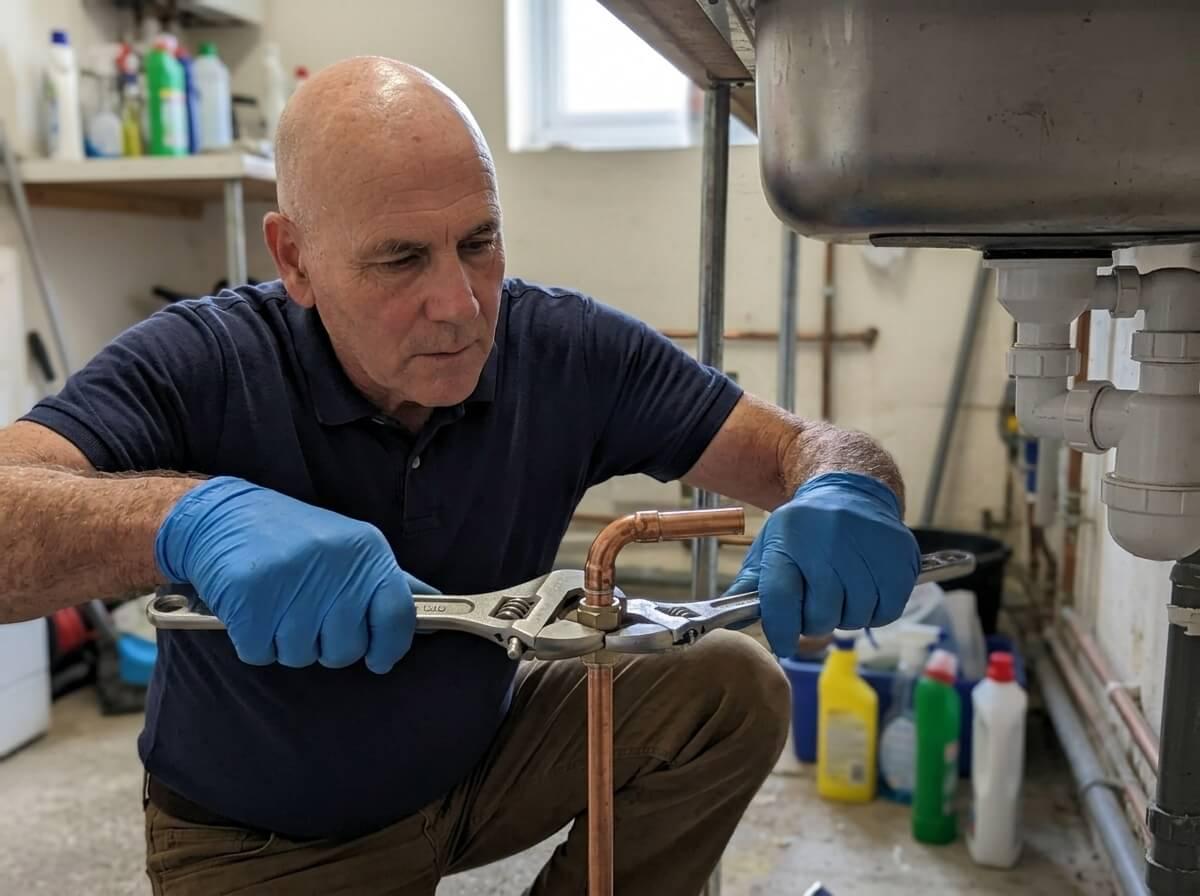
Hold the tap body firmly with one hand, or with a second spanner, and undo the large hexagon nut anticlockwise. Holding the body stops the whole tap twisting and cracking the basin or snapping the pipe.
Replace the washer and check the seat
The washer is on the bottom of the headgear, held by a small nut or pushed on to a button. Fit the new one. Look down into the tap at the brass seat. If it is scaled, clean it gently. If it is badly pitted, a plumber can recut it or fit a seat repair kit.
Reassemble and test
Screw the headgear back in, firm but not forced, refit the handle, close the tap and turn the water back on slowly. It should shut off with a light turn. If it still dribbles, the seat is the problem, not the washer.
Quarter-Turn Tap Won’t Turn Off: Cleaning or Replacing the Cartridge
A quarter-turn tap that reaches its stop but keeps running almost always has something stuck between the ceramic discs. The discs are polished so flat that they seal against each other without a washer. A single grain of sand, a flake of copper or a fleck of limescale between them holds them apart. Ipswich has hard water, so I see this every week, and it is particularly common just after the water company has been working on the main in your road.
- ●Turn off the water, take off the handle and undo the cartridge from the tap body with a spanner, holding the body still.
- ●Look at the bottom of the cartridge. You will see the lower disc and a rubber seal. Rinse it under another tap and turn the spindle a few times to flush out any grit.
- ●Check the discs for chips or scratches. A chipped or scored disc will never seal. Replace the whole cartridge.
- ●Match the replacement exactly. Count the splines on the spindle, measure the length and the thread, and note whether it is the hot or cold side, because they are handed. A cartridge that is nearly right will leak or turn the wrong way.
If you get the cartridge out and it looks perfect, clean the seat it sits on inside the tap body, and check the small rubber seal on the bottom of the cartridge. A seal that has slipped or perished lets water bypass the discs.
Mixer Tap Won’t Turn Off
On a single lever mixer, the lever lifts to turn the water on and swings to change the temperature. If it is all the way down and water still runs, the cartridge is at fault, and it is the same cause as above: debris or wear. Turn off both the hot and cold isolation valves under the sink, because the cartridge controls both. Most mixer taps have flexible hoses on the bottom with an isolation valve on each.
Prise off the small cap on the lever, undo the grub screw with an Allen key, lift the lever off, then undo the decorative shroud and the brass retaining nut. The cartridge lifts straight out. Note which way round it sits before you remove it. Take it, and the make of tap if you know it, to a plumbers’ merchant. Mixer cartridges look similar but are rarely interchangeable.
If the lever is loose or comes off in your hand, check the grub screw first. If the stem on top of the cartridge has snapped, you need a new cartridge.
Bath Tap Won’t Turn Off
Bath taps are awkward, because their isolation valves, if there are any, are hidden behind the bath panel. Pull the plug first, then unclip or unscrew the panel at the tap end and shine a torch onto the pipes just under the taps. If there are no valves, turn off the stopcock for the cold tap, and close the cylinder feed valve for a tank-fed hot tap.
Bath taps are also where I most often find a stripped or seized headgear, because they get the most limescale and the most force. If the headgear will not undo without the tap twisting on the bath, stop. Old taps on acrylic baths crack the bath around the tap holes very easily.
Shower Won’t Turn Off
A thermostatic bar mixer usually has isolation valves built into the elbows where it meets the wall, with a screwdriver slot under a cap. Turn both a quarter turn. Concealed valves may have an access panel nearby, or the isolation valves may be in the loft or behind a ceiling hatch below. If you cannot find any, use the stopcock and the cylinder valve, as for the bath.
An electric shower that will not stop running is different: switch it off at the pull-cord or wall isolator first, because the heater element and the water are both live. It usually means the solenoid valve inside has stuck open, which is a job for a plumber or electrician, not a DIY fix.
Outside Tap Won’t Turn Off
Outside taps are nearly always washered, and the washer takes a beating from cold weather. Find the isolation valve on the pipe inside the house, usually under the kitchen sink or in a cupboard on the other side of the wall from the tap, and turn it off. Then change the washer as above.
If the tap is running after a frost, look hard at the tap body and the pipe behind it. A split body or a split pipe will keep running however tightly you close the tap, and a split inside the wall can put water into your house. Read the frozen pipes guide and turn that valve off. Each winter, turn the inside valve off and leave the outside tap open so the pipe can drain.
Hot Water Tap Won’t Turn Off
The repair is exactly the same as a cold tap. The difference is stopping it, and the safety around it. If you have a combi or unvented cylinder, the stopcock stops it. If you have a tank-fed cylinder, close the cold feed valve into the top of the cylinder as described above. Do not drain the cylinder or open the drain cock at the bottom: the cylinder must stay full for the immersion heater and the boiler coil to be safe.
Switch off the immersion heater while the feed valve is closed, in case someone opens a hot tap and draws the cylinder down. If you are changing a washer on a hot tap, let the water run cold first, wear gloves, and remember the metal of the tap body may still be hot.
Is a Tap That Won’t Turn Off an Emergency?
On its own, it is urgent rather than dangerous. The water is going down a drain, and once you have shut it off at an isolation valve, the repair can wait until the morning. A tap running full bore can put more than 500 litres an hour down the drain, so on a water meter it is worth stopping straight away, and on a tank-fed system it can empty the loft tank and leave you without hot water.
Treat it as an emergency and call a plumber now if:
- ●The sink or bath is filling faster than it drains, especially if the waste is slow or the sink is blocked.
- ●Water is coming out of the tap body, the pipes or the hoses under the sink, not just the spout.
- ●You cannot stop it at any valve, or the stopcock is seized or broken.
- ●Hot water is running and you have no way to isolate the cylinder. Switch off the immersion and boiler.
- ●Water has got into electrics, sockets, light fittings or a ceiling below. Switch the power off at the consumer unit if it is safe to reach.
- ●The tap or pipe has split, for example after a frost.
What Not to Do
- ✕Do not keep forcing the handle tighter. It crushes the washer, strips the splines and can crack the tap body or the ceramic discs.
- ✕Do not grip a chrome tap with pliers or stilsons. They scar the finish and can twist the tap off its base. Wrap a cloth round the jaws of a spanner if you must hold it.
- ✕Do not undo the headgear with the water still on. On mains pressure it will blow out of your hand and flood the room.
- ✕Do not force a stuck stopcock with a long bar. Stopcocks snap. Use the steps in the stuck stopcock guide or call a plumber.
- ✕Do not drain the hot water cylinder to stop a hot tap. Close its cold feed valve instead.
- ✕Do not leave it running overnight and hope it stops. Washers do not heal, and a blocked waste can overflow while you sleep.
Repair or Replace the Tap?
Most taps are worth repairing. A washer or cartridge costs a fraction of a new tap, and fitting one does not disturb the pipework or the seal to the sink. I suggest replacing the tap instead when:
- ●The tap is old and the cartridge is no longer made, or it is an unbranded tap and no merchant can match it.
- ●The tap body is cracked, corroded or split, or the brass seat is too badly pitted to recut.
- ●The headgear is seized solid with limescale and cannot be undone without risking the basin.
- ●It is the second or third repair in a year, which usually means a poor-quality tap or debris in the pipework.
- ●You were thinking of changing it anyway. A new tap fitted with new isolation valves fixes the problem and future-proofs it.
Who Is Responsible in a Rented Home?
In England, landlords must keep the installations for the supply of water in repair, under section 11 of the Landlord and Tenant Act 1985. A tap that has worn out falls under that. As a tenant, your job is to stop the water, keep the damage down and report it straight away, by phone and in writing, with a photo if you can. If you cannot reach your landlord or agent and water is getting into the property, call a plumber, keep the receipt, and tell them what you did.
How a Plumber Fixes a Tap That Won’t Turn Off
When I come out to a tap that won’t turn off, this is what I do. I isolate the tap at the nearest valve, or at the stopcock or cylinder if there is none. I take the tap apart and find out exactly which part has failed: washer, seat, spindle, cartridge or seal. I carry the common washers, headgears and cartridges in the van, and for a branded mixer I can usually match the cartridge the same day.
If the tap has no isolation valves, I will offer to fit them while the water is off, so next time you can stop it in seconds without turning the whole house off. I test the tap, check the waste is draining freely, and look for any water that has got into the cupboard or under the bath. If there is a hidden leak, I will tell you, and our leak detection service can find it without pulling the kitchen apart.
How to Stop It Happening Again
- ●Have isolation valves fitted under every tap, toilet and appliance. It is a small job that turns a panic into a quarter turn.
- ●Know where your stopcock and cylinder feed valve are, and turn them off and on once a year so they do not seize.
- ●Close taps gently. A washer only needs a light turn past the point the water stops. Overtightening wears it out in months.
- ●Deal with limescale. Wipe and descale taps regularly. In Ipswich’s hard water, a scale reducer on the mains can add years to cartridges.
- ●Run the cold tap after mains work in your road, before you use other taps, so loosened grit flushes out through one spout.
- ●Buy branded taps with cartridges you can still get in ten years’ time.
Tap Won’t Turn Off in Ipswich? Call Philip
Most taps that won’t turn off are a short job and a cheap part, and plenty you can fix yourself once the water is off. Call me straight away, day or night, if you cannot stop the water at any valve, the sink is overflowing, water is leaking under the sink or into the ceiling below, or a pipe has split. If you have stopped it at an isolation valve, call in the morning and I will book you in promptly, fix the tap and agree a fair price before I start.
I cover Ipswich, Felixstowe, Woodbridge, Kesgrave, Stowmarket and the surrounding towns, and I answer the phone myself, 24 hours a day, seven days a week, on 07977 857224. You can see everything else I cover on the emergency plumbing services page.