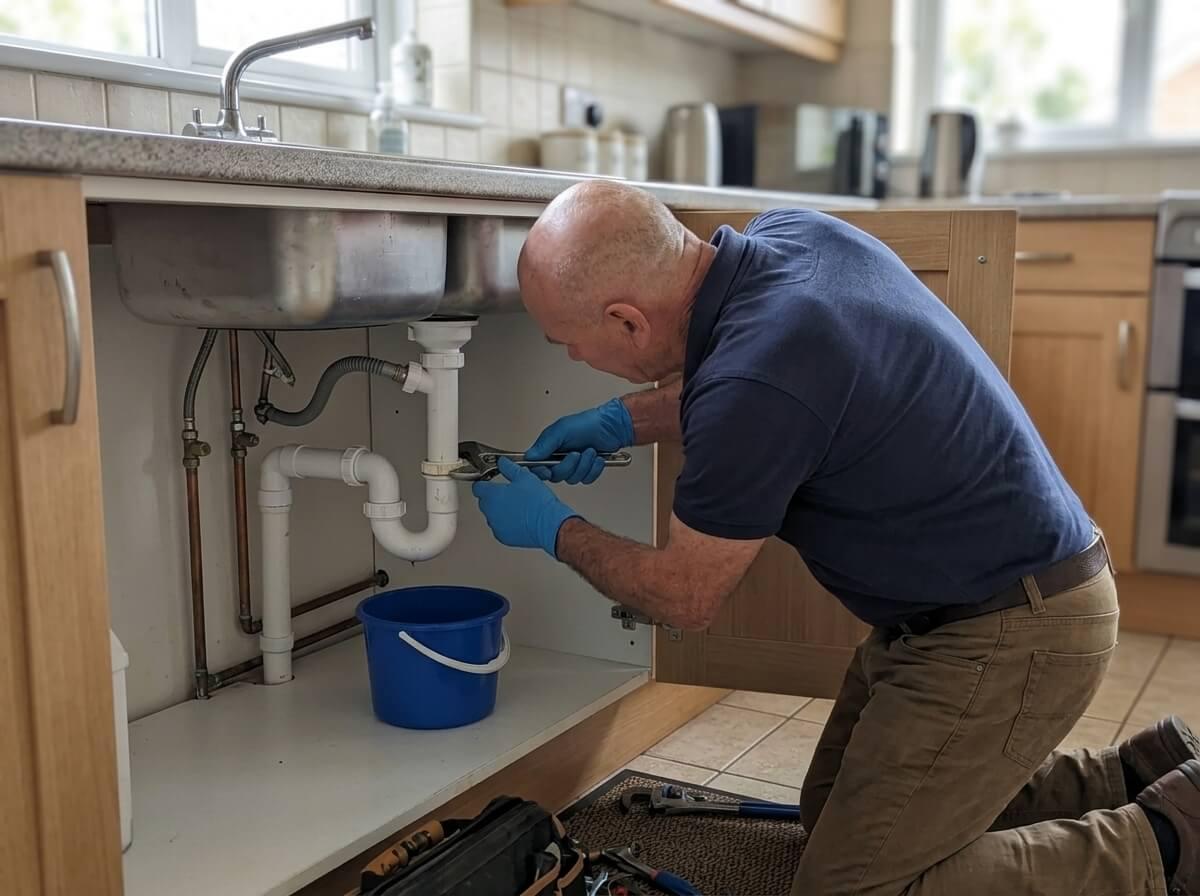
It usually starts with someone noticing a puddle under the kitchen window that should not be there. Then the washing machine empties and the gully spills grey, greasy water across the path. Or, worse, a manhole cover in the drive starts to lift, and what comes out is not rainwater. Either way, the drain is telling you that water is going in faster than it can get away, and it will not sort itself out.
I have been clearing blocked and overflowing drains around Ipswich for more than forty years. Most outside drain problems can be stopped getting worse in a couple of minutes, and plenty can be cleared with nothing more than rubber gloves and a bucket. This guide covers what to do first, how to tell which drain is overflowing and why, how to clear it safely, who is responsible when it is not your drain, how to clean up after sewage, and when it is time to call a plumber.
Outside Drain Overflowing? Do These 6 Things Now
Work through these in order. The first two stop the overflow getting worse. The rest tell you what you are dealing with and who should fix it.
Stop using water inside the house
Every drop that goes down a sink, toilet, bath or appliance in the house ends up at the outside drain. If the washing machine or dishwasher is running, stop it before it reaches the drain cycle, which pumps out a lot of water in one go. Tell everyone at home not to flush, shower or run taps until you know which drain is blocked.
Keep people and pets away
Water from a drain that takes toilet waste is sewage, even when it looks fairly clear. Keep children and pets indoors or well away from it, and do not let a dog drink from or walk through the puddle. If the water is heading for an air brick, a back door or a garage, put old towels, a draught excluder or sandbags across its path.
Work out which drain is overflowing
A small grid against the wall by the kitchen is a gully, and it is usually blocked right there, in the trap you can reach. A larger cover in the garden, path or drive is a manhole, or inspection chamber, and if that is overflowing the blockage is further down the drain. The table below shows how to tell them apart.
Clear the gully if that is the problem
Put on rubber gloves, lift the grid and scoop out the leaves, food, fat and silt from the trap with an old jug or a small trowel, into a bucket lined with a bin bag. Often the water drops away the moment you do. Full instructions are further down.
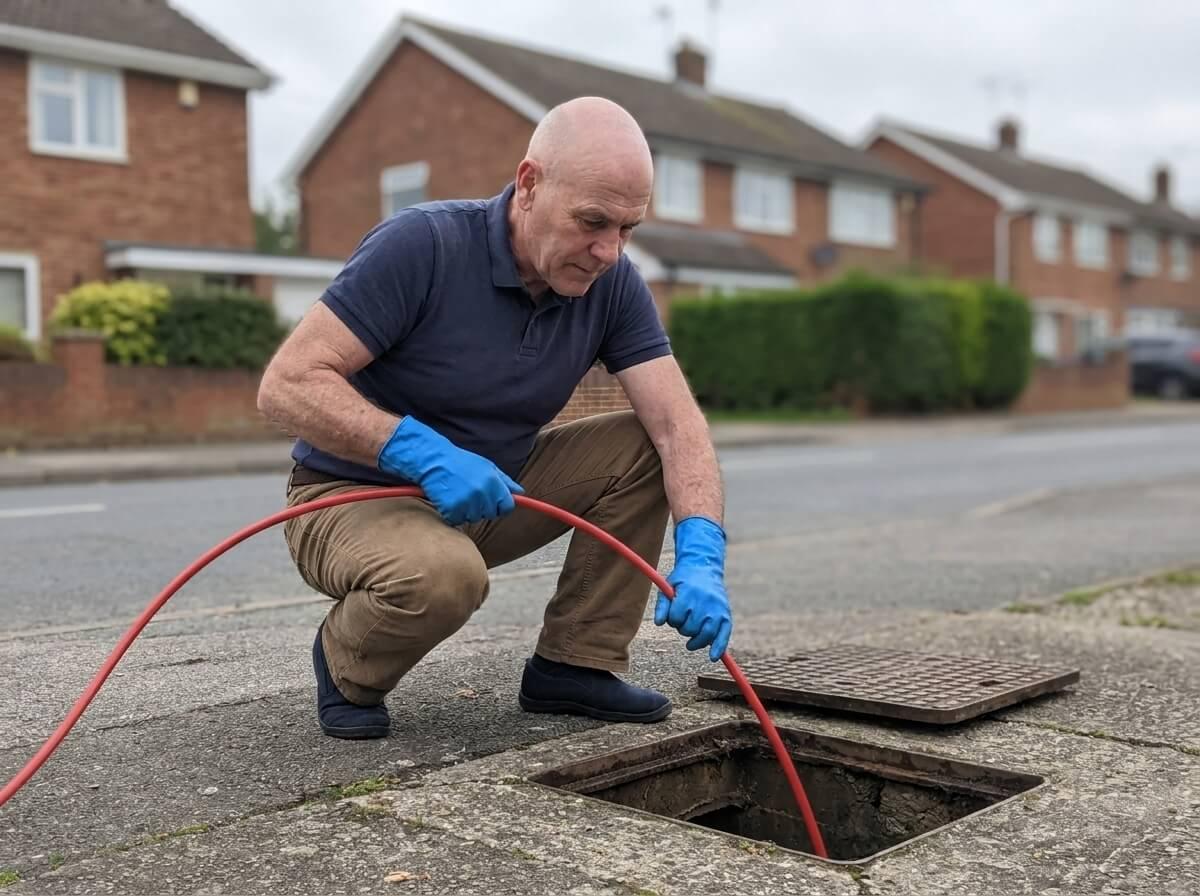
Lift the nearest manhole cover
If the gully is clear, or the manhole itself is overflowing, lift the cover nearest the house and look in. A full chamber means the blockage is further down the line. An empty chamber means it is between the house and that chamber. Never leave a chamber open and unattended.
Decide who to call
If the blockage is in a drain that serves only your home, inside your boundary, it is yours to clear, or your landlord’s if you rent. If the full chamber is shared with a neighbour, or the blockage is beyond your boundary, it belongs to Anglian Water and they clear it free. If you are not sure, a plumber can tell you in a few minutes.
Which Outside Drain Is Overflowing?
Most homes have two or three kinds of outside drain, and they behave differently when they block. Knowing which one is overflowing tells you what is likely to be in it, whether you can clear it yourself, and whose responsibility it is.
| DRAIN | WHAT IT LOOKS LIKE | WHAT GOES INTO IT | WHO LOOKS AFTER IT |
|---|---|---|---|
| Gully | A small square or round grid at ground level, usually against the wall under the kitchen window, a downpipe or a washing machine hose. | Waste water from the kitchen sink, washing machine and dishwasher, and often rainwater from a downpipe. | You, if it serves only your home. Your landlord if you rent. |
| Manhole (inspection chamber) | A larger square or round metal or plastic cover in the garden, path or drive, usually near where pipes leave the house. | Everything: toilets, baths, showers and sinks, sometimes rainwater too. If it overflows, it is usually sewage. | You, if the chamber serves only your home. Anglian Water, if it is shared with a neighbour or outside your boundary. |
| Rainwater shoe or yard gully | The open bottom of a downpipe, or a grid in a patio, drive or yard with no kitchen pipes going into it. | Rainwater only, usually to a soakaway or a surface water drain. | You, for the gully and any soakaway in your garden. |
| Road gully | A long grid at the kerb edge of the road. | Rainwater from the road. | Suffolk County Council as highway authority. Report it to Suffolk Highways. |
Is an Overflowing Outside Drain an Emergency?
Not every overflowing drain needs a plumber in the middle of the night, but some do. Call an emergency plumber straight away if:
- ●Sewage or toilet paper is coming out of a manhole or gully, not just grey water or rainwater.
- ●A toilet, shower, bath or ground-floor drain inside the house is backing up as well.
- ●A manhole cover is lifting or water is pushing up around its edges.
- ●Water is running towards an air brick, a doorway, a garage or under a floor.
- ●You cannot use the toilet, and someone elderly, unwell or very young lives at home.
- ●It is a shared drain or a block of flats, and other households are affected too.
If a gully overflows only when the washing machine empties, or only in a heavy downpour and then drains away, it is not an emergency. But it is a warning, and it should be cleared within a day or two, before a partial blockage becomes a full one. My guide on whether a blocked drain is an emergency goes into more detail on judging the urgency.
Why Is My Outside Drain Overflowing? Read the Clues
When and how a drain overflows tells you most of what you need to know about the cause. These are the patterns I look for, and they are worth describing when you call:
| WHAT YOU NOTICE | LIKELY CAUSE | WHAT TO DO |
|---|---|---|
| Kitchen gully overflows with grey, greasy water, often with a smell | The gully trap is clogged with fat, food scraps, leaves and silt. | Stop using the sink and washing machine. Lift the grid and scoop it out. |
| Gully only overflows when the washing machine or dishwasher empties | A part-blocked gully or drain that copes with a trickle but not a pumped surge. Lint and fat are the usual culprits. | Clear the gully trap. If it still overflows, the blockage is further down the drain. |
| Manhole cover lifting, or sewage and toilet paper coming out of it | The drain is blocked further downstream, so waste is filling the chamber and has nowhere to go. | Emergency. Stop using all water, keep people away, and check who owns the drain before calling. |
| Toilet, shower or ground-floor drain backs up at the same time as the outside drain | The main drain is blocked between the house and the sewer, and the lowest fitting is overflowing first. | Emergency. Do not flush or run water. Call a plumber, or Anglian Water if the blockage is in a shared section. |
| Gully or manhole floods only in heavy rain, then drains away | A combined drain or the public sewer is overloaded by storm water, or a soakaway has silted up. | Clear your gullies. Report repeated sewer flooding to Anglian Water so it is on record. |
| Water running towards an air brick, a doorway or under the house | Any of the above, but now the water can get into the floor void or the house itself. | Emergency. Divert or block the flow with sandbags or towels and get the drain cleared now. |
| Drain overflows every few weeks, however often you clear it | Tree roots, a sunken or cracked pipe, a displaced joint or a long-term fat build-up in the drain. | Book a CCTV drain survey so the real fault can be found and repaired. |
| Neighbour's drain overflowing as well, or the shared manhole is full | A blockage in a shared drain or the public sewer, which is the water company's responsibility. | Call Anglian Water on 03457 145 145. Clearing it is free. |
Rows shaded red usually need help the same day or night. The others still need sorting, but can normally wait for a booked visit once you have stopped using water.
A blocked kitchen gully
This is the outside drain I clear more than any other. The gully outside the kitchen has a U-shaped trap that holds water, and everything that goes down the sink and out of the washing machine passes through it: fat and oil that set as they cool, food scraps, coffee grounds, lint and hair from the laundry. Add leaves and soil blowing in through the grid, and it fills up like a sump. You will usually see the water level sitting high in the gully and a grey, greasy crust on top, often with a smell.
Overflowing when the washing machine empties
A washing machine or dishwasher does not trickle its water away like a sink. It pumps it out, tens of litres in a couple of minutes, and that surge arrives at the gully all at once. A gully or drain that is partly blocked can cope with the sink but not with a full drain cycle, so it fills up and spills over, then slowly drains away again. If yours only overflows on wash day, clear the gully trap first. If it is clean and still overflows, the restriction is further down the drain, or the gully is too small to take a downpipe and a machine together.
A blocked underground drain
When the blockage is further down, in the pipe under the garden or the drive, water backs up until it finds the lowest open point and comes out there. That is often the kitchen gully, because it sits at ground level, or a manhole, or a ground-floor toilet or shower inside the house. Wipes, fat, roots and silt are the usual causes. No amount of clearing the gully will fix a blockage ten metres away under the lawn. It needs rods or a jetter from the manhole, which is my drain unblocking service.
Heavy rain
Many older Ipswich streets have combined drains, where the rainwater from roofs and yards runs in the same pipes as the toilets and sinks, down to a sewer that carries both. In a downpour the drain or the sewer can fill faster than it empties, and water backs up out of the lowest gully or manhole on the street. Newer homes usually send rainwater to a separate surface water drain or a soakaway in the garden, and when a soakaway silts up with age it stops draining and the rainwater gullies overflow instead. If your drain only floods in heavy rain and then clears, clear your gullies and report repeated sewer flooding to Anglian Water so it goes on their records.
Roots, cracks and sunken pipes
If a drain overflows again and again, however often it is cleared, there is usually a fault in the pipe itself. Tree and shrub roots find their way into old clay pipe joints and grow into a mat that catches everything. Pipes crack or sink under driveways and extensions, leaving a dip where water and waste sit. A joint can slip out of line so it catches paper and wipes. You cannot see any of this from the top, which is why a CCTV drain survey is the right next step for a drain that keeps blocking.
Outside Drain Overflowing but No Blockage?
You have cleared the gully, it looks clean, and it still overflows. In my experience there almost always is a blockage, just one you cannot see. These are the usual explanations:
- ●The blockage is further down. Lift the manhole covers. If the chamber nearest the house is full, the problem is downstream of it, not in the gully.
- ●A partial blockage. A drain that is half blocked lets a trickle through, so it looks clear, then overflows when a washing machine, bath or downpipe sends a surge.
- ●The sewer is overloaded. If it happens in heavy rain, or your neighbours have the same problem, the public sewer may be surcharging. That is Anglian Water’s to investigate.
- ●A failed soakaway. If the overflowing gully takes only rainwater, the soakaway it runs to may have silted up or been compacted, so the water has nowhere to go.
- ●A sunken or broken pipe. A dip or crack holds water and slows the flow, even with nothing stuck in it.
- ●A blocked vent. If the soil vent pipe on the roof is blocked, drains gurgle, empty slowly and can pull water out of traps. It is less common, but it explains some “slow but not blocked” drains.
How to Clear a Blocked Outside Gully Yourself
A blocked gully is the one outside drain job most people can do themselves. You need rubber gloves (long ones if you have them), a bucket with a bin bag in it, an old jug or a small trowel, and a hose or a kettle.
Stop the water going in
Make sure the washing machine, dishwasher and kitchen sink are not being used. Put on gloves and, if you have them, safety glasses.
Lift the grid
Most gully grids lift straight out. If one is stuck with silt, lever it gently with a flat screwdriver. Give it a scrub, as it is often half the blockage.
Scoop out the trap
Reach into the gully and scoop out everything you can feel: leaves, food, sludge and set fat. Bag it and put it in the general waste, not back down another drain. Keep going until you can feel the bottom of the trap and the water starts to drop.
Loosen the grease
Pour a bucket of hot water, not boiling, with a good squeeze of washing-up liquid into a greasy kitchen gully. Boiling water can crack older clay and plastic gully pots and softens fat only for it to set again further down the pipe.
Flush it through and test
Run a hose into the gully for a minute, or tip in a couple of buckets of clean water. It should swirl away freely. Then run the kitchen tap for a minute and watch. Put the grid back, and fit a gully guard if leaves are a problem.
How to Unblock an Outside Drain With Rods
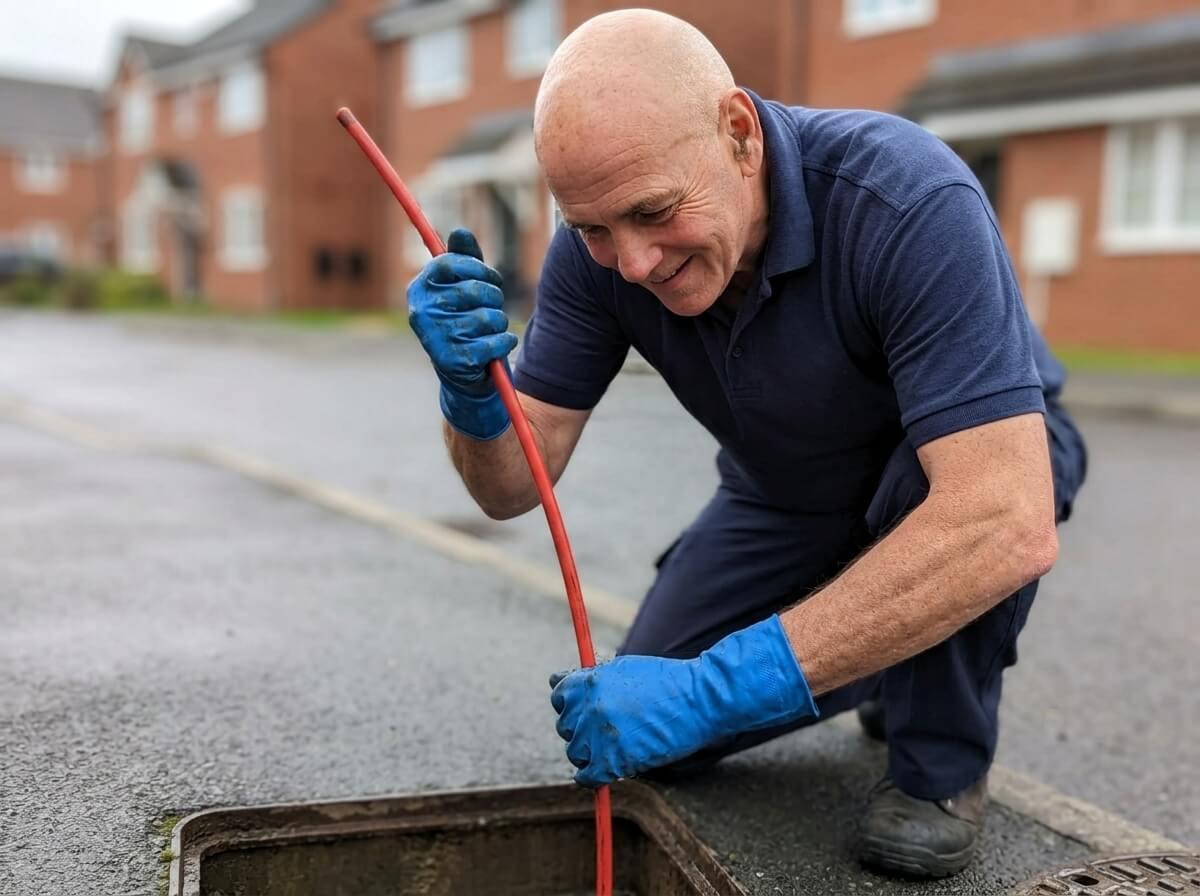
If the manhole is full, the blockage is in the underground pipe. With a set of drain rods and a rubber plunger head, you can clear many of these yourself. Rods are available from DIY shops and tool hire in Ipswich.
Find the right chamber
Lift the covers between the house and the boundary. The blockage is between the last full chamber and the first empty one. Rod from the empty chamber back up towards the full one if you can reach it, as you can see when the water starts to move.
Fit the plunger head
Screw the rubber plunger disc onto the end of the first rod, then add rods one at a time as you push further into the pipe.
Always turn clockwise
Push the rods into the pipe at the bottom of the chamber and work them backwards and forwards firmly. If you twist them, only ever turn clockwise. Turning the other way unscrews the joints and leaves rods stuck in your drain, which is a call I get more often than you would think.
Wait for the rush
When the blockage breaks, the full chamber will empty with a rush. Keep working the rods for a minute to clear what is left, then pull them out slowly, one joint at a time.
Flush and clean up
Run a hose down the drain for a few minutes, flush a toilet, and check the chambers drain freely. Wash the rods with disinfectant before you put them away, and wash your hands well.
Who Is Responsible for an Overflowing Outside Drain?
This is the question that decides who pays, so it is worth getting right before anyone starts work. In England, the rules changed on 1 October 2011, when private sewers and lateral drains connected to the public network were transferred to the water companies.
- ●Your own drain. The pipes, gullies and manholes that serve only your home and sit within your boundary are your responsibility. If you rent, your landlord’s.
- ●Shared drains. Once your drain joins a neighbour’s, the shared section belongs to the water company, even if it runs under your garden.
- ●Beyond your boundary. A pipe that serves only your home but runs outside your boundary, such as under the pavement to the sewer, is a lateral drain, and that belongs to the water company too.
- ●The public sewer. Always the water company’s. Across Ipswich and most of Suffolk, that is Anglian Water.
- ●Road gullies. The drains at the kerb belong to the highway authority, Suffolk County Council, and are reported to Suffolk Highways.
- ●Septic tanks and cesspits. Homes in some villages around Ipswich are not on mains drainage, and the tank and its drains are the owner’s responsibility.
Anglian Water’s 24 hour line for blocked sewers and sewer flooding is 03457 145 145, and they clear blockages in their section free of charge. If you call me and it turns out the blockage is in their section, I will tell you so honestly and point you straight to them.
Renting, or living in a flat
If you rent, report an overflowing drain to your landlord or letting agent straight away, in writing as well as by phone. Drain repairs are normally the landlord’s responsibility, though if the blockage was caused by fat or wipes from your home, they may ask you to cover the clearance. If you cannot reach anyone out of hours and sewage is backing up, calling an emergency plumber is reasonable: keep the invoice and send it on. In a block of flats, the communal drains and manholes are normally the responsibility of the freeholder or managing agent, so call their emergency line and let your neighbours know to stop using water.
Sewage in the Garden: Health and Clean-Up
Water from a manhole or any drain that takes toilet waste is contaminated, even if it looks clear. It can carry bacteria such as E. coli and viruses such as norovirus, and drains attract rats, which can spread Weil’s disease. Once the drain is flowing again:
- ●Protect yourself. Rubber gloves, wellies or old shoes, and keep children and pets off the area until it is cleaned.
- ●Remove the solids. Scrape up toilet paper and waste with a spade, bag it twice and put it in the general waste.
- ●Clean hard surfaces, then disinfect. Hose or scrub paths, patios and drives with hot water and detergent first, then apply a disinfectant and rinse. Disinfectant works far better on a clean surface.
- ●Leave the lawn to the weather. Rake up any solids, then let sunlight and rain do the rest. Keep pets off it for a few days.
- ●Throw away splashed produce. Vegetables, herbs or fruit touched by sewage are not safe to eat.
- ●Do not mix chemicals. Bleach mixed with other cleaners can give off toxic gas.
- ●Wash well. Wash your hands and forearms thoroughly, and put the clothes you wore straight into a hot wash.
If sewage has got into the house, into an air brick or under a floor, anything soft it has soaked, such as carpet and underlay, is usually best thrown away, and the area needs cleaning and drying properly. Speak to your insurer before you throw out anything valuable.
What Not to Do When an Outside Drain Is Overflowing
- ✕Do not keep running the washing machine or flushing to “push it through”. It all ends up on the path.
- ✕Do not pour caustic soda or chemical unblocker into a full gully or chamber. It rarely shifts fat, silt or wipes, it can splash and burn, it can damage older pipe joints, and it makes the water dangerous for whoever then has to put their hands in it.
- ✕Do not pour boiling water down a gully. It can crack older gully pots and just moves the fat further down the pipe.
- ✕Do not turn drain rods anticlockwise. The joints unscrew and the rods are left in the drain.
- ✕Do not leave a manhole open and unattended, even for a minute, with children, pets or visitors about.
- ✕Do not hose sewage into a road gully or a neighbour’s garden. Road gullies usually drain to watercourses, not the sewer.
- ✕Do not ignore a drain that overflows only now and then. Partial blockages become full ones, usually at the worst moment.
How a Plumber Clears an Overflowing Outside Drain
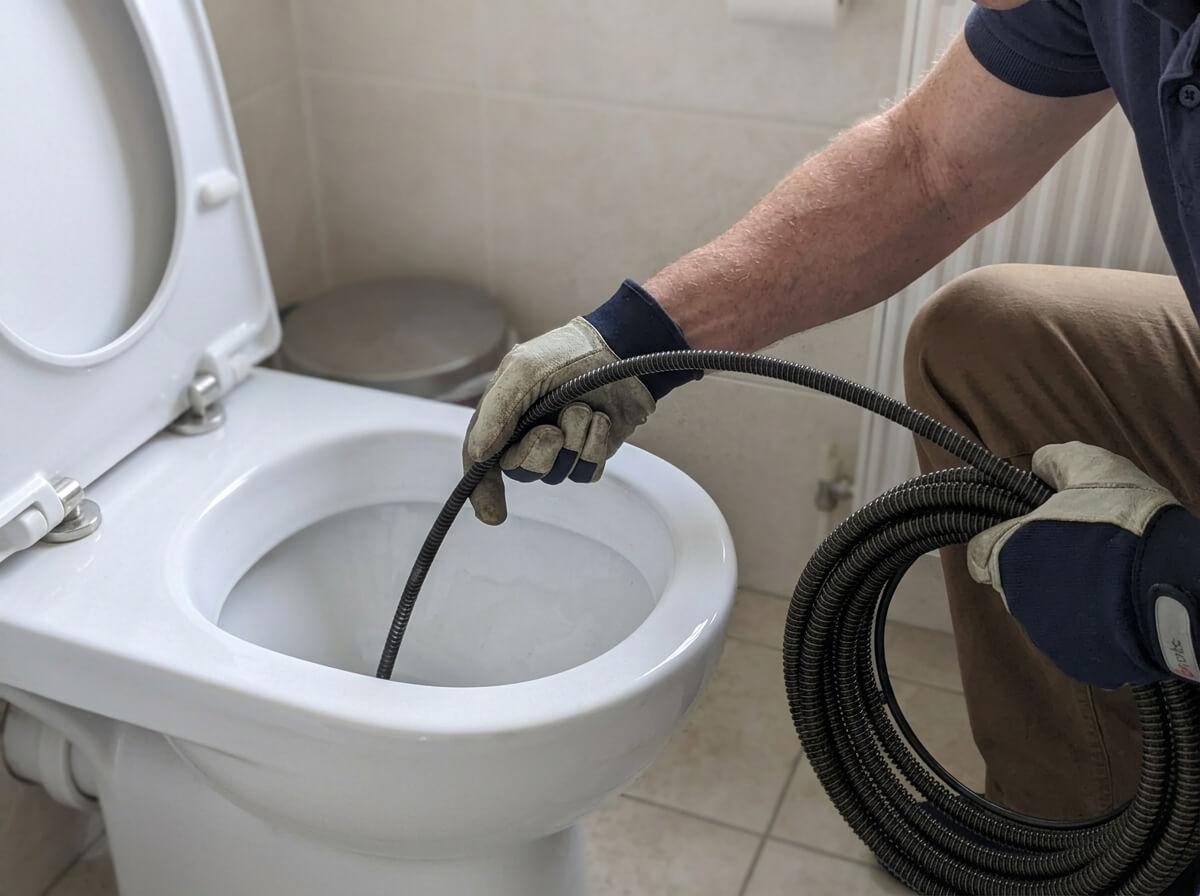
When I arrive at an overflowing drain, the first job is to find where the blockage is and whose drain it is in, by lifting the covers and checking which chambers are full. A blocked gully I clear by hand and with a gully plunger, then flush it through. A blockage in the underground drain I clear with drain rods from the manhole, and where fat, silt or roots have built up along the pipe, with a jetter, which scours the inside of the pipe with high-pressure water rather than just poking a hole through the blockage.
Before I leave, I run water from the house and flush the toilets to make sure everything drains freely. If a drain keeps blocking, or I find roots or a damaged section, I will explain what I have found and what it would take to put it right properly, which often starts with a CCTV survey. You can read more about my drain unblocking service, and you will always get a fair price agreed before any work starts. If the overflow is coming up through the toilet instead, my guide on what to do when a toilet is overflowing covers that side of it.
Overflowing Drains and Home Insurance
Whether your insurance covers an overflowing drain depends on the policy and the cause, so check your documents. In general:
- ●Blocked or collapsed underground drains are covered by some buildings policies, often as an optional extra, including the cost of clearing, surveying or repairing them.
- ●Damage to the house from sewage or water getting in may be covered under escape of water or flood cover, depending on the cause.
- ●Wear and tear and gradual damage are usually excluded, and some insurers exclude blockages caused by fat or wipes.
- ●Photograph everything before you clean up, and keep the plumber’s invoice and any survey report. I note the cause of the blockage on mine, which helps with a claim.
- ●Call early. Most insurers expect you to report a claim as soon as reasonably possible, and many have a 24 hour line.
How to Stop Your Outside Drain Overflowing Again
Nearly every overflowing outside drain I clear could have been avoided. These are the habits and checks that make the biggest difference:
- ●Keep fat out of the sink. Let it cool, wipe pans with kitchen roll and put it in the bin. Fat poured down hot sets solid in the gully.
- ●Use a sink strainer to catch food scraps and coffee grounds before they reach the drain.
- ●Fit a lint filter on the washing machine hose if it empties over a gully.
- ●Clear your gullies every autumn, and fit gully guards to keep leaves and soil out.
- ●Never flush wipes, even the ones labelled “flushable”. They are behind most of the main drain blockages I clear.
- ●Watch for early warnings. Gurgling sinks, slow drains and a gully that sits higher than usual all mean a blockage is building.
- ●Know where your manholes are, and keep them clear of pots, gravel and decking so they can be lifted quickly.
- ●Get a CCTV survey if it keeps happening. Repeated blockages usually mean roots, a sunken pipe or a damaged joint, and a survey shows exactly where.
When to Call an Emergency Plumber
You can handle the first few minutes yourself, and often clear a blocked gully too. Call me straight away, day or night, if sewage is coming out of a manhole, anything is backing up inside the house, water is heading under a door or an air brick, you have rodded without success, or you cannot use the toilet. If it is a gully that overflows only on wash day, call in the day and I will book it in promptly.
When I attend, I find the blockage, clear it properly, check the whole drain runs freely, and explain what caused it so it does not happen again. You can see everything I cover on the emergency plumbing services page. I cover Ipswich, Felixstowe, Woodbridge, Kesgrave, Stowmarket and the surrounding towns, and I answer the phone myself, 24 hours a day, seven days a week, on 07977 857224. If you are wondering what an out-of-hours visit involves, my guide on how much an emergency plumber costs explains how pricing works.