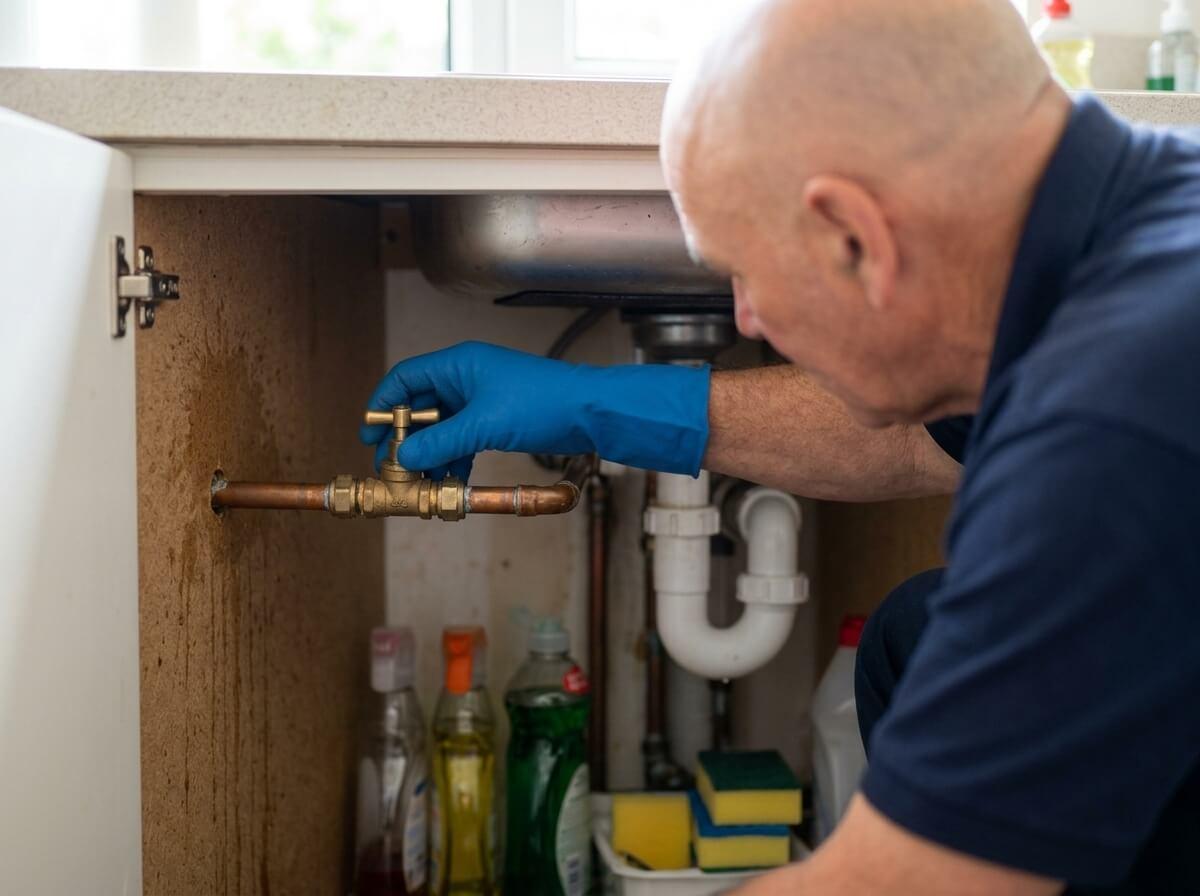

Your stopcock is the master switch for the water coming into your home, and in an emergency it is the single most important thing you can turn off. So there are few worse moments to discover it will not budge than when a pipe has just burst. A seized stopcock is one of the most common problems I deal with in Ipswich, and the reason is simple: we live in a hard-water area, and years of limescale build-up gradually lock the valve solid, especially one that has sat untouched for a long time. The good news is that a stuck stopcock can often be freed safely with a gentle approach, and this guide shows you how, what never to do, and how to make sure yours works before you ever need it in anger.
Why Stopcocks Seize (Especially in Ipswich)
Ipswich and the wider Suffolk area have notably hard water, which means the water carries a high mineral content. Over time, those minerals deposit as limescale inside the stopcock, building up on the spindle and thread and gradually cementing the moving parts together. A stopcock that is turned off and on now and again tends to stay free, but one that is left fully open and untouched for years, as most are, slowly seizes solid. Age and corrosion add to the problem, particularly with older brass valves. The cruel irony is that people usually only discover their stopcock has seized at the exact moment they need it most, during a leak or burst, which is why testing it in advance (covered below) is so worthwhile.
The Golden Rule: Do Not Force It
If your stopcock will not turn, the most important thing is what NOT to do: do not attack it with a wrench, pliers or a hammer, and do not throw your whole weight behind the handle. I cannot stress this enough. Over the years, brass valves and the copper pipe they sit on become brittle, and excessive force will shear the valve head clean off or snap the pipe, turning a stiff but intact valve into an uncontrollable, high-pressure leak that you cannot stop from inside the house. That is a far worse situation than the one you started with, and it usually means an emergency call-out and a bigger repair. A seized stopcock needs patience and a gentle touch, not brute force.
How to Free a Stuck Stopcock Safely
- ●Spray a penetrating oil such as WD-40 onto the spindle and around the thread where the handle meets the body of the valve, and give it at least ten minutes to soak in and start breaking down the limescale.
- ●Grip the handle with your hand, or a small pair of adjustable pliers using only light pressure, and try to move it gently.
- ●Use a small rocking motion: turn it a few millimetres clockwise, then back anti-clockwise, and repeat. This working back-and-forth often breaks the limescale seal without breaking the valve, where forcing it in one direction would not.
- ●Reapply the penetrating oil and wait again if needed; patience achieves far more than force.
- ●If it begins to move, work it fully closed and then open a few times to clear the limescale and keep it free, but stop the moment you feel it might shear rather than turn.
- ●If it will not move with gentle, moderate effort, stop, and do not escalate the force, move to the external valve instead.
If You Cannot Free It: The External Stop Tap
If your internal stopcock will not free up, or if you are in the middle of an emergency and cannot wait, you can shut the water off at the external stop tap instead. This is usually found at the boundary of your property, under a small round or square cover in the pavement or front garden, often marked WATER or with a W. Lift the cover (a flat-head screwdriver helps if it is stuck with grit), clear away any silt or leaves, and reach down to the valve. Many need a long-handled stopcock key, which costs only a few pounds from any Ipswich hardware shop and is well worth keeping in the house, though you can sometimes turn them by hand or with pliers. Turn it clockwise to stop the water before it even enters your home. One note on ownership: the external valve belongs to your water provider, so if it is damaged or leaking, report it to them rather than trying to repair it yourself.
Should You Repair or Replace a Seized Stopcock?
Once the immediate situation is under control, a stopcock that has seized should be sorted properly rather than left, because a valve you cannot rely on is no use in the next emergency. In many cases the best answer is to replace it, ideally with a modern quarter-turn lever valve, which shuts the water off with a single 90-degree turn, is far less prone to seizing, and can be operated in a second even with cold or wet hands. For anyone who struggles to reach or turn a stiff, low valve, this is a genuine improvement. A Surestop switch, operated by a simple rocker that can be sited somewhere convenient at worktop height, is another excellent option. Replacing a stopcock is a straightforward job for a plumber, with a clear, no-obligation quote agreed before any work begins, and inexpensive relative to the peace of mind it brings. I carry the tools to free seized valves or swap them for modern lever versions on the same visit.
Test Your Stopcock Before You Need It
The best way to avoid a seized-stopcock emergency is to make sure yours works while everything is calm. Once or twice a year, turn it fully off and then back on again, this simple habit keeps the valve free and stops limescale locking it up. When you close it, check it actually shuts the water off by running the cold kitchen tap: the flow should slow to a trickle and stop within a few seconds. When you reopen it, turn it fully on and then back a quarter-turn, which helps stop it sticking in the fully open position. While you are there, make sure you and everyone in the household know where the stopcock is, and consider labelling it. A stopcock you have tested and can turn is one of the cheapest and most valuable pieces of home insurance there is. If you turn an old stopcock back on and no water comes through at all, the jumper inside may have stuck: my guide to no water in the house explains what is happening and what to check.
Where to Find Your Stopcock
If you are not sure where your internal stopcock is, it is usually near where the mains water pipe first enters the property, most often under the kitchen sink. In many older Ipswich homes, though, it can be in the downstairs hallway, under the stairs, in a downstairs cloakroom, in the airing cupboard near the hot water cylinder, in a utility room, or low on a garage wall. It looks like a brass tap without a spout, with a round or T-shaped handle, sitting on the pipe. It is well worth locating yours now, I have written a separate guide on how to locate your stopcock fast if you need help finding it.
What a Stopcock Actually Does (and Why It Matters)
It is worth understanding exactly what your stopcock does, because it explains why a working one is so important. The stopcock, also called the stop tap or main stop valve, is the master control for the cold water mains entering your home. Turn it off and you cut the supply feeding every tap, toilet and appliance in the property. In a leak or burst, closing it is the single most effective thing you can do to stop water pouring into your home, because it stops the pressure at source. That is why a seized stopcock is such a problem: if the one valve designed to stop the water in an emergency will not turn, you have lost your main line of defence. It is also worth knowing that if your home has a cold-water storage tank in the loft (common in older Ipswich properties), closing the stopcock stops the tank refilling but the stored water will keep feeding a leak until the tank empties or you close the relevant gate valve, so draining the system by opening the taps helps too.
Keeping Your Whole System Leak-Ready
Freeing and testing your stopcock is part of a wider habit of keeping your plumbing ready for the unexpected, which is especially worthwhile in a hard-water area like ours. Alongside checking the stopcock once or twice a year, it is worth knowing where your external stop tap is and keeping a stopcock key in the house, lagging exposed pipes in lofts, garages and against external walls to guard against winter freezing, and dealing with small drips and weeps promptly before they become bursts. Knowing how to isolate individual appliances and, if you have them, the gate valves on a tank-fed system, gives you even more control in an emergency, for example when a tap won’t turn off. None of this is expensive or time-consuming, but together it means that if something does go wrong, you can act quickly and confidently rather than scrambling, and quick action is what keeps a plumbing problem small.
If you have more than one property, or an elderly relative living alone, it is worth making sure their stopcock is findable and works too, being able to tell someone over the phone exactly where their stop tap is and how to turn it off can save a home from serious damage in the minutes before a plumber arrives. A few minutes spent locating, labelling and testing the stopcock in every home you are responsible for is some of the cheapest peace of mind there is.
Call Your Local Ipswich Plumber
A seized stopcock is common in our hard-water area, and while a gentle approach often frees it, the safe rule is never to force it, a snapped valve turns a manageable problem into a flood. If yours will not free up, if you would rather not risk it, or if you want it replaced with a modern, reliable lever valve, that is exactly the sort of job I am glad to help with. I can free or replace a seized stopcock quickly across Ipswich and Suffolk, and fit an easy-turn valve so you are never caught out in an emergency. With a genuine 24-hour service, honest pricing and a clear quote before any work, just call 07977 857224, and do take five minutes to check your stopcock today, before you ever need it.