It always happens at the worst moment. You go to fill the kettle first thing, or turn the shower on, and the tap gives a cough and nothing else. Or the toilet does not refill after a flush, and when you try the kitchen tap that is dry too. The first question everyone asks me is “is it something I have done?” and the honest answer is: usually not.
I have been a plumber in Ipswich for more than forty years, and I get these calls every winter and every time a main bursts somewhere in the town. Half the time I can save people a call-out over the phone, because the fix is to wait for the water company, or to open a valve somebody has shut. The other half, there is a real problem in the house that needs sorting quickly. This guide walks you through the same checks I would do, in the same order, so you know which one you have. It also answers the questions people ask next: can I use the boiler, can I flush the toilet, why is the water brown when it comes back, and am I owed anything.
No Water in the House? Check These 6 Things First
Work through these in order. Most people have their answer by step two or three, and none of them need tools.
Try the kitchen cold tap
In most homes the kitchen cold tap is the one tap fed straight from the mains, so it tells you whether water is reaching the house at all. In older homes with a tank in the loft, the bathroom taps, the toilet and the hot water may come from that tank instead, which is why they can keep running for a while after the mains goes off, or stop on their own while the kitchen tap is fine. Try the kitchen cold tap, a bathroom cold tap and a hot tap, and note which ones work. That pattern is the biggest clue you have.
Ask a neighbour, and check your water company
Knock next door or send a message to the street group. If they have no water either, the problem is almost certainly in the main, and there is nothing you or a plumber can do but wait. Look up your postcode on your water company’s website, which shows live bursts and planned work. Anglian Water supplies most homes around Ipswich, and its 24 hour line is 03457 145 145, but check the name on your bill, as some parts of Suffolk are supplied by a different company. If your neighbours have water and you do not, carry on.
Check your stopcock is fully open
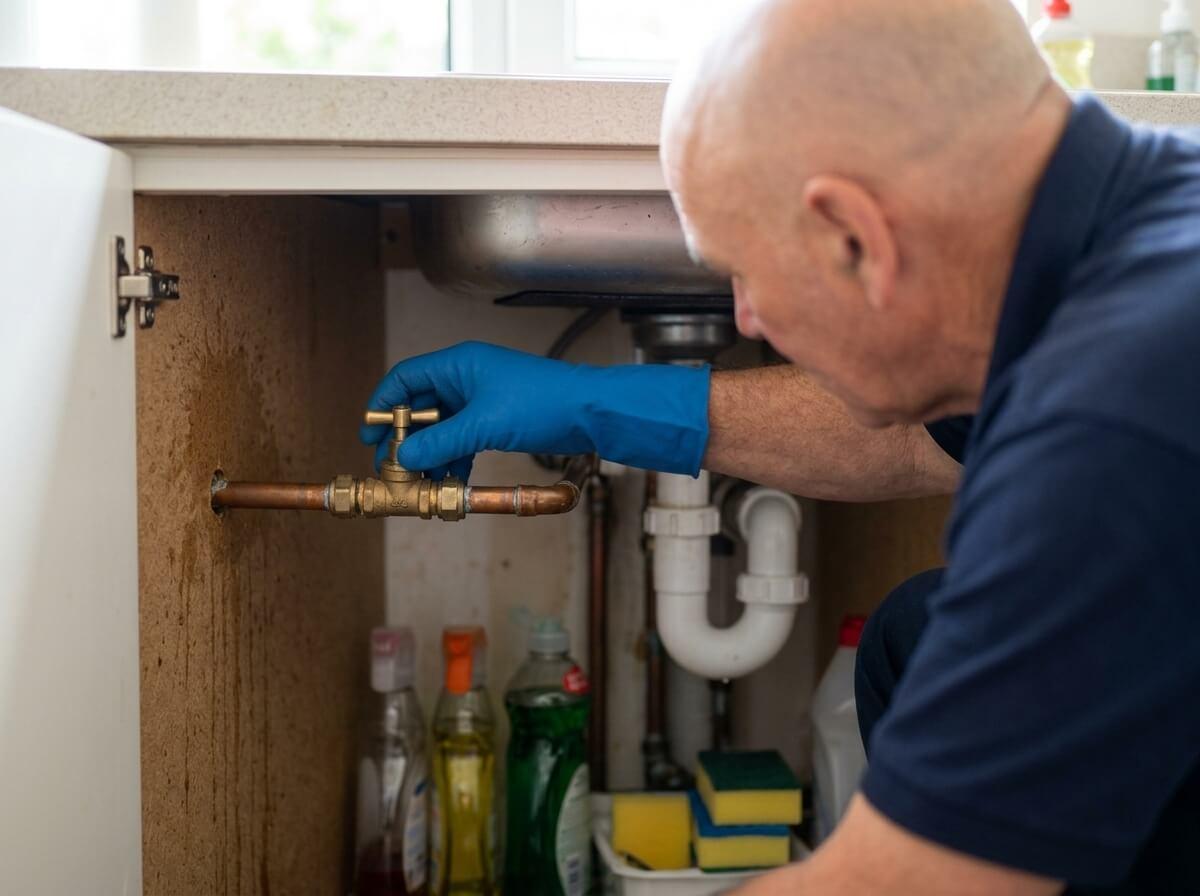
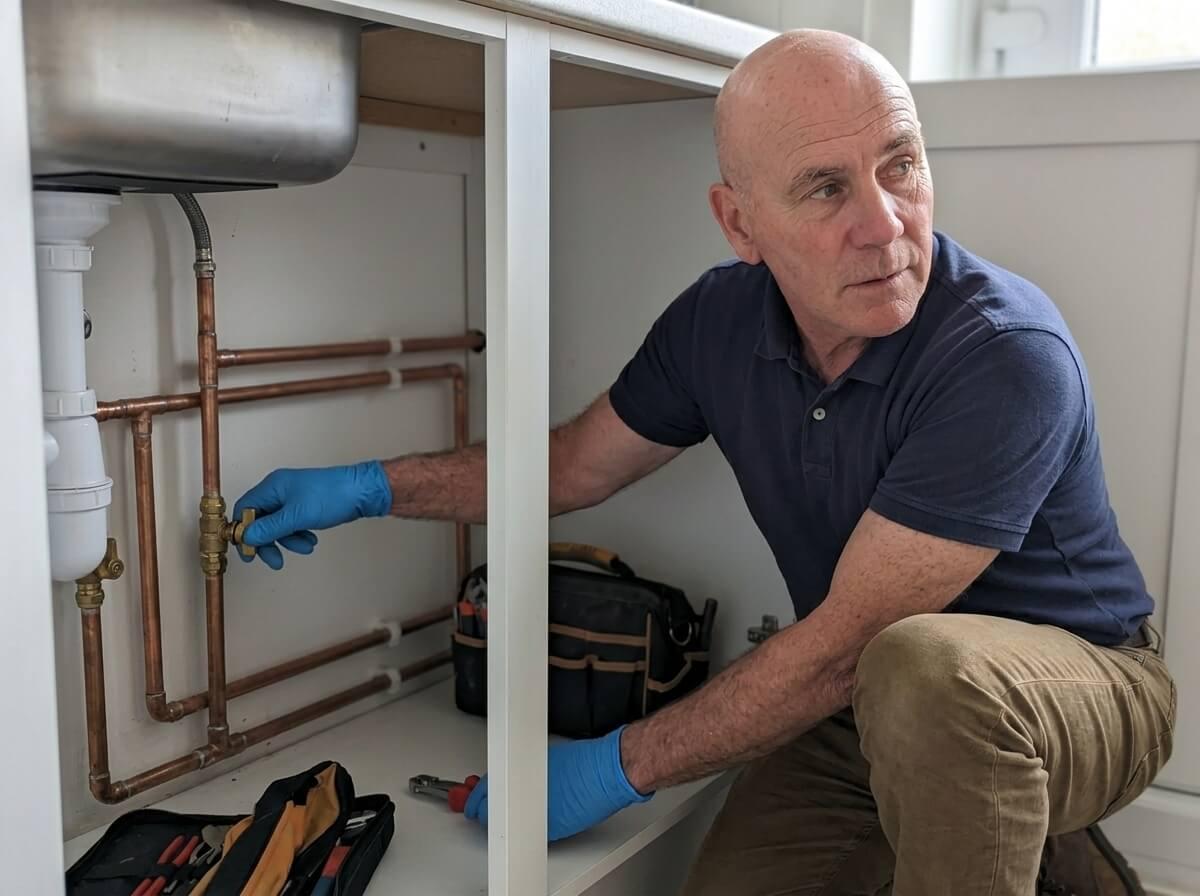
Your internal stopcock is where the mains comes into the house, usually under the kitchen sink, in a downstairs cloakroom, under the stairs or in a utility room. Turn it anticlockwise as far as it goes. It is surprisingly common for a stopcock to be left shut, or only part open, after a tap or washing machine has been fitted, or by a child exploring a cupboard. If you cannot find it, my guide on how to locate your stopcock shows every place I find them. If it will not turn, do not force it: see stopcock stuck or seized.
Check the outside stop tap and meter
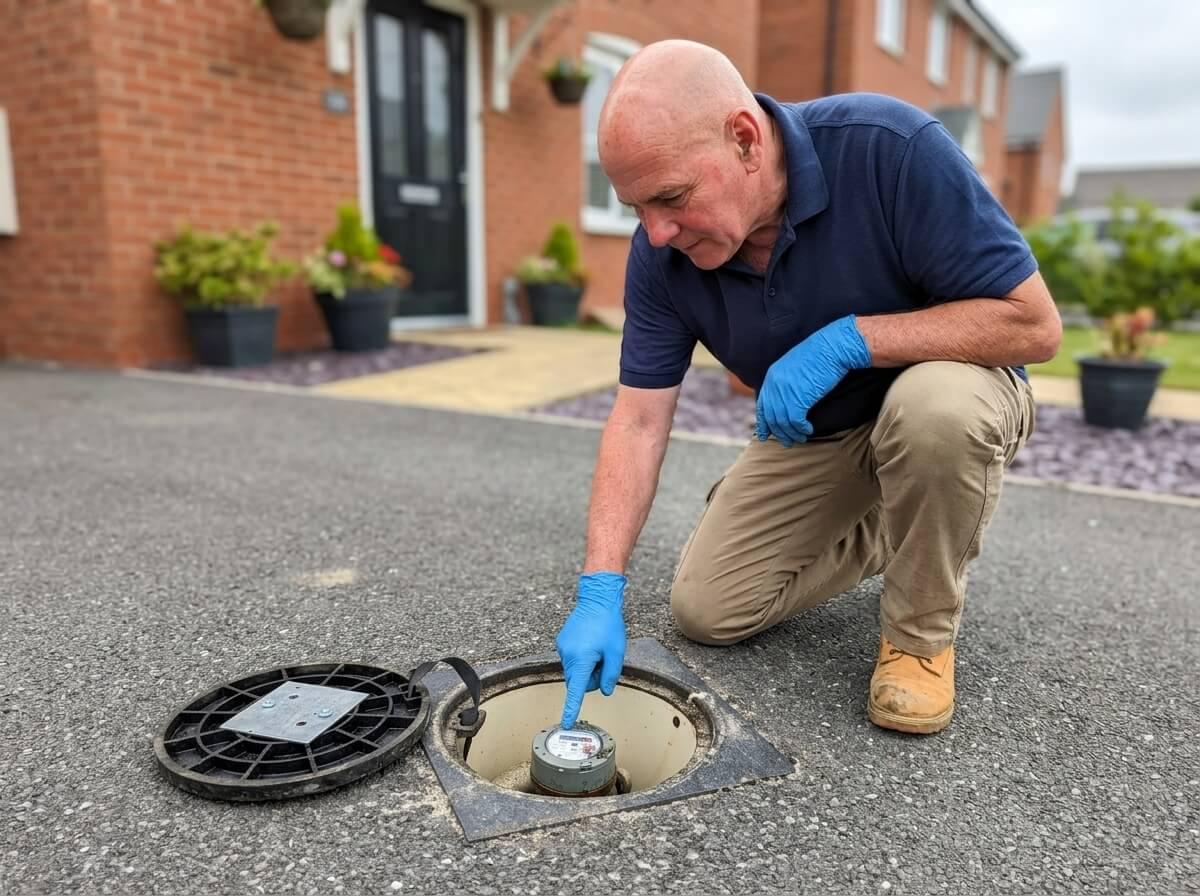
Outside, usually in the pavement or at the edge of your drive, is a small cover marked “W” or “Water”. Under it is the outside stop tap and, on most homes now, the water meter. If a meter has just been fitted, or there has been work in the road, the tap may have been left closed. Do not try to turn it with makeshift tools: these are often deep and stiff, and the water company is responsible for them. While you are there, if your meter has a dial or a small star wheel, look at it with every tap off. If it is turning, water is escaping somewhere between the meter and your taps, which means a leak.
Think about the weather
If it has been below freezing overnight, a frozen pipe is the most likely cause. The usual suspects are the supply pipe where it comes up through a cold floor or an outside wall, pipes in the loft, and pipes in a garage or utility room. Turn the stopcock off before you try to thaw anything, because a frozen pipe may have split, and you only find out when the ice melts. My guide to frozen pipes shows how to find the frozen section and thaw it safely.
Look and listen for a leak
A burst pipe can stop the water reaching your taps without the flood being obvious, especially if it is under a floor, in a ceiling void or in the ground outside. Listen for hissing near the stopcock with everything off. Look for a wet patch on the drive or lawn along the line of the supply pipe, damp on a ground floor, or water coming through a ceiling. If you find any of these, turn the stopcock off and read my guide on what to do when a pipe bursts.
Is No Water in the House an Emergency?
If the whole street is off, it is an emergency for the water company, not for you or a plumber, and they will be working on it. If only your house has no water, treat it as urgent, because the likely causes on your side are the ones that cause damage. Call an emergency plumber straight away if:
- ●Your neighbours have water and you do not, your stopcock is fully open, and it is not freezing.
- ●You can hear hissing, see a wet patch outside, or your water meter is still turning with every tap off.
- ●Water is coming through a ceiling or up through a floor, or there is damp spreading on a wall.
- ●Your stopcock is broken, will not open, or spins without doing anything.
- ●A pipe has frozen and you can see a split or bulge, or water appears as it thaws.
- ●Someone in the house is elderly, unwell, has a young baby, or relies on water for medical care.
If it is just one tap, one toilet, or the hot water only, it is a problem to book in rather than an emergency, and you will find the likely causes below.
What Your Taps Are Telling You
Which taps work, and which do not, points straight at the cause. These are the patterns I ask about on the phone, and they are worth noting down before you call anyone:
| WHAT YOU NOTICE | LIKELY CAUSE | WHAT TO DO |
|---|---|---|
| No water from any tap, and your neighbours have none either | The water company has turned off the main in your street, for a burst main or planned work. | Check your water company's website by postcode. Turn your taps off and wait. A plumber cannot help. |
| No water from any tap, but your neighbours have water | Your stopcock or outside stop tap is closed or has failed, a pipe has frozen, or your supply pipe has burst. | Check the stopcock and outside stop tap. If both are open and it is not freezing, call a plumber now. |
| Kitchen cold tap works, but bathroom taps, the toilet and hot water have stopped | The cold water storage tank in your loft has run dry: a stuck float valve, or a frozen or blocked pipe feeding it. | Look in the loft tank. If it is empty, see the loft tank section below, then call if you cannot get it filling. |
| Kitchen cold tap is dead, but the bathroom taps and toilet still run | The mains has gone off and you are running on what is left in the loft tank. | Save that water. Find out whether it is the street or your house, using the neighbour check. |
| Water stopped suddenly, and you can hear hissing, see a wet patch, or the meter keeps turning | A burst or a serious leak on your side, possibly underground or under the floor. | Emergency. Turn off the stopcock, switch off electrics near any water and call a plumber. |
| No water, or only a trickle, on a freezing morning | A frozen pipe, usually where the supply comes into the house, or in a loft, garage or outside wall. | Turn off the stopcock before you thaw it, in case the pipe has split. See my frozen pipes guide. |
| Water spits and splutters, then slows to nothing, usually after work on the pipes | An air lock: a bubble of air trapped in a pipe, most often on a tank-fed hot tap. | Usually fixable yourself. See the air lock section below. |
| Only one tap, or one toilet, has no water | A closed isolating valve, a blocked tap aerator or cartridge, or a faulty fill valve in a cistern. | Not an emergency. Check the small valve on the pipe under that tap or behind that toilet. |
| Cold water is fine, but there is no hot water | A boiler, cylinder or immersion problem, not your water supply. | Check the boiler display and pressure gauge, and the immersion switch. Call a heating engineer for a boiler fault. |
Rows shaded red usually need a plumber the same day or night. The others can normally be sorted yourself, or wait for a booked visit.
The Common Causes of No Water, Explained
A burst main or planned work in the street
This is the most common cause by a distance. When a water main bursts, the water company isolates that section of the network, which can take out a few houses or a whole estate. For planned work, they should give you at least 48 hours’ written notice, usually a card through the door. Unplanned bursts are usually fixed within a few hours, though a big one can take longer. There is nothing in your house to fix, so save your money and do not call a plumber. Turn your taps off so nothing overflows when the water comes back, and keep an eye on the water company’s website for updates.
A closed, part-closed or failed stopcock
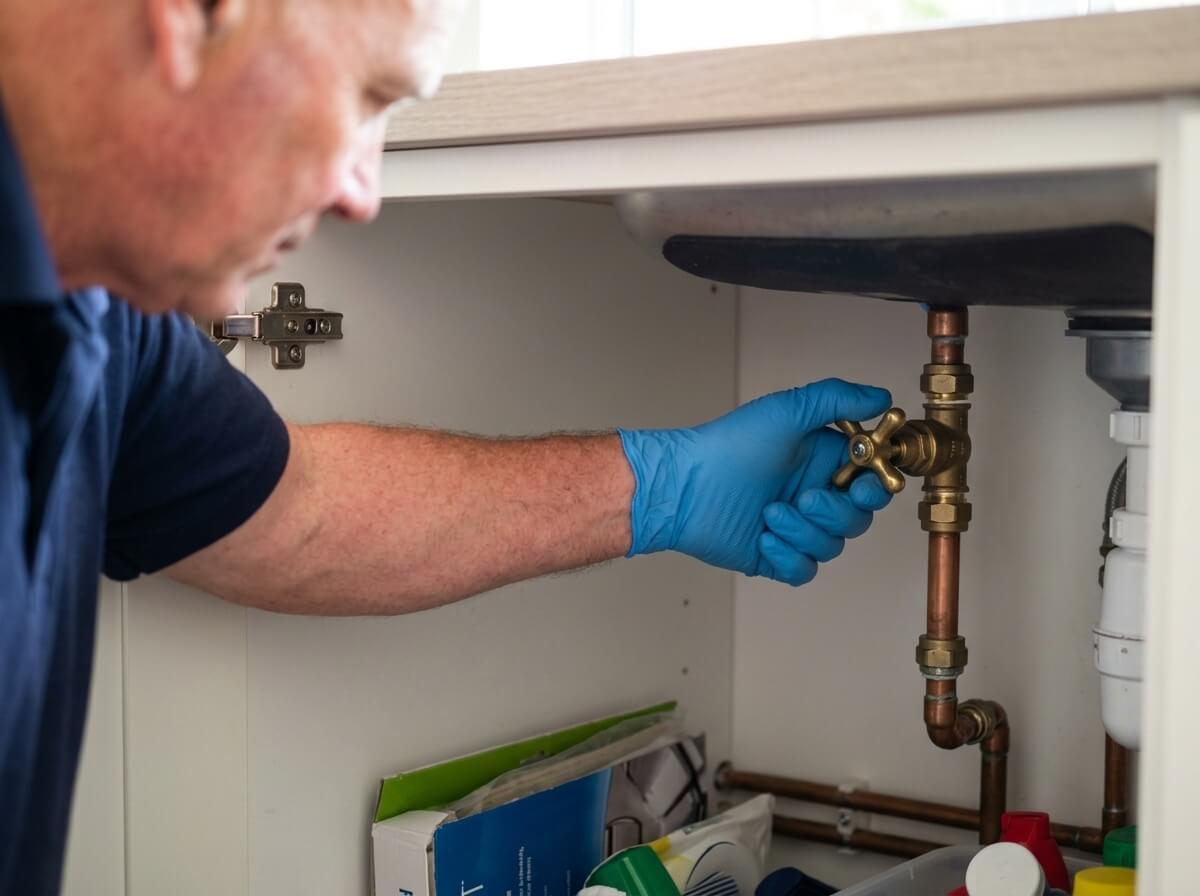
A stopcock that has been closed is the easiest fix in this guide. The trickier one is a stopcock that has failed inside. Old brass stopcocks have a loose part called a jumper, with a washer on it, that lifts off the seat to let water through. After years of being left in one position, the jumper can stick down or come away, so the handle turns but no water passes. It usually happens just after someone has turned the stopcock off and back on, often for the first time in decades. You will have water up to the stopcock but none after it. It is not something to repair yourself, because you cannot isolate the stopcock from inside the house. I replace them with a modern quarter-turn valve, which is a quick job once the outside stop tap is off.
A frozen pipe
In a cold snap, the supply pipe can freeze where it comes into the house, especially if it rises through a cold floor void or along an outside wall. You might have a trickle at first, then nothing. Frozen pipes in the loft tend to stop the tank filling, so you lose the bathroom taps and toilet first. Whatever you do, do not use a blowtorch or boiling water on the pipe. Turn the stopcock off, open the tap nearest the frozen section, and warm the pipe gently with a hairdryer or a hot water bottle, working from the tap end back. Then check carefully for drips as it thaws.
A burst or leaking supply pipe
The pipe that runs underground from your outside stop tap to your house is called the supply pipe. In older Ipswich homes it is often lead or galvanised steel, and on many 1960s and 70s houses it is early plastic, and any of them can fail. A big leak can drop the pressure so far that nothing reaches your taps. The signs are a wet patch or a sunken area of lawn or drive along the pipe’s route, the sound of running water when everything is off, a water meter that will not stop turning, or a sudden jump in your water bill. A leak indoors is usually more obvious: water through a ceiling, a damp floor, or a puddle that keeps coming back. If you suspect a leak but cannot see it, my leak detection service finds it without pulling up the whole floor, and my guide to the signs of a hidden water leak lists the clues to look for.
An empty loft tank
If you have a cold water storage tank in the loft, it is filled by a float valve, the same idea as the one in a toilet cistern. If the float sticks, the valve furs up with limescale, or the pipe feeding it freezes, the tank slowly empties and stops refilling. The kitchen cold tap still works because it comes from the mains, but the bathroom taps, the toilet and eventually the hot taps go dry. Go up carefully, with a torch, and look in the tank. If it is empty or low, gently move the float arm down: if water starts to flow, the valve was stuck and may need replacing. If nothing comes out, the pipe feeding the tank is frozen or blocked. A float valve that has stuck once will usually stick again, so it is worth having it replaced.
An air lock
After the water has been off, or after work on the pipes, air can get trapped at a high point in the pipework, most often on a hot tap fed from a tank. The tap spits, splutters and then runs slowly or not at all. The simplest fix is to open every hot and cold tap in the house, starting downstairs, and let them run until they flow smoothly, then close them, upstairs first. If one tap still will not clear, a common trick is to push a short hose from the kitchen cold tap (mains pressure) onto the stuck hot tap, open both for a few seconds, and let the mains pressure push the air back up and out. Turn the hot tap off first. If it keeps coming back, there is a fault in the pipework layout that a plumber should look at.
Just one tap or one toilet
If everything else works, look for the small isolating valve on the pipe feeding that tap or toilet. It usually has a slot for a flat screwdriver: when the slot runs along the pipe it is open, and across the pipe it is closed. If that is open, the tap’s aerator may be blocked with limescale, which is easy to unscrew and clean, or a toilet’s fill valve may have failed. My guide on toilet cistern problems covers the fill valve.
Can I Use My Boiler If the Water Is Off?
This is the question I am asked more than any other when the water goes off, and the answer depends on why it is off and what kind of system you have. If the water company has turned off the street supply, your heating system is still full, so in most homes the heating can keep running. It is hot water that you may lose.
| YOUR SYSTEM | HEATING | HOT WATER |
|---|---|---|
| Combi boiler (no hot water cylinder, no loft tanks) | Usually yes. The heating is a sealed loop that is already full, so it does not need the mains. | No. A combi heats mains water as it flows through, so no mains means no hot water. |
| System boiler with an unvented cylinder (pressurised cylinder, no loft tanks) | Usually yes, for the same reason. | Little or none. The cylinder stays full, but it relies on mains pressure to push the hot water out. |
| Regular boiler with a hot water cylinder and loft tanks (older homes) | Yes, while the small feed and expansion tank in the loft has water in it, which it will. | Yes, until the big cold tank in the loft runs dry. The cylinder itself stays full, so it is safe. |
| Electric immersion heater | Not applicable. | Safe to leave on while the cylinder is full. Turn it off if the cylinder has been drained. |
That changes completely if the water is off because of a problem in your own house. Switch off the boiler, and the immersion heater if you have one, if any of these apply:
- ✕You have turned off the stopcock and opened taps to drain the pipes because of a burst or a leak.
- ✕The pressure gauge on a combi or system boiler has dropped to zero or close to it.
- ✕Pipes are frozen. A frozen condensate pipe will also stop a condensing boiler working.
- ✕The boiler is showing a fault code, making banging or kettling noises, or has locked out.
- ✕Water is leaking from the boiler, the cylinder or a radiator.
Running a boiler or an immersion heater with no water in it can damage the heat exchanger or burn out the element. Do not try to top the boiler pressure up with the filling loop while the mains is off either: there is nothing to top it up from. For a fault on the boiler itself, call a heating engineer. If you are not sure, switch it off at the controls and ask: a cold house for an hour is cheaper than a new heat exchanger.
Living Without Water: Toilets, Drinking and Washing
Most supply interruptions are over in a few hours, but it pays to make the water you have go further.
- ●Toilets. You get one flush from what is in the cistern. After that, pour a bucket of water (six to eight litres) quickly into the pan, or refill the cistern by hand. Use bath water, water butt water or stored tap water, not bottled drinking water.
- ●Drinking. Plan on two to three litres per person per day for drinking, and more for cooking and for babies’ feeds, which should be made with boiled tap water, not mineral water. Do not drink water from the loft tank or the hot taps.
- ●Washing. A bowl of warm water from the kettle goes a long way. Hand sanitiser saves water for the things that matter.
- ●Help with bottled water. If someone in your home is elderly, disabled, seriously ill, has a newborn baby or relies on water for medical care, sign up to your water company’s free Priority Services Register. If the supply goes off for a long time, people on the register are prioritised for bottled water deliveries.
- ●Turn off the taps. Every one of them, including the one you tested, and take the plugs out of sinks and baths so nothing overflows when the water comes back while you are out.
When the Water Comes Back On
The supply coming back is not quite the end of it. A few minutes of care now saves a ruined load of washing or an air lock later.
Run the kitchen cold tap first
Open it slowly. Expect spluttering and bursts of air at first, which is normal. Let it run until it flows smoothly and looks clear.
Do not panic about brown or cloudy water
Refilling the main stirs up harmless sediment, which can make the water brown, yellow or orange for a while. Cloudy or milky water is usually tiny air bubbles: fill a glass and if it clears from the bottom up within a minute or two, it is just air. Run the kitchen cold tap at a moderate flow until it is clear, normally within twenty minutes. If it does not clear, or smells or tastes odd, contact your water company.
Work round the other taps
Once the kitchen tap is clear, open the other taps one at a time to let the air out, then flush each toilet. Hold off on the washing machine and dishwasher until the water is clear, so you do not stain your laundry.
Check the boiler and the loft tank
A combi boiler may need resetting if it locked out when the water went off. If you have a loft tank, check it is refilling and that the float valve shuts off properly when it is full.
Look for leaks
The surge of pressure when a supply is restored can find any weak joint. Have a quick look under sinks, around the stopcock and at any pipework you can see, and keep an eye on ceilings for the next day or so.
Am I Owed Compensation for No Water?
Possibly. Under the Guaranteed Standards Scheme in England, if your water company does not restore your supply within 12 hours of an unplanned interruption, such as a burst main, or by the time it told you for planned work, it owes you £50, plus another £50 for each further full 12 hours, up to a cap of twice your annual water supply charge. Planned work lasting more than four hours should come with at least 48 hours’ written notice, and a payment is due if it does not. These amounts have applied since 1 October 2025. If you think you are owed a payment, contact your water company, and if you are not happy with the answer, the Consumer Council for Water gives free advice. None of this applies when the fault is on your own pipework.
One more thing that worries people: in England and Wales, a water company cannot cut off a household’s supply for unpaid bills. That has been the law since 1999, so if your water has stopped, that is not why.
Who Is Responsible for Which Pipe?
Knowing who owns which bit of pipe saves you calling the wrong people. As a general rule:
- ●The water company owns the main in the road and the short communication pipe up to your boundary, usually as far as the outside stop tap and meter. Leaks there, and loss of supply to the street, are theirs to fix, at no cost to you.
- ●The property owner owns the supply pipe from the boundary to the house, plus the stopcock and everything inside. That is a job for a plumber. Some water companies offer help with underground supply pipe leaks or an allowance on the water lost, so it is worth asking them.
- ●Shared supply pipes are common on older terraces, where one pipe feeds several houses. If you and the neighbours on the same pipe lose water but the rest of the street is fine, a shared supply pipe is a likely culprit, and the owners usually share the repair.
No Water in a Flat or Rented Home
In a block of flats, your water may come through a shared supply, a communal tank or a booster pump, so one fault can leave several flats without water. Ask your neighbours, then call the managing agent or the building’s out-of-hours number: a failed booster pump or communal tank valve is theirs to fix. If you rent, tell your landlord or letting agent straight away, in writing as well as by phone. Landlords are responsible for keeping the water supply and the pipes in working order, and a loss of water is an emergency repair. If you cannot reach them and water is leaking, you can still turn off your stopcock to limit the damage.
What Not to Do When You Have No Water
- ✕Do not leave taps open. When the water comes back you could come home to an overflowing sink.
- ✕Do not force a stiff stopcock with a long bar or pliers. A snapped spindle turns a small problem into a big one.
- ✕Do not dig up or open the water company’s outside stop tap with makeshift tools.
- ✕Do not use a blowtorch, heat gun or boiling water on a frozen pipe.
- ✕Do not run the boiler or immersion heater if you have drained the system.
- ✕Do not drink water from the loft tank or the hot taps.
- ✕Do not pay for a plumber if the whole street is off. Nobody can fix that but the water company.
How a Plumber Fixes No Water in the House
When I come out to a house with no water, I start the same way you have: which taps work, is the stopcock open, is the meter turning. From there, the fix depends on what I find. A failed stopcock gets replaced with a quarter-turn valve that will not seize. A frozen pipe gets thawed safely, checked for splits, and lagged so it does not happen again. A burst gets cut out and repaired, and if it is underground I find the leak first rather than digging up the whole garden. A stuck loft tank valve gets replaced, and an air lock gets cleared and the cause put right. You can see the full range of work on my burst pipe repair and emergency plumbing services pages. You get a fair price agreed before any work starts.
How to Be Ready Next Time
- ●Find your stopcock now, and turn it off and on once or twice a year so it does not seize. Label it for everyone in the house.
- ●Know where your outside stop tap and meter are, and take a photo of the meter reading. It is your best leak detector.
- ●Keep some water stored, a few large bottles for drinking and a bucket or two for the toilet, especially over winter.
- ●Lag pipes in the loft, garage and outside walls, and keep the heating ticking over in a cold snap.
- ●Save your water company’s number in your phone, and sign up for their text alerts if they offer them.
- ●Get a quarter-turn stopcock fitted if yours is an old brass one that has not been turned in years. It is a small job that saves a lot of stress.
When to Call an Emergency Plumber
If the whole street is off, save your money and call the water company. If your neighbours have water and you do not, and your stopcock is fully open, call me straight away, day or night, especially if there are any signs of a leak, a pipe has frozen and split, or your stopcock has failed. If you have water but one tap or toilet has stopped, or the loft tank is slow to fill, call in the day and I will book it in promptly.
I cover Ipswich, Felixstowe, Woodbridge, Kesgrave, Stowmarket and the surrounding towns, and I answer the phone myself, 24 hours a day, seven days a week, on 07977 857224. Often I can tell you on the phone whether you need me at all. If you are wondering what an out-of-hours visit involves, my guide on how much an emergency plumber costs explains how pricing works.