There are not many calls that sound as urgent as this one, and for good reason. It usually goes like this: someone flushes the toilet, and a few seconds later dirty water bubbles up through the shower tray. Or the bath is let out upstairs and the downstairs toilet fills almost to the rim. Sometimes it is the kitchen sink filling from below while the washing machine empties.
I have been clearing drains across Ipswich and Suffolk for more than forty years. Most of what you will find online about this is written for American houses with basements and floor drains. Our drains work differently, and so do the rules on who pays. The good news is that where the water comes up tells you a lot about where the blockage is. This guide walks you through what to do right now, how to read the clues, how to tell whether it is your drain or the public sewer, and how to clean up safely afterwards.
Sewage Coming Up? Do These 6 Things Now
Stop using water, all of it
Tell everyone in the house not to flush, shower, run a bath or use the taps. Switch off the washing machine and dishwasher at the wall, even mid cycle, because they pump out a lot of water quickly. Every drop that goes down any plughole in the house ends up in the same blocked drain, and comes back up at the lowest point.
Keep people and pets away
Water from a drain is sewage, even when it looks clear. Keep children and pets out of the room, close the door, and do not walk it through the house on your shoes or socks.
Make the electrics safe
If the water could reach sockets, an electric shower, an extractor fan, a heater or floor level wiring, switch that circuit off at the consumer unit. If the consumer unit itself is wet, or you are not sure, do not touch it and keep everyone out.
Do not plunge the toilet hard
If the toilet is full, a hard plunge can force sewage straight out of the shower, bath or sink instead of shifting the blockage, which is often outside the house anyway. Leave it, and put old towels round the base of the toilet and shower to stop it spreading.
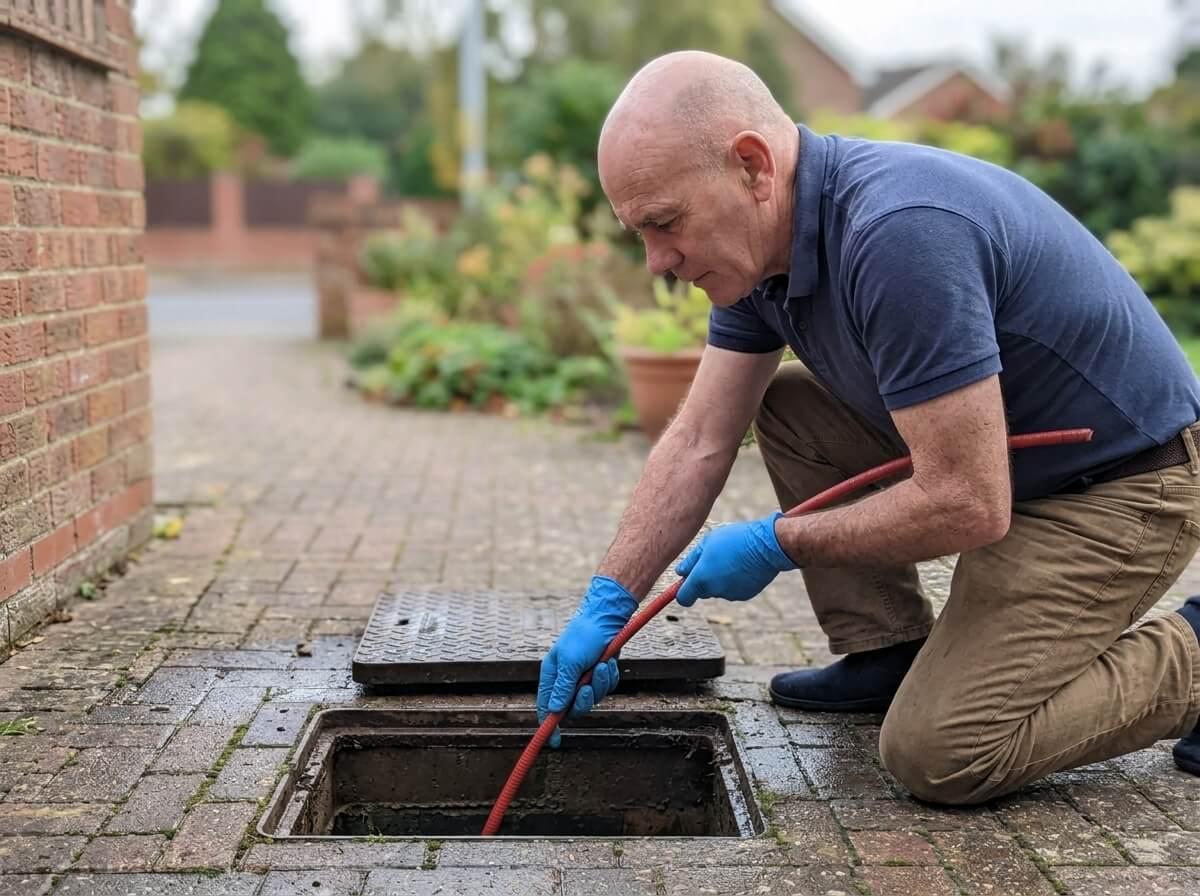
Lift the manhole cover outside
Find the inspection chamber nearest the house, usually a square metal or plastic cover in the garden, path or drive, and lift it with a screwdriver or spade. Full or empty tells you where the blockage is. The manhole test below explains what each result means and whose job it is to clear it.
Make the right call
If the blockage is in a drain you share with a neighbour, or beyond your boundary, call Anglian Water on 03457 145 145. Clearing it is free. If it is your own drain, or you cannot tell, call a plumber. Take photos and a short video of the water and any damage first, for your insurer.
Why It Comes Up in the Shower, Bath or Sink
In most British homes, every toilet, bath, shower, basin and sink drains into one main drain that runs under the house and out to the manholes in the garden, then on to the public sewer. Upstairs, the waste usually goes into a soil stack, the large vertical pipe on the outside or inside of the house, and down into that same drain.
When the drain is blocked, the water backs up the pipe until it reaches the lowest opening in the house. That is almost always on the ground floor: a downstairs shower or wet room, a ground floor toilet, a utility sink, or a bath in a bungalow. Shower trays and baths are low and have no water seal deep enough to hold back a column of sewage, so they are usually first. Nothing is wrong with the shower itself. It is simply the overflow point for the whole house.
That is also why water appears when you flush the toilet. A flush sends six to nine litres down the pipe in a few seconds. If the drain below is blocked, it has to go somewhere, and it comes up wherever is lowest and closest.
Where Is the Blockage? Read the Clues
When someone rings me with sewage coming up, my first question is where it is coming up, and when. Find the row that matches what is happening in your home.
| WHAT YOU SEE | WHERE THE BLOCKAGE USUALLY IS | URGENCY |
|---|---|---|
| Dirty water comes up the shower or bath plughole when the toilet is flushed | The main drain or soil stack is blocked below the point where the shower or bath joins it. The flush has nowhere to go, so it rises at the lowest opening. | Act now |
| Downstairs toilet bowl fills up when the upstairs toilet is flushed or the bath is emptied | A blockage in the main drain below the downstairs toilet, usually between the house and the first manhole, or in the manhole itself. | Act now |
| Ground floor shower, wet room or utility drain backing up, and the manhole outside is full | The drain is blocked further downstream of that manhole, often at the last chamber before the sewer or in an old interceptor trap. | Act now |
| Neighbours have the same problem, or a shared manhole is full | A blockage in a shared drain or the public sewer. That belongs to Anglian Water, and they clear it free. | Act now |
| Sewage coming up only during heavy rain, then draining away | The public sewer, or a combined foul and rainwater drain, is overloaded by storm water and backing up into the lowest fittings in the house. | Act now |
| Sewage in the shower or toilet and your home is on a septic tank or treatment plant | The tank is full and overdue emptying, the outlet or soakaway has failed, or the pump or aerator in a treatment plant has stopped. | Act now |
| Kitchen sink fills from below when the washing machine or dishwasher empties | The kitchen waste pipe or the gully outside is blocked with fat, food and lint. Usually only the kitchen branch, not the main drain. | Today or tomorrow |
| Bathroom basin fills when the bath or shower empties | The basin and bath share a waste pipe, and it is blocked just below where they join. Hair and soap are the usual cause. | Today or tomorrow |
| Every drain is slow and gurgling, but nothing has come up yet | A partial blockage in the main drain that is building. This is the warning before sewage starts coming up. | Today or tomorrow |
The rule of thumb: if only one plughole is affected, the blockage is close to it, in that fitting’s own waste pipe. If two or more fittings are involved, especially a toilet and a shower or bath, the blockage is in the main drain they share, and that is almost always outside.
The Manhole Test: Your Drain or the Sewer?
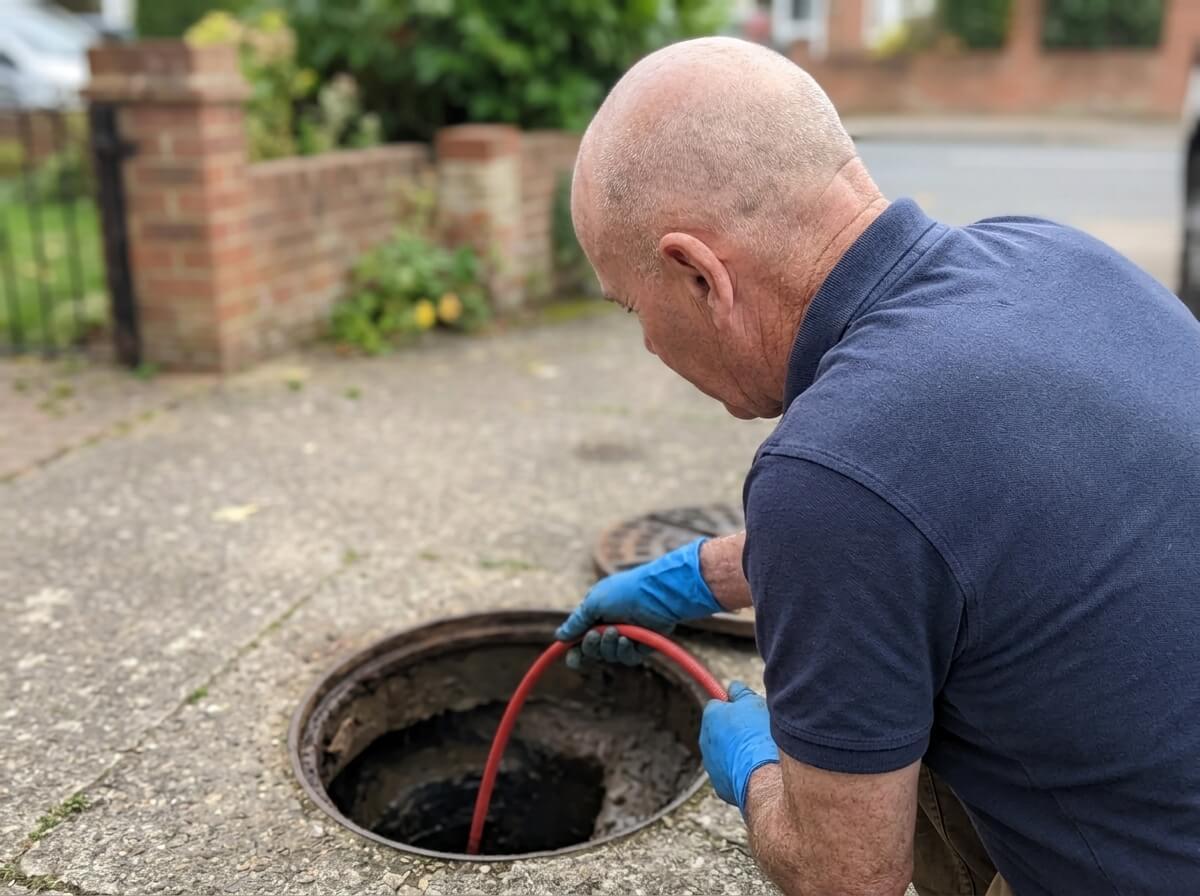
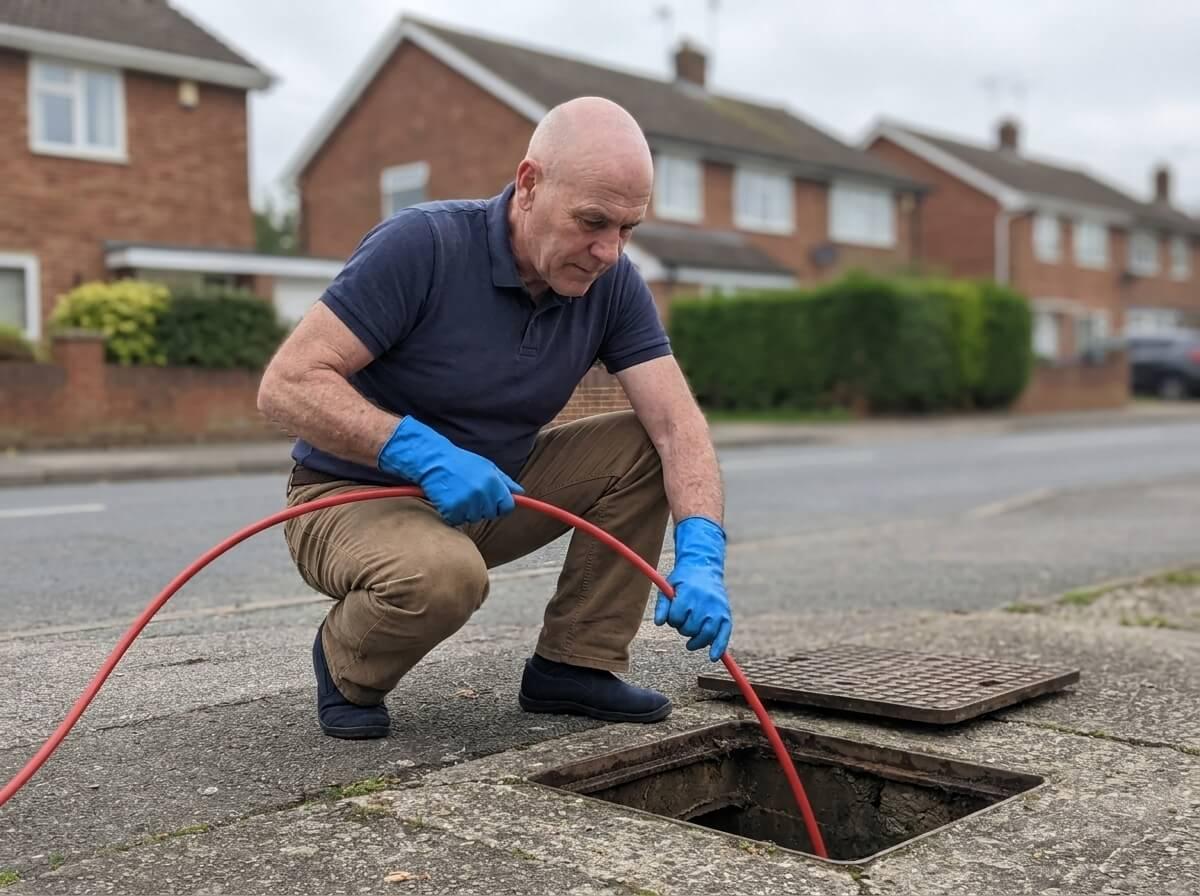
This takes five minutes and tells you, and whoever comes out, exactly where to start. Wear rubber gloves, lift covers carefully as they can be heavy and sharp edged, and never leave an open manhole unattended where a child or pet could fall in.
Find all your manholes
Start nearest the house and work towards the road. Many homes have one or two. Older houses and longer gardens can have three or more, and the last one is often near the front boundary or under the drive.
Lift the one nearest the house
If it is empty or flowing normally, the blockage is between the house and this manhole, usually in the pipe under the house or where the soil stack meets the drain. That is your drain.
If it is full, check the next one down
Keep going towards the road. The blockage sits between the last full chamber and the first empty one. If every chamber in your garden is full, the blockage is at the last one or beyond it.
Check whether it is shared
If a neighbour’s drain also runs into the full chamber, or their manhole is full too, the blockage is in a shared drain or the public sewer. That is Anglian Water’s, and they will clear it free of charge.
Who Is Responsible? You, a Neighbour or Anglian Water
On 1 October 2011, most private sewers and shared drains in England were transferred to the water companies. Around Ipswich and most of Suffolk that means Anglian Water. Since then, the rule is simple: if a pipe serves only your home and is inside your boundary, it is yours. If it is shared, or outside your boundary, it is theirs.
| PART OF THE DRAIN | WHO CLEARS IT |
|---|---|
| Waste pipes, toilets, traps and the soil stack inside and on the walls of your home | You. Your landlord if you rent. |
| The drain and manholes in your garden that serve only your home | You. Your landlord if you rent. |
| A drain that serves your home and a neighbour's, even where it runs through your garden | Anglian Water, as a public sewer, since 1 October 2011. |
| The pipe that serves only your home but lies outside your boundary, under the pavement or road | Anglian Water. This is called a lateral drain. |
| The public sewer in the road | Anglian Water. |
| A septic tank, cesspit or sewage treatment plant | You, or shared between the homes it serves. |
| A private pumping station on a newer estate that has not been adopted | The developer or the estate management company, until it is adopted by Anglian Water. |
If you are not sure, call Anglian Water first. They will usually send someone to check, and if the blockage turns out to be in your own drain they will tell you. If you rent, tell your landlord or letting agent straight away. Drains are part of the structure, so clearing them is normally the landlord’s job unless the blockage was caused by something a tenant put down them. In a block of flats, the drains are usually shared, so contact the managing agent or freeholder as well as Anglian Water.
Water Coming Up the Shower or Bath When You Flush the Toilet
This is the single most common version of the problem, and it nearly always means a blockage in the main drain or at the bottom of the soil stack, below where the shower or bath connects. It is not the shower that is blocked, and clearing the shower trap will not help.
- ●Clear or grey water that drains away slowly: the blockage is partial. It will get worse, so get it cleared before it fully blocks. Stop putting wipes and fat down in the meantime.
- ●Brown water, toilet paper or solids: the drain is fully or nearly blocked. Stop using water and treat it as an emergency.
- ●Water only rises when a neighbour flushes: the blockage is in a shared drain or sewer. Call Anglian Water.
- ●Gurgling and bubbling but nothing coming up: air is being pushed back up through the traps by a partial blockage or a vent problem. See my guide to why a toilet gurgles.
If it is only the shower or bath draining slowly, with nothing coming up when the toilet is flushed, that is a blockage in its own waste. My guides to a blocked shower drain and a blocked bath walk you through clearing those yourself.
Sewage Coming Up After Heavy Rain
If it only happens in a downpour, then drains away once the rain stops, your drain is probably not blocked at all. Many older parts of Ipswich have combined sewers, which carry rainwater from roofs and roads in the same pipes as sewage. In a heavy storm they fill up, and the water backs up into the lowest fittings of the houses connected to them, usually ground floor showers, toilets and gullies.
- ●Report every incident to Anglian Water. Sewer flooding is recorded, and repeat problems are how streets get put on the list for improvements.
- ●Ask about compensation. Under the Guaranteed Standards Scheme, if sewage from the public sewer floods inside your home, you may be entitled to a payment equal to your annual sewerage charges, up to £1,000. Ask Anglian Water when you report it.
- ●Consider an anti-flood valve. A non-return valve fitted in your drain lets sewage out but stops it coming back in. Anglian Water may help with the cost where a property has flooded from the sewer more than once, so ask before paying for one yourself.
- ●Keep your gullies and rainwater pipes clear. If your own downpipes run into the foul drain, they add to the problem. Leaves and silt in a gully make it worse.
Septic Tanks, Treatment Plants and Pumping Stations
Plenty of homes in the villages around Ipswich are not on mains drainage. If yours has a septic tank, cesspit or sewage treatment plant, sewage coming up in the house usually means one of these:
- ●The tank is full. Septic tanks normally need emptying at least once a year. Cesspits fill much faster, often every few weeks. If it is overdue, book a tanker.
- ●The outlet or soakaway has failed. The tank cannot drain away, so it fills to the top and backs up. Wet, smelly ground over the drainage field is the giveaway.
- ●The pump or aerator in a treatment plant has stopped. Check the alarm and the power to the unit. A tripped switch is a common and easy cause.
- ●The pipe between the house and the tank is blocked. If the tank level is normal but the house is backing up, the blockage is in the drain, and a plumber can clear it like any other.
Some newer estates have a pumping station that lifts the sewage up to the main sewer. If it fails, every home on it can back up at once. If it has been adopted, it is Anglian Water’s. If not, it is the developer’s or the management company’s, and your house deeds or management pack will say which.
Is Sewage Coming Up an Emergency?
Yes, in most cases. Call straight away, day or night, if:
- ●Sewage or dirty water is in the shower, bath, sink or toilet and is not going down.
- ●It has overflowed onto the floor, or is close to it.
- ●It is coming up in more than one place, or in every ground floor fitting.
- ●You only have one toilet and cannot use it.
- ●There are young children, an elderly person or someone unwell in the house.
- ●Water is near electrics, or coming up through a floor drain or wet room.
It can wait until the morning, as long as you stop using water, if it has drained back down on its own and you have a second toilet you can use, or if it only happens in heavy rain and has gone. Do not leave it longer than that. A drain that has backed up once will back up again, usually at a worse moment. If you are wondering what an out of hours call involves, my guide to how much an emergency plumber costs explains how pricing works.
What You Can Safely Do Yourself
- ●Only one fitting affected? Clear that waste yourself. Pull the hair out of a shower or bath waste, take apart and clean a sink trap, or use a plunger on a basin or bath with the overflow covered. See my guide to unblocking a kitchen sink for that one.
- ●Kitchen gully outside blocked? With rubber gloves on, lift the grid and scoop out the fat, food and silt. My guide to an outside drain overflowing covers it step by step.
- ●Main drain blocked and you have drain rods? You can try rodding from the first empty manhole back towards the full one, pushing in short strokes and only ever turning the rods clockwise, as turning them the other way unscrews them in the pipe. If you do not have rods, or it does not clear in ten minutes, stop.
- ●Toilet blocked on its own? If only the toilet is affected and nothing is coming up elsewhere, my guide to unblocking a toilet without a plunger is the place to start.
What Not to Do
- ✕Do not keep flushing to see if it has cleared. Each flush adds more sewage to the shower or bath. Check the manhole instead.
- ✕Do not pour chemical drain cleaner down. It will not touch a blockage in the main drain, and it leaves a pool of caustic sewage that burns skin and eyes, for you and for whoever comes to clear it.
- ✕Do not plunge hard with sewage in the shower or bath. The pressure has to go somewhere. It often sprays out of another plughole or the toilet.
- ✕Do not take the shower or bath trap apart. With the drain blocked, the pipe behind it is full of sewage, and it will all come out onto the floor.
- ✕Do not climb into a manhole. Even a shallow chamber can contain sewer gases, and the sides can collapse. Work from the top only.
- ✕Do not clean up with bare hands or a vacuum cleaner. Sewage carries bacteria such as E. coli. Use gloves, and never a household vacuum.
How to Clean Up Safely After Sewage Comes Into the House
Once the drain is clear and the water has gone down, clean up properly. Sewage is a health risk, but a small spill in a shower tray or on a tiled floor is manageable yourself.
Protect yourself
Wear rubber gloves and wellies or old shoes you can wash, and open the windows. Keep children, pets and anyone with a weak immune system out until you have finished. Cover any cuts.
Remove the solids and water
Scoop solids into a bin bag with a dustpan, and mop up the water with old towels or a wet and dry vacuum you can disinfect after. Bag up anything soaked that cannot be washed hot, such as bath mats and rugs.
Wash, then disinfect
Clean every hard surface the water touched with hot soapy water first, then a disinfectant or a diluted bleach solution, following the instructions on the bottle. Do not mix bleach with other cleaners. Rinse the shower tray, bath and toilet the same way.
Dry it out and wash your hands
Ventilate the room and let it dry fully. Wash clothes and towels on the hottest cycle they will take, separately from everything else, then wash your hands thoroughly. If sewage has soaked into carpets, floorboards, plasterboard or under the floor, call your insurer, as that usually needs a specialist clean and drying.
Sewage Backflow and Home Insurance
Most buildings insurance covers damage to your home from sewage backing up, and many policies also cover the cost of clearing the blockage, either as part of the main policy or under home emergency cover. Accidental damage to the drain pipe itself is often covered too. What is usually not covered is a blockage caused by wear and tear or by things you put down the drain, and repeat problems you knew about and did not fix. Ring your insurer before you start cleaning anything that is more than a shower tray, and keep the photos, the plumber’s report, and a note of what caused the blockage. If the sewage came from the public sewer, tell Anglian Water as well, because that may change who pays.
How I Clear a Drain That Is Backing Up
Find where it is blocked
I ask what came up where, then lift the manholes in order to pin down which length of pipe is blocked. That also tells us straight away whether it is your drain or Anglian Water’s, so you do not pay for something that should be free.
Clear it from the right end
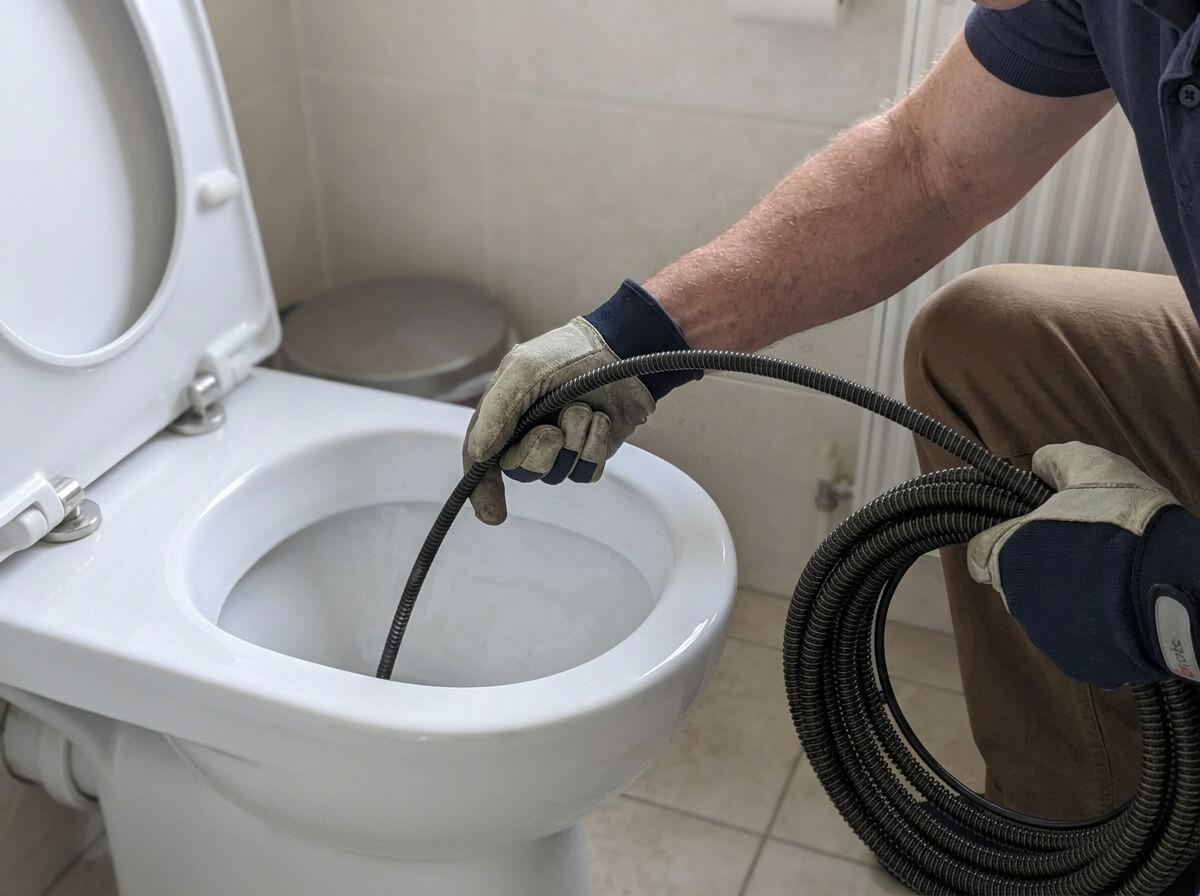
Most main drain blockages are cleared from the manhole below them, working back up the pipe, so the sewage drains away from the house rather than being pushed back into it. Blockages at the base of the soil stack or close to the toilet can be cleared from inside with a drain auger.
Test it properly
Once it is moving, I run water through every fitting in the house, flush every toilet and watch the manholes, so we know the whole drain is flowing and not just the first few metres.
Tell you what caused it
Wipes, fat, nappies and sanitary products cause most blockages I clear. If it was roots, a collapsed or dipped pipe, or an interceptor stopper, I will tell you, and if it keeps happening, a camera survey will show what needs repairing. You get a fair price agreed before any work starts.
You can see more about how I deal with blocked drains on my drain unblocking and blocked toilet repair pages.
How to Stop Sewage Coming Up Again
- ●Only flush the three Ps. Pee, poo and paper. Wet wipes, including ones labelled flushable, do not break down and are behind more blocked drains than anything else.
- ●Keep fat out of the sink. Let cooking fat cool, then scrape it into the bin. Hot fat sets hard in the cold drain outside.
- ●Fit hair catchers in showers and baths. They cost a few pounds and stop the hair and soap that build up in shared waste pipes.
- ●Look in your manhole once or twice a year. If the water is sitting high or there is a build up of paper, deal with it before it backs up into the house.
- ●Act on the early signs. Gurgling, slow drains and a smell outside are the drain telling you it is starting to block. See my guide to a sewage smell in the house if that is what you are noticing.
- ●Get recurring blockages surveyed. If it has happened twice, something in the drain is catching waste, such as roots, a cracked or sunken pipe, or a displaced joint. A camera survey finds it so it can be fixed for good.
Sewage Coming Up in Your Ipswich Home? Call Philip
If sewage or dirty water is coming up in your shower, bath, sink or toilet and it is your own drain, call me on 07977 857224, 24 hours a day, seven days a week. I cover Ipswich, Felixstowe, Woodbridge, Kesgrave, Martlesham, Stowmarket and the villages in between, and for local emergencies I am usually with you in about 30 minutes. If you are not sure whether it is your drain or the sewer, ring anyway and I will help you work it out over the phone. For other urgent problems, see my guide to when a blocked drain is an emergency, or everything else on the emergency plumbing services page.