A leaking stopcock is an unsettling thing to find. It is the one valve in the house you are meant to rely on when something goes wrong, and now it is the thing dripping into the cupboard under the sink. The good news is that most stopcock leaks are slow weeps from one of two places, and both can often be cured with a spanner and a quarter turn, no parts needed.
I have been a plumber in Ipswich for more than forty years, and leaking stopcocks are a call I get every week, very often from someone who has just read that they should test their stopcock and did exactly that. Old brass stopcocks that have not moved in twenty years are happy until you turn them, and then the seal round the spindle lets go. Our hard Suffolk water makes it worse, coating spindles in scale. This guide walks you through what to do now, how to find exactly which part is leaking, the fixes in the right order, and when it is a job for a plumber.
Stopcock Leaking? Do These 5 Things First
Catch the water and protect the floor
Put a bowl, a baking tray or a plastic tub under the stopcock and lay towels round it. Take everything out of the cupboard. Water that runs under kitchen plinths, into laminate or between floorboards does far more damage than the drip itself, and you will not see it until the floor lifts. If water is near sockets, plugs or an appliance, switch them off at the consumer unit.
Decide how bad it is
A slow weep, a drop every minute or so, can wait for a repair in a day or two. A steady drip that fills a cup in an hour needs fixing today. A spray, a stream, or water coming out of the brass body itself is an emergency: go straight to step 5.
Dry it and find exactly where it comes from
Wipe the stopcock, the nuts and the pipe completely dry with kitchen roll. Then watch, or wrap a separate square of tissue round the spindle, each nut and the pipe either side. Water runs downhill and gathers at the lowest point, so the drip you see is often not where the leak starts. The first tissue to darken is the culprit. The table below tells you what each spot means.
Try a quarter turn, holding the body still
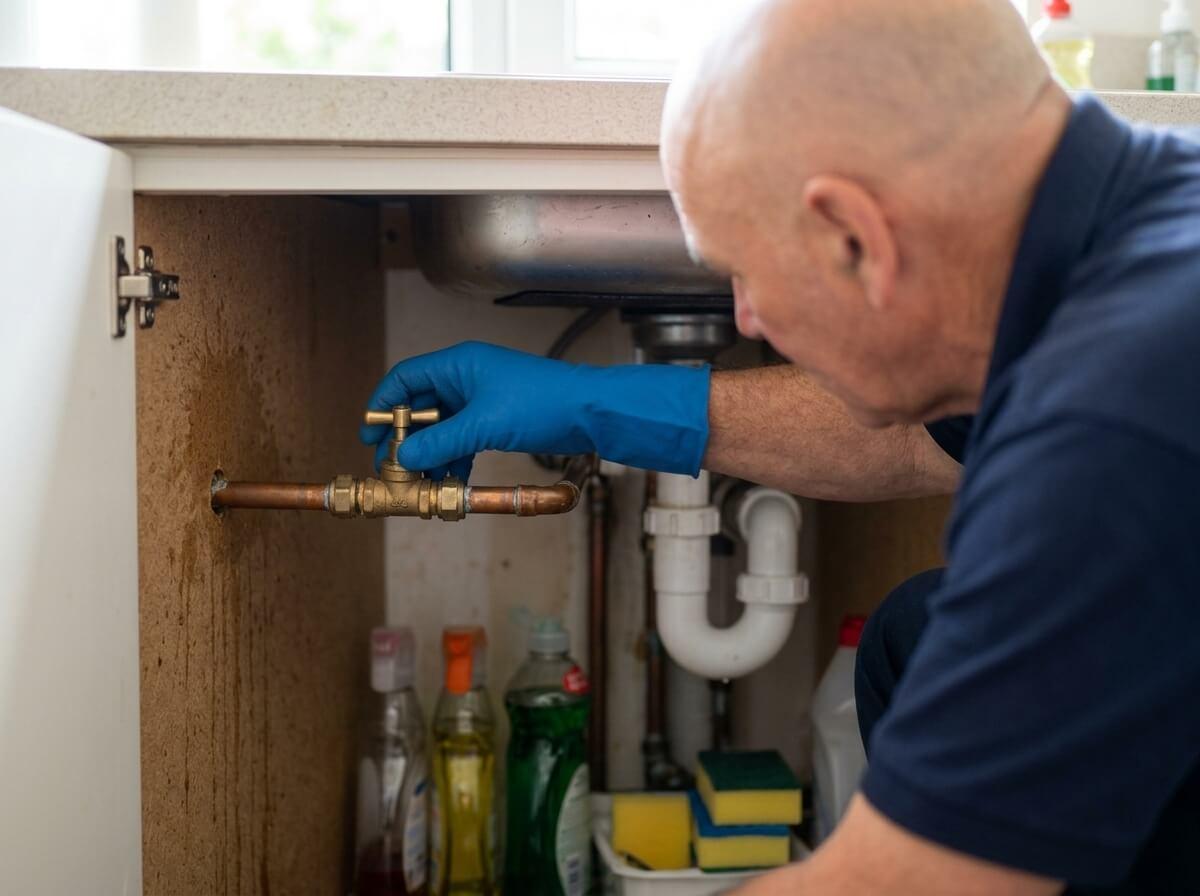
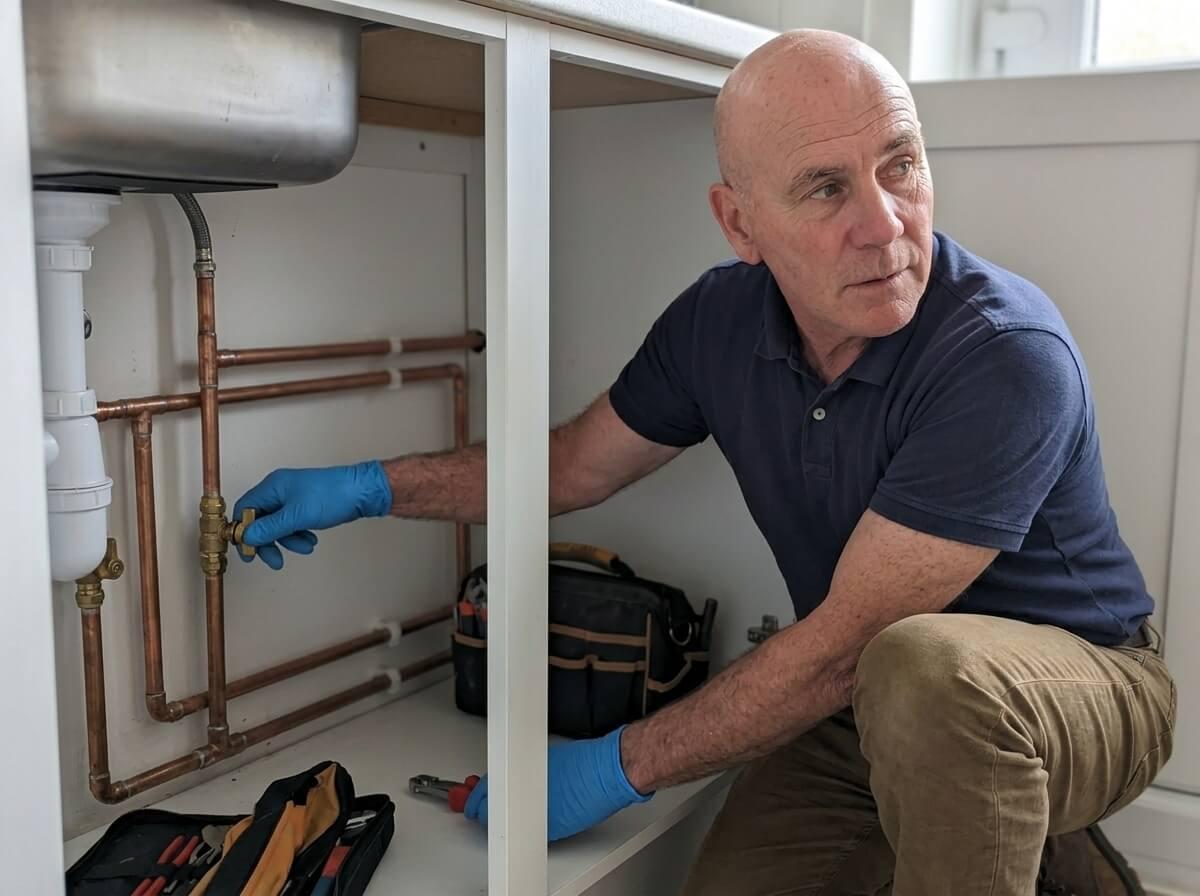
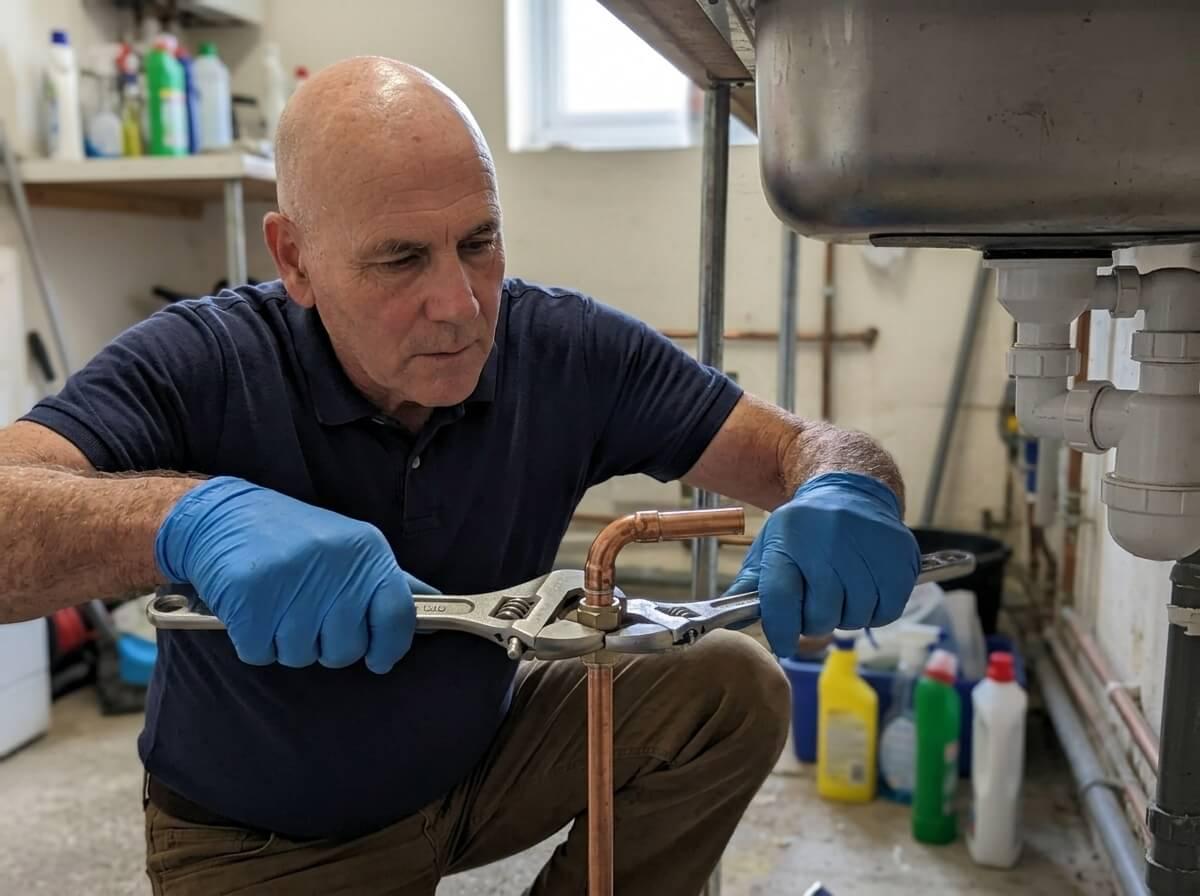
For a weep from the spindle or a compression nut, a quarter turn is often all it needs. Use two spanners: one to hold the stopcock body still, one to turn the nut. Without the second spanner you twist the whole stopcock and can crack an old joint or the pipe below it. The fixes section further down explains which nut to turn and which way.
If it will not stop, turn off the outside stop tap
If the stopcock itself is the leak, closing it may not help, because the water is coming from the mains side. The outside stop tap in the pavement or front garden cuts the supply before it reaches the house. Then open the cold kitchen tap to drain the pipe. My guide on how to locate your stopcock shows where both valves usually are.
Where Is Your Stopcock Leaking? Match the Leak to the Fix
There are only a handful of places a stopcock can leak from, and each one points to a different part. Find the row that matches what you can see.
| WHERE THE WATER IS | WHAT HAS FAILED | DO THIS NEXT |
|---|---|---|
| Round the spindle, just under the handle | Worn or dried-out gland packing, very often after the stopcock has just been turned | Nip the gland nut up a quarter turn or less. If it still weeps, the gland needs repacking. |
| Under the handle, but only when the stopcock is open | The gland again: it is only under pressure when the valve is open | Same fix as above. Until then, a bowl underneath is fine for a slow weep. |
| Where the pipe enters the stopcock from below (the inlet nut) | A loose compression nut or a worn olive on the incoming main. Leaks whatever the handle position | Hold the body and tighten the nut a quarter turn. If that fails, the olive needs replacing with the outside stop tap off. |
| Where the pipe leaves the stopcock (the outlet nut) | A loose compression nut or worn olive on the house side | Hold the body and tighten a quarter turn. Close the stopcock first and this joint has no pressure on it. |
| Between the top section and the body (the headgear joint) | A perished fibre washer under the headgear, or the headgear has worked loose | A gentle tighten may help. Otherwise new washer, which needs the outside stop tap off. |
| From the small side tap or cap on the stopcock | The drain-off is slightly open, its cap is loose, or its little washer is worn | Close the square spindle gently clockwise and refit the cap. Still dripping means a new washer or stopcock. |
| From the brass body itself, a pinhole, crack or green crust | Corrosion, frost damage or a crack. The body cannot be repaired | Replace the stopcock. Treat a spray as an emergency and turn off the outside stop tap. |
| Plastic stopcock on blue pipe, or a remote stopcock with a switch | A push-fit joint not fully home, a missing pipe insert, or a damaged seal | Do not try to pull or twist the fitting. Outside stop tap off and call a plumber. |
| Pavement or garden chamber, at the outside stop tap or meter | A fault on the water company's valve, meter or pipe | Report it to your water company. In Ipswich that is usually Anglian Water. |
| Damp all along the pipe, beads of water but no single drip | Probably condensation on the cold main, not a leak | Do the tissue test below. If it is condensation, insulate the pipe. |
The Parts of a Stopcock, and Why Each One Leaks
Knowing what is inside a stopcock makes the fixes make sense. A traditional UK brass stopcock is a small screw-down valve, and from top to bottom it has:
- ●The handle and spindle. The crutch or wheel handle turns a threaded spindle that runs down into the valve.
- ●The gland nut and packing. A small nut just under the handle squeezes packing, traditionally greased hemp or a rubber ring, round the spindle so water cannot escape as it turns. This is where most stopcock leaks start.
- ●The headgear. The larger hexagon that screws into the body. It holds the spindle and seals to the body with a fibre washer.
- ●The jumper and washer. At the bottom of the spindle, a small washer presses down onto a seat to shut the water off. A worn washer is why an old stopcock turns but never quite stops the water.
- ●The body and compression nuts. The brass body has a nut at each end, each squeezing a brass ring called an olive onto the pipe. An arrow on the body shows the direction of flow.
- ●A drain-off, on some. A little side outlet with a square spindle, used to drain the pipework above the stopcock.
Why Your Stopcock Started Leaking After You Turned It
This is the single most common stopcock leak I am called out for. The stopcock has sat untouched for years, someone turns it off to test it or to change a tap, and when it is turned back on, water starts weeping from under the handle.
What has happened is simple. The packing round the spindle has dried out and set hard in one position. As long as nothing moved, it held. Turning the spindle breaks that seal and scrapes off any scale that was helping it, and the old packing cannot spring back. Nothing is broken, and you were right to test it: far better to find a weak stopcock now than at two in the morning with a burst pipe. In most cases nipping up the gland nut cures it. If it does not, the gland needs repacking, a ten-minute job for a plumber.
If your stopcock is so stiff that you are worried about forcing it, stop before it gets to a leak. My guide on a stopcock that is stuck or seized explains how to free one safely without snapping the spindle.
Why It Only Leaks When the Stopcock Is Open
Many people notice their stopcock leaks when it is on and stops when it is off, and wonder if that means it is fine. It is a useful clue. On a UK stopcock the mains water comes in underneath the washer. When the stopcock is closed, the top half of the valve, where the spindle and gland are, is cut off from the mains and has no pressure in it. Open it, and the gland is under full mains pressure again.
- ●Stops when closed: the leak is the gland, the headgear washer or the outlet-side nut. All of these can be worked on with the stopcock closed, as long as it shuts off properly.
- ●Leaks open or closed: the leak is on the inlet side, at the bottom nut or the body below the washer. That side is always under pressure, so any work beyond a quarter turn needs the outside stop tap off.
- ●Leaks and will not shut off: the washer is worn as well as the gland. The stopcock is not doing its job and needs replacing.
Is It a Leak or Just Condensation? The Tissue Test
The rising main carries cold water straight from the ground, and in a warm kitchen, a cupboard next to the boiler or a steamy utility room, the pipe and stopcock often sweat. I get calls every summer about leaking stopcocks that turn out to be condensation. To tell the difference:
Dry everything
Wipe the stopcock, nuts and a good length of pipe either side completely dry.
Wrap separate tissues
Wrap one square of tissue round the spindle, one round each nut, and one round a plain length of pipe away from any fitting.
Check after 30 minutes
Condensation dampens all the tissues, including the plain pipe, evenly. A leak soaks one tissue first and much more heavily, with a drip forming at the bottom of that fitting. If it is condensation, foam pipe insulation over the pipe and a little air round the cupboard cures it.
How to Fix a Leaking Stopcock
Work through the fix that matches where your leak is. You need two adjustable spanners or grips, a torch and some kitchen roll. Turn anything gently: old brass is soft, and a nut that feels as if it is getting looser rather than tighter is stripping.
1. Leaking from the spindle: tighten the gland nut
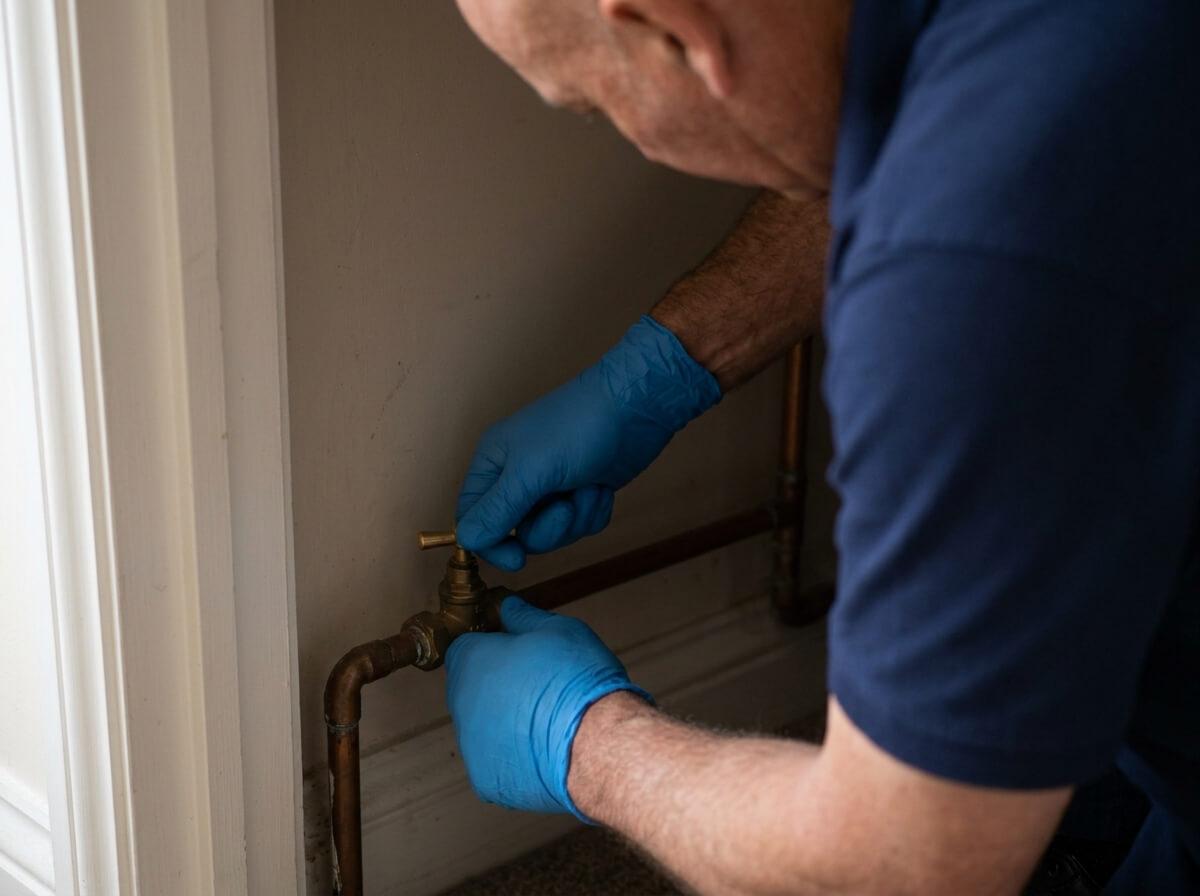
The gland nut is the small nut immediately under the handle, the one the spindle passes through. Hold the stopcock body with one spanner. With the other, turn the gland nut clockwise, looking down on it, by no more than a quarter turn. Dry it and watch for ten minutes. If it still weeps, give it another eighth of a turn. Then turn the handle a little each way to check it still moves. If the handle has become very stiff, you have gone too far: back the nut off slightly. A stopcock you cannot turn in an emergency is worse than one that weeps.
2. Still leaking from the spindle: repack the gland
If tightening has not stopped it, the packing has had it. With the stopcock closed, so the gland is not under pressure, the gland nut is undone and slid up the spindle, the old packing picked out, and new packing or a few turns of PTFE tape wound round the spindle and pressed into the gland before the nut is refitted. It is a quick job for a plumber. If you try it yourself and the stopcock does not shut off fully, water will come out of the gland as soon as the nut is loose, so have the outside stop tap off first.
3. Leaking where the pipe joins: the compression nuts
Hold the body still and tighten the leaking nut a quarter turn clockwise, as you look at the nut from the pipe side. That is enough to stop most weeps. If it still leaks, the olive inside is worn, damaged or was never seated properly. Replacing it means the water off, the nut undone, the old olive cut off and a new one fitted, with a smear of jointing compound on the new olive. If the leaking nut is on the inlet side, the outside stop tap has to be off for that.
4. Leaking at the headgear
If water is coming from the joint between the big hexagon and the body, the headgear may have worked loose, or the fibre washer under it has perished. Holding the body, a small nip on the headgear can stop it. If not, the headgear comes out for a new washer, which needs the supply off at the outside stop tap. While it is out, I usually fit a new jumper and washer too, so the stopcock shuts off properly.
5. Plastic stopcocks, push-fit and remote stopcocks
Newer homes often have a plastic stopcock on the blue mains pipe, or a push-fit stopcock on plastic pipe. Some have a remote stopcock operated by a switch on the kitchen wall. These usually leak at a push-fit joint where the pipe has not been pushed fully home, was cut at an angle, or is missing the metal insert plastic pipe needs. Do not tug or twist a push-fit joint to try to reseat it under pressure. Turn the supply off at the outside stop tap and have the joint remade.
How to Turn the Water Off When the Stopcock Is the Leak
If the leak is on the inlet side, or the stopcock will not shut off, the only way to stop the water is before it reaches the house. Here is how:
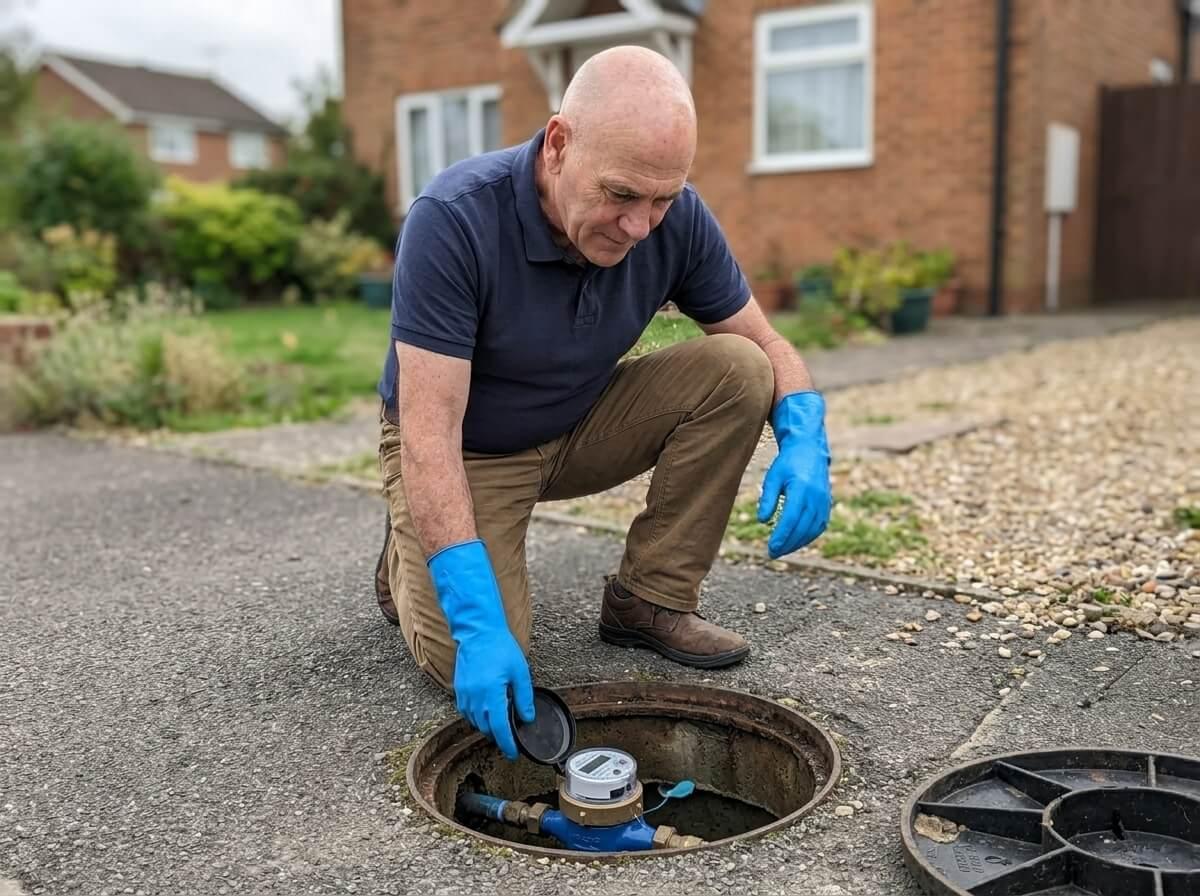
- ●Find the outside stop tap. It is usually under a small round or square cover in the pavement outside your property or at the edge of your front garden, often marked W or WATER. On newer homes it is often in the same chamber as the water meter.
- ●Turn it clockwise. Many sit at the bottom of a narrow pipe and need a long stopcock key from a hardware shop. Some newer ones turn by hand. Turn until the water stops.
- ●Drain the pipe. Open the cold kitchen tap and leave it open. The leak will slow and stop as the pressure drops.
- ●Check it is yours. In older Ipswich terraces, one outside stop tap sometimes feeds two or three houses. If yours is shared, tell your neighbours before you turn it off, and use it only for as long as you need.
- ●If it will not turn or you cannot find it, call a plumber. I can isolate the supply, and if the outside stop tap is faulty I can freeze the pipe with a pipe freezing kit so the stopcock can be replaced without waiting for the water company.
Repair or Replace a Leaking Stopcock?
A gland or nut weep on a sound stopcock is a repair. But a stopcock is cheap, and the whole point of it is to work first time in an emergency. I recommend replacing it if:
- ●It will not turn the water off fully. Close it and open the cold kitchen tap. If water keeps running after a minute, the washer or seat is worn.
- ●The body is cracked, pitted or crusted green. Corrosion on the body means it is being eaten away, and brass that has been frozen can split.
- ●The spindle is bent or the handle is loose or rounded. You will not be able to turn it when you need to.
- ●It has seized, or is so stiff you need tools to turn it. Forcing an old stopcock is how spindles snap.
- ●It keeps leaking after the gland has been repacked. The spindle itself is worn or scored.
When I replace a stopcock, I fit a new approved stopcock with the flow arrow the right way round and often add a lever-operated quarter-turn valve, which shuts the water off with one movement of the hand. If you have old lead pipe coming in, I will tell you, because disturbing lead can start new leaks and it is worth knowing your options.
Who Is Responsible for a Leaking Stopcock?
Who pays depends on which side of your boundary the leak is. In Ipswich and most of the surrounding area the water company is Anglian Water, but your bill will confirm who supplies you.
| WHAT IS LEAKING | WHO OWNS IT | WHO TO CALL |
|---|---|---|
| Stopcock inside your home | The homeowner | A plumber. If you rent, report it to your landlord, who arranges the repair. |
| Pipe from your boundary to the stopcock (the supply pipe) | Usually the homeowner | A plumber. Check your home insurance, which often covers supply pipe leaks. |
| Outside stop tap in the pavement or front garden | The water company | Your water company. Anglian Water for most of Ipswich and the surrounding area. |
| Water meter and the fittings either side of it | The water company | Your water company. Do not try to tighten a meter fitting yourself. |
| Stopcock or pipe serving more than one flat or house | Usually the freeholder or the owners jointly | The managing agent or freeholder. In an emergency, anyone can still turn the water off. |
If you have found water outside, in the garden or the pavement, rather than at the stopcock, my guide on a water leak outside your house explains how to tell whose side of the boundary it is on.
What Not to Do
- ✕Do not crank the gland nut down hard. It stops the leak but locks the spindle, so the stopcock will not turn in an emergency.
- ✕Do not use one spanner on its own. Turning a nut without holding the body twists the stopcock and can crack the joint or pipe beneath it.
- ✕Do not undo anything on the inlet side with the mains on. That side is always under pressure, whatever position the handle is in.
- ✕Do not wrap tape or sealant round the outside of a leaking joint. It hides the leak for a while, and water keeps working into the cupboard behind it.
- ✕Do not ignore a slow weep for months. A constant drip rots kitchen plinths, cupboard bases and floor timbers, and limescale builds up until the stopcock seizes.
- ✕Do not repair or tamper with the outside stop tap or meter. You can turn it off in an emergency, but repairs are the water company’s job.
Renting or in a Flat?
If you rent, the stopcock is part of the water installation, and keeping that in repair is your landlord’s responsibility. Report a leaking stopcock in writing, with a photo, and put a bowl under it in the meantime. You can still turn the water off in an emergency, and you should. In a block of flats, find out whether your stopcock serves only your flat. If it serves others, or if the leak is on a shared riser, tell the managing agent or freeholder straight away, and warn the flats below.
Leaking Stopcock in Ipswich? Call Philip
If your stopcock is leaking, will not shut off, or you just want a stopcock you can trust, call me. I carry stopcocks, gland packing, olives, lever valves and a pipe freezing kit on the van, so most leaking stopcocks are repaired or replaced on the first visit, even if the outside stop tap will not turn. You will get a clear, fair price agreed before I start.
I cover Ipswich, Felixstowe, Woodbridge, Kesgrave, Stowmarket and the surrounding towns, and I answer the phone myself, 24 hours a day, seven days a week, on 07977 857224. If you have damp near the stopcock but cannot see where it is coming from, our leak detection service will trace it. If the pipe into the stopcock has split, our burst pipe repair page explains what happens next. Or see everything else on the emergency plumbing services page.