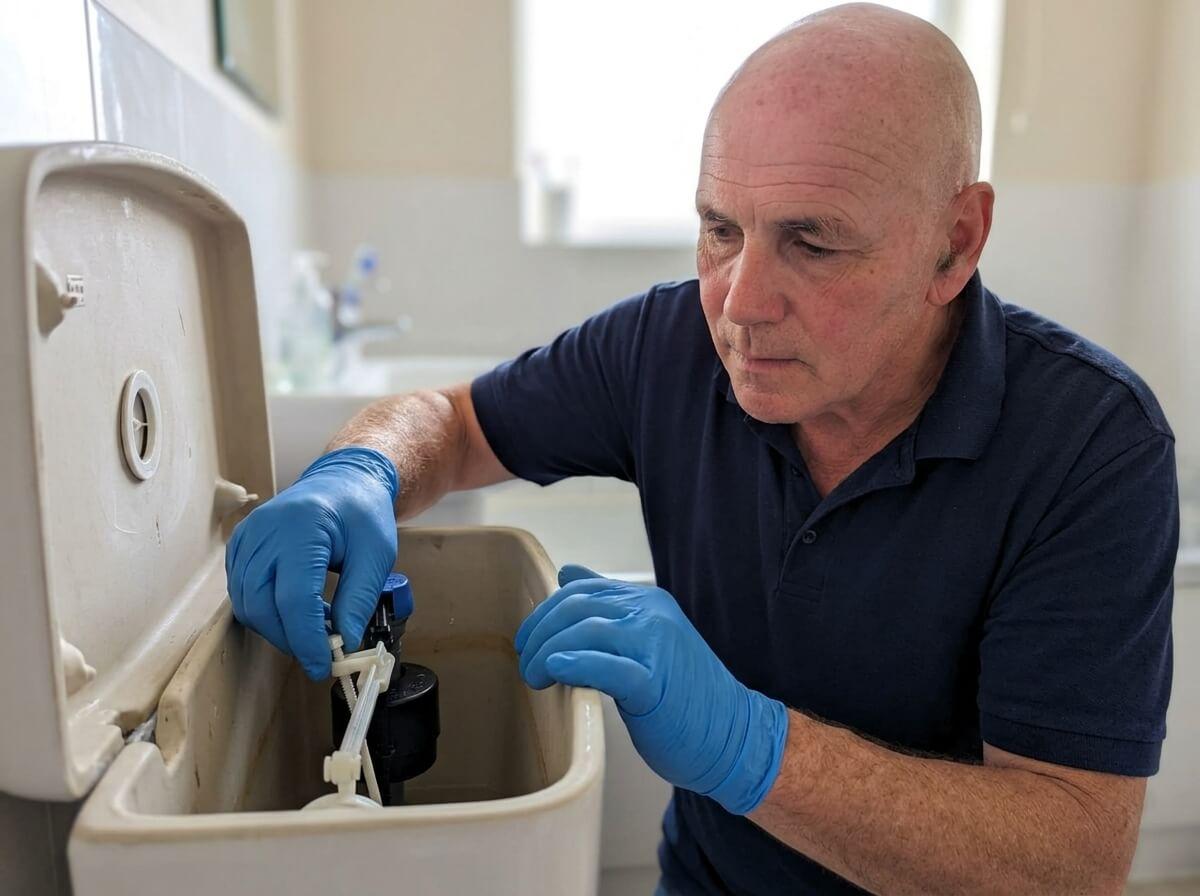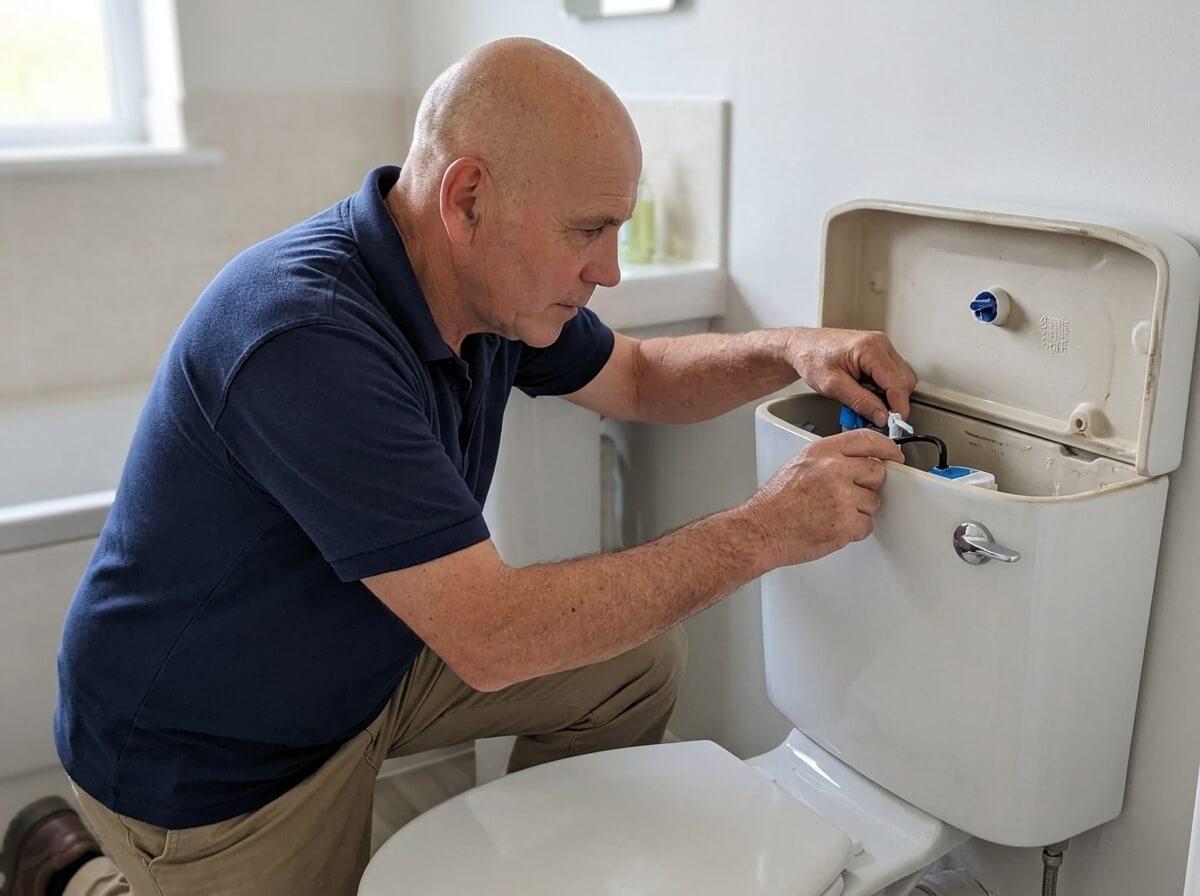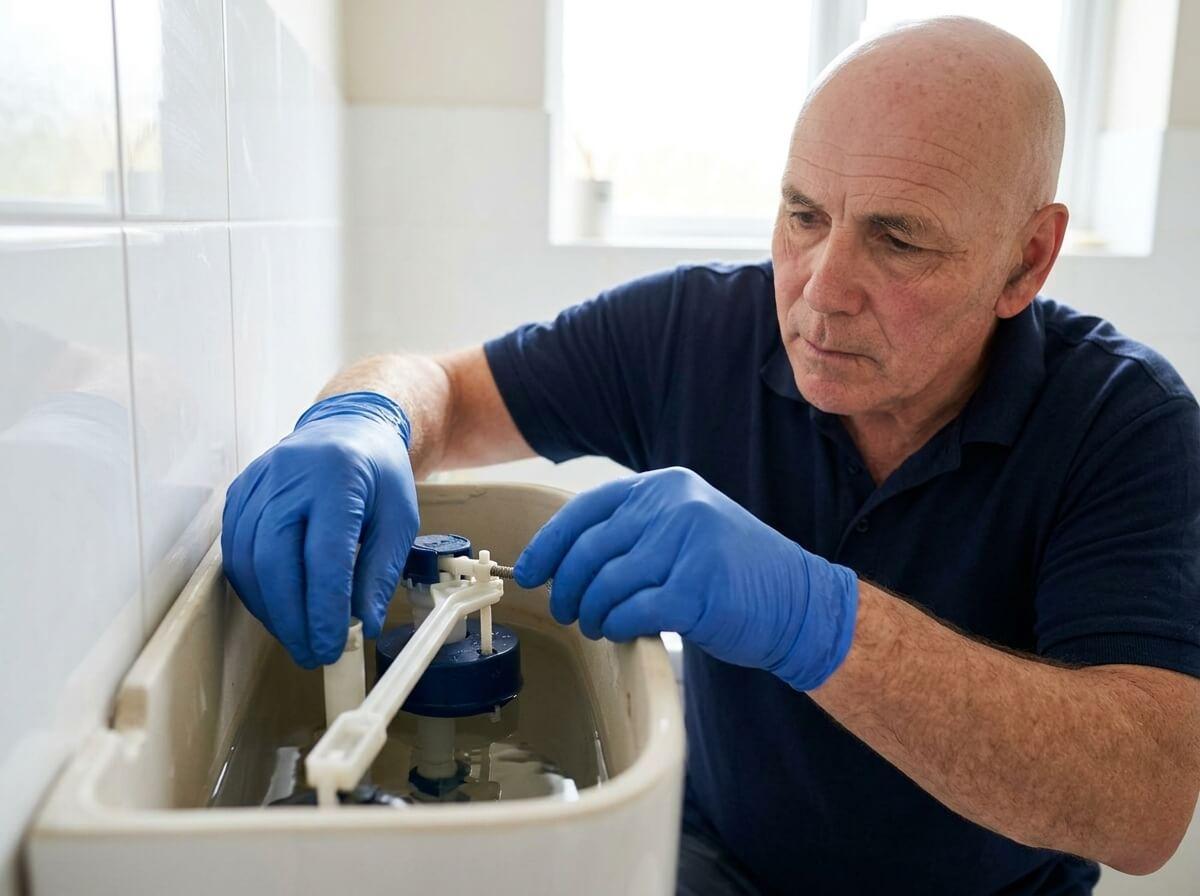
It starts as a faint trickle you only notice at night. Then the cistern hisses into life for a few seconds every so often, when nobody has been near it. Or you flush, walk away, and five minutes later it is still running. A toilet that will not stop running is one of the most common calls I get, and one of the most ignored, because it does not look like an emergency. Nothing is dripping on the floor and the toilet still works.
The trouble is what it costs you quietly. WaterSafe, the plumbing approval scheme run with the UK water companies, says a toilet leaking from the cistern into the pan can waste up to 400 litres a day, and that about one home in ten has one. If you are on a water meter, that is real money going straight down the pan. I have been a plumber in Ipswich for more than forty years, and the good news is that a running toilet only ever has a handful of causes. Most of them you can find in two minutes with the lid off, and plenty you can fix yourself. This guide is written for the push-button, lever and concealed cisterns in British bathrooms, not the American tank toilets most online advice is based on.
Toilet Keeps Running? Do These 4 Things First
Check the water is not coming over the top
Look at the pan and the cistern. If water is rising towards the rim of the pan, or coming out of the cistern onto the floor, this is not a running toilet any more, it is a flood. Turn the water off at the isolation valve, or at the stopcock if that will not turn, and see my guide on what to do when a toilet is overflowing.
Turn off the isolation valve
On the pipe that feeds the cistern there is usually a small valve with a screw slot or a little lever, either under the cistern, on the side, or in the boxing beside it. Slot along the pipe is on. Turn it a quarter turn with a flat screwdriver or a coin so the slot is across the pipe, and the cistern stops refilling. My isolation valve guide shows the different types and what to do if it will not budge.
Lift the lid and look at the overflow
Unscrew the push button first if it is the screw-in type, lift the lid off and put it somewhere flat on a towel. Find the overflow: on most modern cisterns it is a plastic tube built into the flush valve in the middle, open at the top. Is the water level right up at the top of that tube, or below it? That one look tells you which half of the cistern has failed.
Turn the water back on and watch one refill
Open the isolation valve again and watch the cistern fill. It should rise steadily, the float should lift, and the water should stop with a click a couple of centimetres below the top of the overflow. If it keeps rising, the fill valve is the problem. If it stops but you can still see or hear water moving into the pan, the flush valve is the problem. Turn it off again if you cannot fix it straight away.
How a Toilet Cistern Should Behave After a Flush
To spot what is wrong, it helps to know what right looks like. Every flush on a healthy cistern follows the same cycle, and a running toilet is simply one where that cycle never finishes.
- ●The flush empties the cistern. On a push-button toilet, the button lifts the flush valve off a rubber seal at the bottom of the cistern and the water drops into the pan. On a lever toilet, the lever lifts a plate inside the siphon and the siphon drains the water over a bend.
- ●The outlet closes again. The flush valve drops back onto its seal, or the siphon breaks with a gulp of air. From that moment, no water should pass from the cistern into the pan until the next flush.
- ●The fill valve refills it. As the water level falls, the float drops and opens the fill valve. On mains pressure, a cistern normally refills in under two minutes. Fed from a tank in the loft, it can take a little longer.
- ●The float shuts the water off. As the water rises, so does the float, until it closes the fill valve. The water should stop about 2 to 3 cm below the top of the overflow and the cistern should then go completely silent.
- ●The overflow is a safety net, not a drain. It only exists to catch water if the fill valve fails. In a cistern that is working properly, no water ever goes down it.
That gives you a simple rule I use on every job. Water can only escape a full cistern two ways: over the top of the overflow, or past the flush valve or siphon at the bottom. Over the top means the water is coming in when it should not. Past the bottom means the water is going out when it should not. Everything else in this guide is detail.
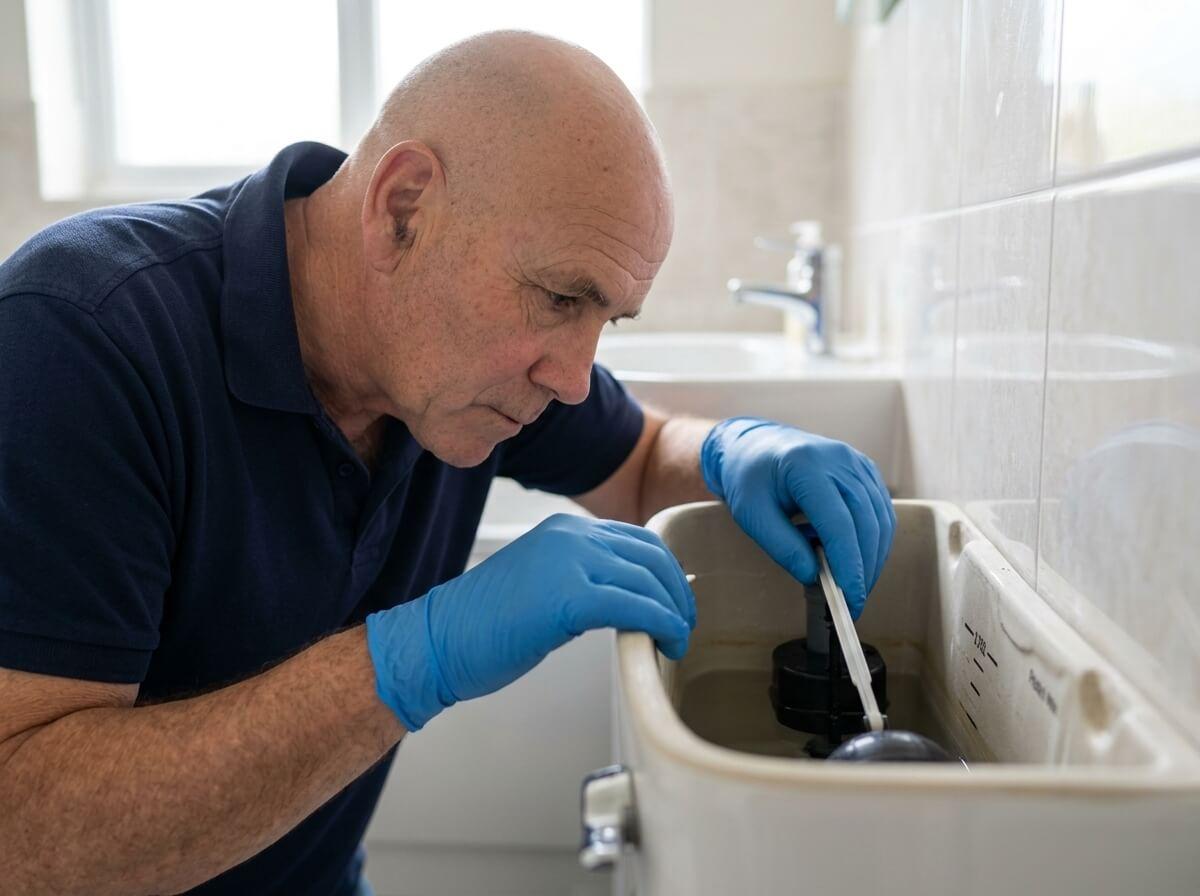
Running Toilet Finder: What Your Cistern Is Telling You
These are the patterns I listen and look for when somebody rings to say their toilet will not stop running. Find the row that matches what you can see or hear. The last two columns tell you whether it is usually a DIY job and how quickly it needs sorting.
| WHAT YOU NOTICE | LIKELY CAUSE | DIY FIX? | URGENCY |
|---|---|---|---|
| Water level is right up at the top of the overflow tube and trickling over it | The fill valve is not shutting off: float set too high, float rubbing on the cistern wall, or a worn washer or diaphragm in the valve. | Usually | Fix this week |
| Water level sits below the overflow, but a thin stream runs down the back of the pan all the time | The flush valve seal at the bottom of the cistern is not sealing: limescale, grit, a hair or a perished rubber seal. | Usually | Fix this week |
| Cistern hisses and refills for a few seconds every few minutes, with nobody using it | A slow leak past the flush valve seal (a ghost flush). The refill is the symptom, not the fault. | Usually | Fix this week |
| Keeps running after a flush until you press or wiggle the button again | The flush valve is not dropping back squarely: a sticky dual-flush button, a lid out of line, or a cable or rod holding it up. | Usually | Fix this week |
| Push button stays down or feels stiff | Limescale in the button, a button rod set too long, or the lid pressing on the valve. | Usually | Book in, not urgent |
| Runs mainly at night, quiet during the day | Mains pressure rises overnight and pushes past a tired fill valve washer or a float set right at its limit. | Sometimes | Book in, not urgent |
| Started running straight after the water was off for work in the street or in the house | Grit or a flake of scale from the mains is stuck in the fill valve seat, holding it slightly open. | Usually | Fix this week |
| Cistern never fills, and water pours straight into the pan | The flush valve has dropped off its seat, come unclipped or the seal has split or fallen off. | Sometimes | Fix this week |
| Water dripping or running from a pipe outside, below the bathroom window | An older cistern with an external overflow. The fill valve or float is letting the level rise too high. | Sometimes | Fix this week |
| Concealed cistern behind a panel, water running into the pan | The same parts as a normal cistern, but reached through the flush plate opening. Usually the flush valve seal. | Sometimes | Fix this week |
| Water rising in the cistern above the overflow, or coming out over the top | The fill valve has failed open and the overflow cannot keep up, or the overflow tube is cracked or set too high. | Call a plumber | Call now |
| Toilet will not stop running and the isolation valve will not turn | A seized isolation valve on top of a failed fill or flush valve. The water has to go off at the stopcock. | Call a plumber | Call now |
Where Is the Water Going? 5 Simple Tests
Sometimes it is obvious. Often it is not, especially with a slow leak that never makes a sound. These are the tests I use, from the quickest to the most thorough. You do not need any special kit for any of them.
| TEST | HOW TO DO IT | WHAT IT TELLS YOU | TIME |
|---|---|---|---|
| Lid-off look | Lift the lid after the cistern has refilled and look at the top of the overflow tube. | Water at or over the top of the overflow means the fill valve. Water below it means look at the flush valve. | 1 minute |
| Pencil line | Turn off the isolation valve and draw a pencil line at the water level inside the cistern. | If the level drops below the line, water is escaping past the flush valve. If it holds, the flush valve is sealing. | 30 minutes |
| Tissue test | Dry the back of the pan, then lay a dry sheet of toilet paper where the flush water enters. Leave it. | Wet or torn paper means water is running from the cistern into the pan. | 3 hours to overnight |
| Colour test | Add a few drops of food colouring to the cistern. Do not flush. | Colour in the pan means the flush valve or siphon is leaking. | 30 minutes |
| Meter test | With every tap and appliance off, read the water meter, wait an hour, read it again. Repeat with the toilet isolated. | If the meter moves with the toilet on but stops with it isolated, the toilet is the leak. | 2 hours |
The tissue test
This is the test WaterSafe recommends for a leaky loo, and it catches the silent leaks you will never hear. About half an hour after a flush, wipe the back of the pan dry with toilet paper, just under the rim where the flush water comes in. Then lay a fresh, dry sheet across that area so it touches the porcelain. Leave the toilet unused for three hours, or overnight. If the sheet is damp or torn when you come back, water is running from the cistern into the pan. Some water companies also hand out free leak detection strips that work the same way, so it is worth asking Anglian Water.
The colour test
Take out any blue in-cistern cleaning blocks first. Add a few drops of food colouring to the water in the cistern, enough to give it a strong colour. A spoonful of instant coffee works too. Put the lid back and do not flush for half an hour. If any colour shows in the water in the pan, the flush valve or siphon is leaking. Flush afterwards to clear the dye. Leaks can come and go, so if it is clean the first time but you are still hearing refills, try again overnight.
The pencil line test
This one separates the two causes neatly. With the cistern full, turn off the isolation valve and draw a line on the inside of the cistern at the water level. Come back in half an hour. If the level has dropped, the water is escaping past the flush valve at the bottom, because with the supply off there is nothing else it can do. If the level has not moved, the flush valve is sealing, and the running you were seeing is the fill valve letting too much in and spilling down the overflow.
The water meter test
If your water bill has jumped and you are not sure whether it is the toilet, use the meter. Turn off every tap, the washing machine, the dishwasher and any outside taps, and make sure nobody uses water. Read the meter, wait an hour, and read it again. If it has moved, turn off the isolation valve on each toilet and repeat. If the meter stops once the toilets are isolated, you have found your leak. If it still moves, the leak is somewhere else, and my guide to the signs of a hidden water leak will help you track it down.
Cause 1: The Fill Valve Is Not Shutting Off
If the water in your cistern is right up at the top of the overflow tube, with a thin stream running over the lip and down inside it, the cistern is overfilling. The fill valve is letting water in after the cistern is full, and the overflow is doing its job by sending the extra into the pan. On older cisterns with an outside overflow pipe, this is the fault that sends water dripping down the wall below the bathroom window, which I cover in my guide to an overflow pipe dripping outside. There are four reasons it happens.
The float is set too high
This is the first thing to check and the easiest to fix. If the float is set so high that it only shuts the valve once the water is already at the overflow, any slight movement, or a small rise in pressure, tips it over. You want the water to stop 2 to 3 cm below the top of the overflow. How you lower it depends on the valve:
- ●Modern top-entry or bottom-entry valves: the tall plastic valve with a float that rides up and down a central column. Most have a clip, a twist collar or a long plastic screw that sets the height of the float. Lower the float a centimetre at a time, turn the water on and let it fill, and check where it stops.
- ●Valves with a float on a short arm: like the one in the photo at the top of this page. There is usually a plastic adjusting screw where the arm meets the valve. Turning it changes the angle of the arm, and so the level the float closes at.
- ●Old ball valves with a long brass arm: often found in older bathrooms and loft tanks. Some have an adjusting screw. On a brass arm with no screw, you can gently bend the arm downwards with both hands, holding the valve end steady so you do not strain the valve or the pipe.
The float is catching
If the float rubs on the side of the cistern, the flush valve or the overflow, it can stick part way up and never rise far enough to close the valve. You will often see it sitting at an angle. Move it so it rises freely, and check nothing has been knocked out of line when the lid was last put back. On cisterns where the float is close to the flush valve, a quarter turn of the fill valve body can give it the clearance it needs. A float with water inside it, which you can hear sloshing when you shake it, will not lift properly and needs replacing.
Grit or limescale in the valve
If your toilet started running straight after the water was off, either for street works or for a job in the house, a speck of grit or a flake of scale from the pipes has probably lodged in the valve seat. It holds the seal a fraction open and water creeps past. Most modern fill valves have a cap or top section that unscrews or twists off. With the water isolated, take the top off, hold a cup over the open valve, and turn the isolation valve on and off briefly to flush water through. That usually clears it. Many valves also have a small filter on the inlet, which is worth rinsing at the same time. Ipswich water is hard, and I find scale in fill valves all the time.
A worn washer or diaphragm
Inside every fill valve there is a rubber washer or a flexible diaphragm that the float pushes against the inlet to shut the water off. After a few years it hardens, gets a groove worn in it, or picks up scale, and it stops sealing fully. A tired washer is also why a toilet runs more at night: mains pressure rises when the rest of the street goes to bed, and the extra push gets past a seal that just about held during the day. Some valves have a replaceable washer. On many modern valves it is quicker and more reliable to replace the whole fill valve, which is a standard part.
Cause 2: The Flush Valve Seal Is Leaking
If the water is sitting below the top of the overflow but you can still see a thin ripple of water running down the back of the pan, or the cistern refills on its own every few minutes, the leak is at the bottom. On a push-button toilet, that means the flush valve.
Flush valves have been allowed in British toilets since 2001, under the Water Supply (Water Fittings) Regulations 1999, and they are now in most new toilets because they make dual flush easy. The weakness is that they depend on a rubber seal sitting perfectly flat on a plastic seat at the bottom of the cistern. The old lever siphons they replaced could not leak like that, which is why running toilets have become so much more common. Thames Water puts the water lost through leaking toilets across the UK at around 400 million litres a day.
Limescale, grit or a hair on the seal
By far the most common cause I find. A ridge of limescale on the seat, a little grit or a single hair across the seal is enough to let a steady trickle through. With the water isolated, flush to empty the cistern and mop out what is left with a sponge. Most flush valves twist a quarter turn anticlockwise and lift out of a base that stays fixed in the cistern. Some unclip, and some lift out once you release a catch at the side. Look at the rubber seal on the bottom of the valve and the ring it sits on. Wipe both clean, soak off any scale with white vinegar or descaler and a soft cloth, and refit the valve squarely, making sure it locks into its base. Do not use anything abrasive on the seat, because a scratch will leak as badly as the scale did.
A perished or distorted seal
If the seal is hard, cracked, flattened on one side, or swollen, cleaning will not save it. Seals are cheap, but there are a lot of sizes and shapes, so take the valve or the old seal to the plumbers’ merchant, or note the make on the valve. Some in-cistern cleaning blocks and harsh bleach products sitting in the cistern speed up the perishing of rubber seals, which is one reason I would keep cleaning products in the pan rather than the cistern.
A cracked or broken flush valve
If the plastic body of the valve has cracked, a clip has snapped so it no longer locks into its base, or the overflow tube built into it has split, the whole valve needs replacing. On many close-coupled toilets the base of the valve is held to the cistern by a large nut underneath, and the cistern has to come off the pan to change it. That means disturbing the doughnut washer and the cistern bolts, which is where DIY repairs often go wrong. My guide to a toilet leaking from the base explains what can leak there afterwards.
Lever toilets: is it the siphon?
A traditional lever toilet with a siphon very rarely runs into the pan, because a siphon has no seal to leak past. If an older lever toilet is running, it is almost always the fill valve overfilling into the overflow. The exception is a cracked siphon, or a loose siphon nut under the cistern, which tends to show as a drip on the floor rather than water in the pan.
Cause 3: The Button Is Holding the Valve Open
If your toilet keeps running after a flush but stops when you press the button again, give it a wiggle, or lift the lid, the flush valve is not dropping back down onto its seal. The valve is fine. Something is holding it up.
- ●The lid is out of line. The push button sits in the lid directly above the valve. If the lid has been put back slightly off centre, or the wrong way round, the button can rest on the top of the valve and keep it lifted a few millimetres. Refit the lid carefully and try again.
- ●The button rod is too long. Many push buttons have adjustable rods or plungers that reach down to the valve. If they are set too long they press on the valve all the time. Most twist or snap to the right length. There should be a small gap between the bottom of the rod and the valve when the button is up.
- ●The button is sticking. A dual-flush button scaled up with limescale, or with soap and grime around it, may not spring back fully. Unscrew it from the lid, soak it in white vinegar or descaler for an hour, rinse and refit.
- ●A cable has kinked. Some toilets, especially concealed ones and those with the button on the side, work the valve through a cable. A kinked or stretched cable can hold the valve slightly open. Check it runs smoothly and the ends are clipped in properly.
- ●The half flush is catching. On some dual-flush valves the small and large flush are separate parts. If one sticks, the valve hangs open after a flush. A clean and a check that both parts move freely usually sorts it.
Cause 4: Problems With the Overflow Itself
Less common, but worth knowing about. On many modern flush valves the overflow tube is height adjustable or comes in sections. If it has been set too low, the cistern is overflowing at a perfectly normal water level, and you will see water running down it even with the float set right. If it is cracked below the waterline, water gets into the tube and runs into the pan however low you set the level. Either way, check the tube is in one piece, clipped in properly, and its top sits clearly above the level the fill valve shuts off at.
The opposite problem is just as important. An overflow tube set too high, or an old external overflow that is blocked, cannot do its safety job, and a failed fill valve will then fill the cistern until it spills over the top onto the floor. That is when a running toilet becomes an emergency.
Concealed Cisterns: Running Toilets Behind a Panel
Wall-hung toilets and back-to-wall units hide the cistern behind a panel or inside a frame, with only the flush plate showing. The parts inside are the same as a normal cistern, so the same causes apply, but you reach them differently.
- ●Find the isolation valve first. On most frames it sits inside the cistern, reached through the flush plate opening, or behind a small access panel in the boxing.
- ●Take off the flush plate. Most lift upwards and pull out at the bottom, or unclip. Behind it there is usually a removable cover or bracket. Take a photo before you take anything off so you can put it back.
- ●Lift the flush valve out through the opening. Many concealed cisterns are designed so the valve and the fill valve come out through the flush plate hole without touching the tiles. Clean the seal and refit exactly as above.
- ●Check the buttons and their linkages. Concealed buttons work the valve through rods, cables or air tubes. A misadjusted rod is a common cause of a concealed toilet that runs.
If there is no way in without removing tiles, or the frame is an unusual make, this is a job for a plumber who works on concealed cisterns. I carry the common parts and I am used to getting at them through the flush plate opening.
How Much Water and Money a Running Toilet Wastes
People are always surprised by this. A trickle down the back of the pan looks like nothing, but it runs every minute of every day. Water UK polling found that most people think a leaky loo wastes less than 50 litres a day. The real figures are several times that.
| HOW IT RUNS | ROUGH LITRES A DAY | ROUGH LITRES A YEAR |
|---|---|---|
| A refill of a litre or so every 20 minutes (ghost flush) | 70 | About 26,000 |
| A thin, silent ripple down the back of the pan | 200 | About 73,000 |
| A steady trickle you can hear from the landing | 400 | About 146,000 |
| Fill valve running flat out into the overflow | 1,000 or more | Hundreds of thousands |
For a sense of scale, the average person in the UK uses around 140 litres a day for everything. A toilet running at 400 litres a day is like adding three extra people to the household. WaterSafe estimates a leaking toilet can add around £300 a year to a metered bill, and the Waterwise figure for a typical leaking toilet is 200 to 400 litres a day. Most homes in the Anglian Water area are metered, and on a meter you pay for every litre twice: once as water in and again as sewerage out.
One more thing to know. Water companies will sometimes give an allowance on your bill for a leak on your underground supply pipe once it has been repaired, but water lost through a faulty fitting inside the house, like a running toilet, is normally your cost. So it pays to fix it quickly.
Running Toilet Plus Something Else? What It Means
A running toilet sometimes comes with another symptom that changes the diagnosis. These are the combinations I see most.
- ●Running and the flush is weak. If the cistern is running into the pan, it may also never fill to the right level, so every flush is short. Fix the leak and the flush often comes back. If the toilet will not flush at all, see my guide on why a toilet won’t flush.
- ●Running and a bang in the pipes when it stops. A fill valve that snaps shut on mains pressure can cause water hammer, a thud or knock in the pipes. A worn valve that also lets by often does both. My guide to banging pipes explains the fix.
- ●Running and water on the floor. That is a separate leak, usually from the supply connection, the cistern bolts or the seal between the cistern and the pan. Turn the toilet off and find it before it gets into the floor.
- ●Running and the cistern takes ages to refill. Usually grit or scale in the fill valve, or a part-closed isolation valve, which leaves the valve half open and dribbling instead of filling and shutting cleanly.
- ●Running and a dripping pipe outside. Older cisterns and loft tanks have overflows that go outside. If one of those is dripping, the fill valve in that cistern or tank is the cause. Do not ignore it in winter, because a dripping overflow can freeze and block.
- ●Running and the water in the pan is rising. That is a blockage, not a running cistern. Stop flushing and follow my guide on a toilet overflowing.
Is a Running Toilet an Emergency?
Most of the time, no. A toilet running quietly into the pan is wasting water and money, but it is not damaging your home. Turn off the isolation valve, use the toilet with a bucket of water if you need to, and book a repair in normal hours if you cannot fix it yourself. You will not need to pay for an out-of-hours call-out.
It is an emergency, and worth calling me straight away, day or night, if:
- ✕Water is coming over the top of the cistern or out of it onto the floor, because the overflow cannot keep up with a fill valve that has failed fully open.
- ✕You cannot turn it off. The isolation valve is seized or missing, the float trick has not worked, and the stopcock is stiff or you cannot find it. My guide on how to locate your stopcock helps with the second part.
- ✕An outside overflow is pouring down a wall, onto a neighbour’s property, or into a flat below.
- ✕Water is coming through the ceiling below the bathroom. That means a leak, not just a running cistern. See my guide on water leaking through the ceiling.
- ✕It is your only toilet and it is also blocked or you have had to isolate it and it is the only toilet in a house with young children, elderly relatives or someone unwell.
If you are not sure, my guide on what counts as a plumbing emergency has a simple call now, call today or book in table.
Fixes to Try, in Order
Start at the top and work down. The first few cost nothing and take minutes. Turn off the isolation valve and flush to empty the cistern before you take anything apart, and keep a towel and a sponge handy.
| FIX | WHEN IT APPLIES | WHAT YOU NEED | WHO |
|---|---|---|---|
| Lower the float so the water stops 2 to 3 cm below the overflow | Water up at the top of the overflow | Hands, sometimes a screwdriver | DIY |
| Free a float that is catching on the cistern wall or the flush valve | Level creeps up, float sits crooked | Hands | DIY |
| Flush grit out of the fill valve and clean the filter | Started after the water was off, or runs in bursts | Screwdriver, cup, old toothbrush | DIY |
| Refit the lid and push button so the button sits square over the valve | Stops running when you lift the lid | Hands | DIY |
| Descale the push button and the button rod | Button sticks or stays down | White vinegar or descaler | DIY |
| Clean the flush valve seal and the seat it sits on | Thin trickle into the pan, ghost flushes | Cloth, white vinegar, soft scourer | DIY |
| Replace the flush valve seal (washer) | Seal is hard, cracked, misshapen or still leaks after cleaning | Correct size seal for your valve | DIY or plumber |
| Replace the fill valve | Still runs with the float set low, or the valve is old and scaled | Spanners, new valve, bucket, towels | Confident DIY or plumber |
| Replace the whole flush valve | Cracked body, broken clips, or the valve cannot be sealed | New valve to suit the cistern outlet, sometimes cistern off the pan | Plumber recommended |
| Replace a seized isolation valve | You cannot turn the toilet off | Water off at the stopcock, new valve | Plumber |
Replacing a fill valve, briefly
If you are confident with spanners, a fill valve is a fair DIY job on a close-coupled toilet. Turn off the isolation valve, flush, and sponge out the cistern. Put a towel and a bowl under the cistern, then undo the supply connection at the bottom of the valve. Undo the large plastic back nut that holds the valve to the cistern and lift the old valve out. Fit the new one with its washer on the inside of the cistern, tighten the back nut by hand and then a little more, reconnect the supply, and turn the water on slowly. Set the float, check for drips underneath for a good few minutes, and check again the next morning.
The two things that catch people out are the inlet position, because valves come as bottom entry and side entry, and the length of the valve, because it has to clear the lid. Measure before you buy, or take the old one to the merchant.
What Not to Do
- ✕Do not just leave it running. It is easy to get used to the sound. At 200 to 400 litres a day, the water bill will remind you later.
- ✕Do not bend a plastic float arm. Brass arms bend, plastic ones snap. Use the adjusting screw or clip.
- ✕Do not overtighten plastic nuts. The back nuts on fill valves and flush valves are plastic. Hand tight plus a quarter turn is plenty. Overtightening cracks them, and a cracked nut under a cistern leaks onto the floor.
- ✕Do not scrub the valve seat with anything harsh. Wire wool or a scourer scratches the seat, and a scratched seat never seals properly again.
- ✕Do not force a seized isolation valve. Old isolation valves can snap or start leaking at the gland if you force them with pliers. If it will not turn by hand with a screwdriver, use the stopcock instead.
- ✕Do not put bleach tablets or blocks in the cistern. Strong chemicals sitting in the cistern all day can harden and perish the rubber seals that stop it running.
- ✕Do not take the cistern off the pan unless you have to. Once the cistern bolts and doughnut washer are disturbed, they need new seals and careful refitting, or you swap a running toilet for a leaking one.
Who Is Responsible for Fixing a Running Toilet?
If you own your home, it is your job, and your cost, to fix. Home insurance does not usually cover worn toilet parts, although some home emergency policies will send someone out. If you rent, the landlord is normally responsible for keeping the toilet and the water supply in working order under section 11 of the Landlord and Tenant Act 1985. Report it in writing, isolate the toilet if it is running constantly, and let them arrange the repair. My guide on whether your landlord is responsible for plumbing goes into more detail, including what to do if they do not respond.
In a flat, an outside overflow running onto a neighbour’s property or a shared area is something to sort quickly, because it can cause damp and staining that becomes your responsibility.
How a Plumber Fixes a Running Toilet
When I come out to a running toilet, it is rarely a long job. This is what to expect:
- ●A quick diagnosis. Lid off, look at the level against the overflow, watch a flush and a refill, and if it is a slow leak, a dye or isolation test. Usually five minutes.
- ●The isolation valve checked first. If it is seized or weeping, I replace it so the toilet can be turned off properly in future.
- ●The fault fixed with the right part. I carry fill valves for bottom and side entry, common flush valve seals and universal flush valves, so most running toilets are fixed on the first visit.
- ●The level set and tested. I set the water level correctly, flush several times, and check the cistern goes silent and nothing is leaking underneath.
- ●Honest advice on the rest. If the cistern is old and every part is scaled up, I will tell you whether a full refit of the internals makes more sense than fixing one part at a time.
Before I start, I explain what has failed and agree a fair price with you, so there are no surprises. You can read more about my overflowing cistern repairs, and if a slow leak has been going on for a while and you are worried it has got into the floor or a ceiling, my leak detection service will find out. For blocked toilets, see blocked toilet repair.
How to Stop Your Toilet Running Again
- ●Lift the lid twice a year. Check the water stops below the overflow, the float moves freely, and nothing is trickling into the pan.
- ●Do the tissue test once a year, or whenever your water bill jumps. It takes one sheet of paper and one night.
- ●Keep cleaning products out of the cistern. Clean the pan instead, and the rubber seals last much longer.
- ●Descale the button and valve when you notice the button getting stiff. In hard-water Ipswich, that is often every year or two.
- ●Put the lid back carefully so the button sits directly above the valve and does not rest on it.
- ●Exercise the isolation valve once a year with a screwdriver, so it turns when you need it.
- ●After any work on the water supply, listen to your toilets the next day. Grit from the mains is the classic cause of a sudden running toilet.
Toilet Keeps Running in Ipswich? Call Philip
Most running toilets are a five-minute diagnosis with the lid off, and plenty are a quick fix. If you have turned it off and it is not causing any harm, call in the day and I will book you in promptly, find the fault and explain exactly what I have done. Call me straight away, day or night, if water is coming over the top of the cistern, an overflow is pouring outside, or you cannot turn the water off.
I cover Ipswich, Felixstowe, Woodbridge, Kesgrave, Stowmarket and the surrounding towns, and I answer the phone myself, 24 hours a day, seven days a week, on 07977 857224. You can see everything else I cover on the emergency plumbing services page.