A toilet cistern that overflows, whether water is trickling endlessly into the pan, dripping from an overflow pipe outside, or worst of all spilling from the top of the cistern onto the bathroom floor, is one of the most common problems I am called out for in Ipswich. It is also one of the most misunderstood: people assume it is a big, expensive job, when in fact it is nearly always a worn internal part costing very little to put right. What matters is stopping the water quickly to prevent waste and damage, then fixing the actual cause. This guide explains how to stop an overflowing cistern straight away, why it happens, and how the repair works, plus how to tell when it is a simple DIY fix and when to call a plumber.
Step 1: Stop the Water Right Now
Your first priority is to stop more water entering the cistern, especially if it is overflowing internally onto the floor. The quickest way is the isolation valve: most toilets have a small valve on the water supply pipe just behind or beneath the cistern, and turning it a quarter-turn with a flat-head screwdriver (so the slot sits across the pipe) shuts off the supply. If there is no isolation valve or it will not move, turn off your main stopcock, usually under the kitchen sink, which stops water to the whole property.
As an immediate stop-gap while you sort out the valve, you can lift off the cistern lid (set it down somewhere safe, it is heavy ceramic) and gently lift the float arm or float upward by hand, which closes the inlet and stops water flowing in. You can even prop it up or tie it to something to hold it while you deal with the problem. Mop up any water that has overflowed and protect the floor, particularly if the overflow is internal rather than out through an external pipe, because water escaping from the top of the cistern can damage floors, ceilings and the room below.
Understanding Your Cistern: The Key Parts
To fix an overflowing cistern it helps to understand the few parts that control the water. Inside, the fill valve (with its float, a ball on an arm in older cisterns, or a cup-style float on modern ones) lets water in after a flush and shuts it off when the cistern reaches the right level. The flush valve or siphon releases the water into the pan when you flush and should then reseal to hold the water. And there is an overflow, in older cisterns a pipe leading outside, in modern ones an internal overflow that spills into the pan, designed as a safety measure to divert water if the level rises too high. When a cistern overflows, one of these parts has failed to do its job: the water level is rising above where it should, and the overflow is doing exactly what it is meant to do by carrying the excess away.
Why Cisterns Overflow: The Common Causes
- ●A worn or stuck float valve (ballcock) that does not shut off the incoming water at the right level.
- ●A failed or worn fill valve letting water in continuously.
- ●A float set at the wrong height, so the water rises above the overflow point.
- ●A waterlogged float (in older ball-float systems) that sinks instead of floating and so never shuts the valve.
- ●A worn flush valve or flapper letting water leak from the cistern into the pan, so it constantly refills.
- ●Grit or limescale: very common in hard-water Ipswich, stopping a valve seating cleanly.
- ●An old or damaged siphon in traditional cisterns.
Because several different faults produce similar symptoms, it is worth identifying which part has failed rather than guessing, so the right component is repaired or replaced and the problem does not simply return.
How to Fix It Yourself (If You Are Confident)
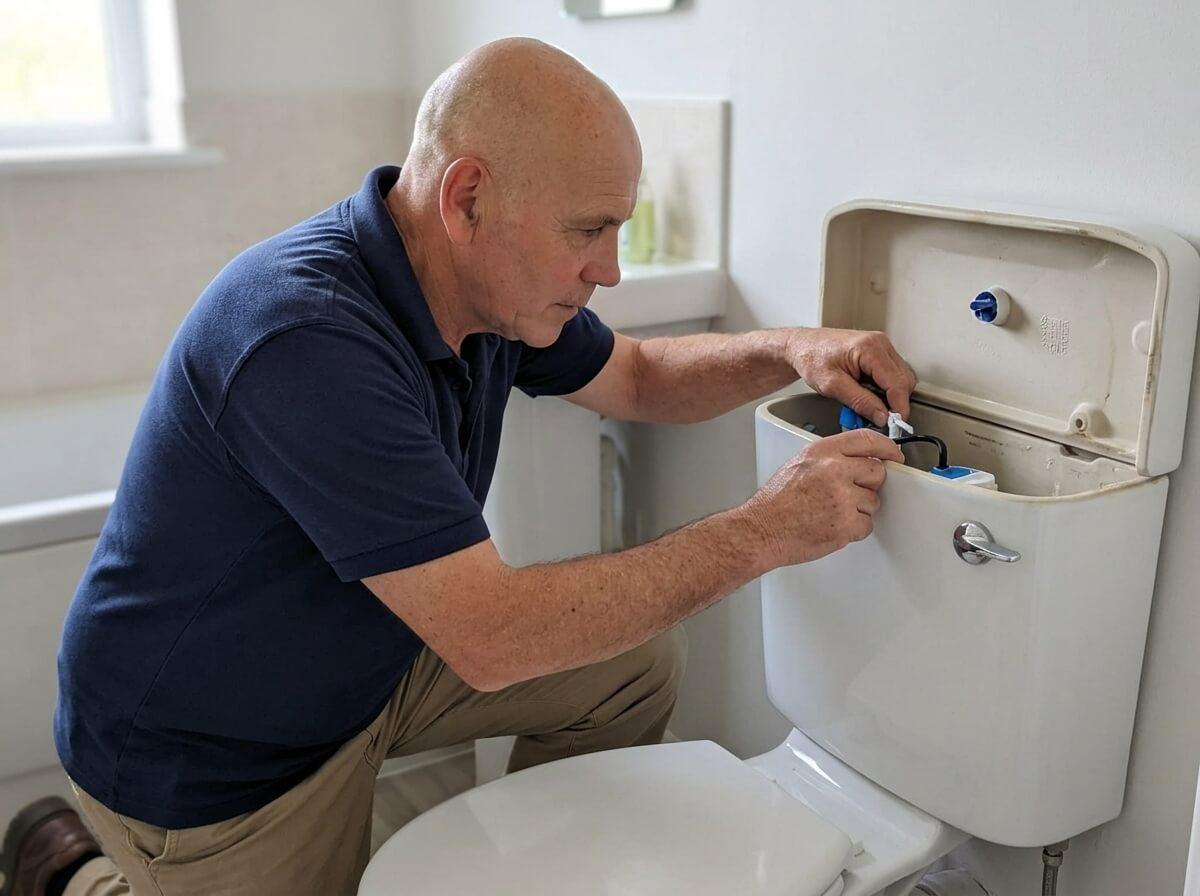
Some cistern problems are within reach of a confident DIYer. If the water level is just a little too high, you may be able to lower it by adjusting the float: on a modern cup float there is usually an adjustment screw or clip; on an older ball-and-arm system you can gently bend the arm downward so the valve shuts off sooner. If the float is waterlogged, it needs replacing. Replacing a fill valve or a flush valve is also achievable if you are comfortable with basic plumbing, turn off the water, drain the cistern, and follow the instructions for the correct replacement part, taking care to fit the seals properly to avoid new leaks.
That said, there are pitfalls. Identifying the failed part is not always obvious, parts must be the correct type and well fitted, and in our hard-water area limescale can make old fittings brittle and awkward to remove. If you are not confident, if you cannot pinpoint the fault, if the problem persists after a repair, or if the cistern itself is leaking, it is better to call a plumber than risk a bigger problem or a flood. A botched valve replacement can turn a minor overflow into a soaked bathroom. If the water is ending up on the floor rather than in the pan, my guide to a toilet leaking from the base shows how to find which seal has failed.
Why You Should Not Ignore an Overflowing Cistern
It is tempting to live with a cistern that trickles or drips outside, but it is worth fixing promptly for several reasons. A continuously running cistern can waste a remarkable amount of water, commonly hundreds of litres a day, which quietly adds up on a metered bill. An internal overflow, where water escapes from the top of the cistern into the room, can cause damp, staining and damage to floors and ceilings, sometimes affecting the room below. A dripping external overflow pipe can stain the outside wall and, in freezing weather, create ice hazards on paths beneath. And the underlying fault rarely fixes itself, a sticking valve or worn washer tends to get worse. Dealing with it early is quick, inexpensive and saves both water and potential damage. If the dripping pipe outside is high up rather than under the bathroom, it is probably a loft tank, not the toilet: my guide to an overflow pipe dripping outside shows how to tell which tank it is.
How a Plumber Fixes an Overflowing Cistern
When I attend an overflowing cistern, I start by diagnosing exactly which component has failed, because treating the wrong part simply wastes money. Once the fault is confirmed, I repair or replace the worn part with a quality component, adjust the water level correctly, and test the cistern through several fill-and-flush cycles to make sure it shuts off cleanly, holds its water and flushes properly. Where an old cistern has several worn parts or an obsolete mechanism, I will give you honest advice on whether renewing the internals is better value than repeated small repairs. It is usually a straightforward, affordable job completed in a single visit, and fixing it promptly stops the constant waste of water that quietly inflates your bill.
How Much Water Does a Running Cistern Waste?
It is easy to dismiss a cistern that trickles or runs as a minor annoyance, but the volume of water it wastes is anything but minor. A continuously running or trickling cistern can waste a remarkable amount of water, commonly estimated in the hundreds of litres a day for a steady leak, and considerably more for a badly failed valve that runs constantly. Because the loss is hidden inside the toilet and often nearly silent, it is easy to overlook for weeks or months, during which it steadily adds to a metered water bill. Beyond the cost to you, it is simply wasteful of a precious resource, and if the fault is allowing an internal overflow it also risks damp and damage on top of the wasted water. This is why I always encourage people not to live with a toilet that hisses, trickles or refills by itself: what feels trivial is often quietly costing real money, and the underlying fault, usually a worn valve, will not fix itself and tends to get worse over time. The reassuring part is that the repair is nearly always quick and inexpensive, and stopping the waste often pays for itself over time on your water bill.
How to Tell Where Your Cistern Fault Is
A little observation before you call, or before you start a repair, helps pinpoint the fault. Take the cistern lid off and watch what happens after a flush as it refills:
- ●If water keeps trickling into the pan and the cistern never settles at a full level, the flush valve or flapper at the bottom is likely leaking and not resealing.
- ●If the water rises above the top of the overflow and spills: internally into the pan or out through an external pipe, the fill valve is not shutting off, or the float is set too high or is waterlogged.
- ●If the cistern fills very slowly, the fill valve may be partly blocked with scale, or the isolation valve may not be fully open.
- ●If the flush is weak, the water level may be set too low, or the flush valve or siphon may not be releasing the water effectively.
It is also worth checking the simple things first: make sure the isolation valve on the supply pipe is fully open, that the float moves freely and is not catching on the side of the cistern or on the flush mechanism, and that the float itself is not cracked and waterlogged. A float that has filled with water sinks instead of floating, so it never rises far enough to shut the valve off, a common and easily missed cause of an overflow in older ball-float cisterns. These quick checks sometimes reveal a straightforward fix, and if they do not, they at least narrow down the fault so the repair is faster.
If your cistern problem turns out to be part of a wider toilet issue, a weak or incomplete flush, a blocked toilet, or a leak where the pan meets the soil pipe, it is worth dealing with it all in one visit rather than piecemeal. The same worn parts and hard-water scale that cause an overflow often affect the flush and fill at the same time, so a plumber can check the whole toilet while sorting the cistern and save you a second call-out. A toilet that fills quietly, holds its water and flushes cleanly on the first press is a sign everything inside is working as it should. If your problem is the opposite, a cistern that will not fill or a button that does nothing, my guide on what to do when a toilet won’t flush covers it.
Call Your Local Ipswich Plumber
An overflowing cistern is rarely as serious as it looks, but it does need stopping quickly and fixing properly. If you cannot stop the water, if the repair is beyond what you are comfortable doing, or if the cistern keeps overflowing after you have tried, it is worth having it sorted by a professional. I fix overflowing and faulty cisterns across Ipswich and Suffolk, usually in a single visit, with a clear quote before any work. You can read more on our overflowing cisterns page, or simply call 07977 857224, with a 24-hour service, I can stop the waste and get your toilet working properly again.