A leaking soil pipe is one of those jobs nobody wants to look at too closely. It usually starts with a smell you cannot place, then a brown mark on the boxing behind the toilet, a drip from the ceiling every time someone upstairs flushes, or a dark streak down the outside wall that was not there last week.
Unlike a leaking water pipe, a soil pipe is not under mains pressure, so it rarely floods a house in minutes. What it does is worse in a quieter way. It leaks sewage, a little at a time, every time the toilet is used, into floors, ceilings and walls that soak it up. The good news is that most soil pipe leaks come down to a handful of causes, and almost all of them are fixed in a single visit. This guide covers what to do in the first ten minutes, how to find where it is leaking, why it happens, what you can safely do yourself, and what a proper repair looks like.
Soil Pipe Leaking? Do These 6 Things Now
You do not need tools for any of these. Do them in this order.
Stop using everything that drains into that pipe
Tell everyone in the house: no flushing, no baths or showers, no washing up, no washing machine or dishwasher. In most houses one stack takes the upstairs toilet, basin and bath, and often the kitchen too. If you have a downstairs toilet on a separate drain, use that. Every flush sends six to nine litres through the leak, so this one step matters more than anything else on the list.
Put gloves on and contain it
Rubber gloves first. Put a bucket or an old washing-up bowl under the drip and old towels round the area. If it is coming through a ceiling, catch it from the side rather than standing directly underneath. Bag soaked towels and throw them away rather than washing them with everything else.
Make the electrics safe
If dirty water is near a light fitting, a ceiling rose, an extractor fan or a socket, do not touch the switch. Turn that circuit off at the consumer unit, or the main switch if you are not sure which circuit it is. Our guide to water leaking from a light fitting explains what to do and when it is safe to use the lights again.
Ventilate and keep people away
Open windows and close the door to the room. Keep children and pets out until it has been cleaned. Sewage carries bacteria such as E. coli, and it does not take much contact to cause a stomach upset.
Check the drain outside
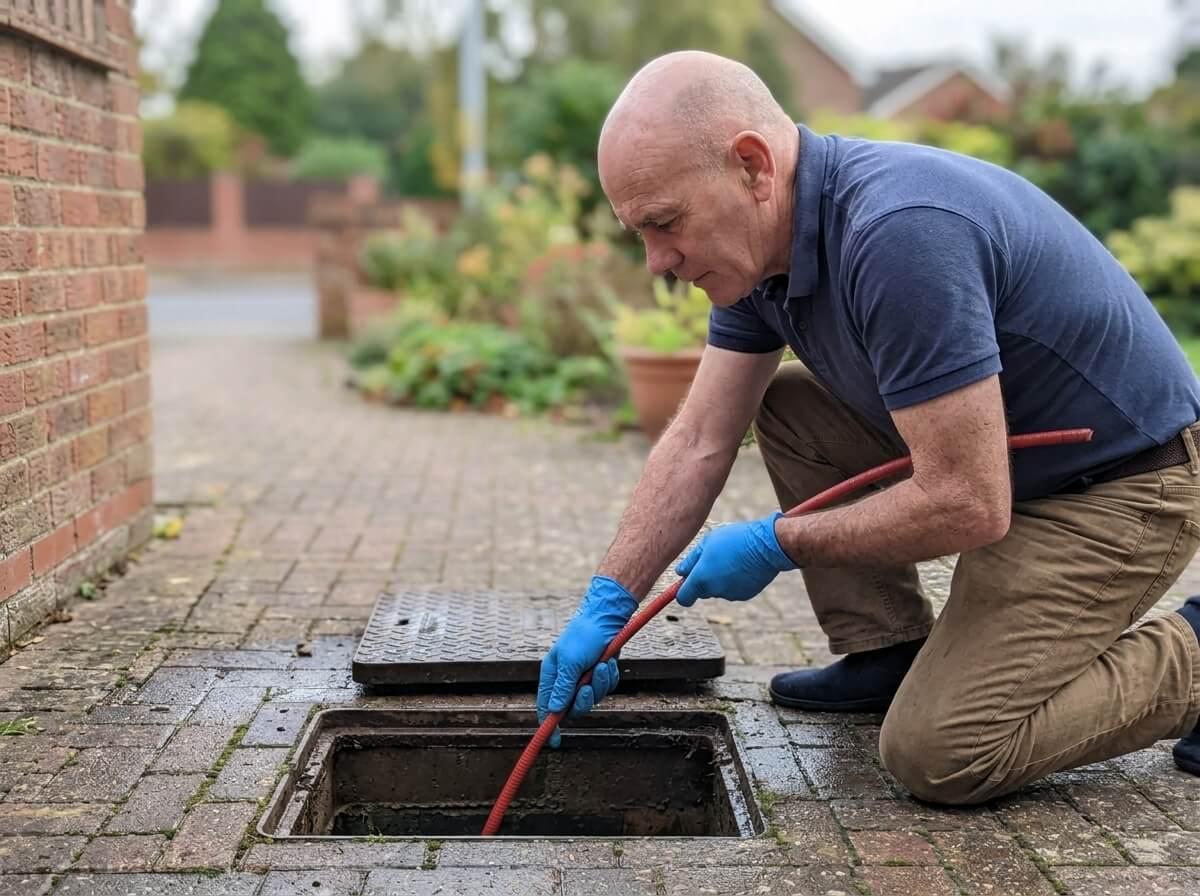
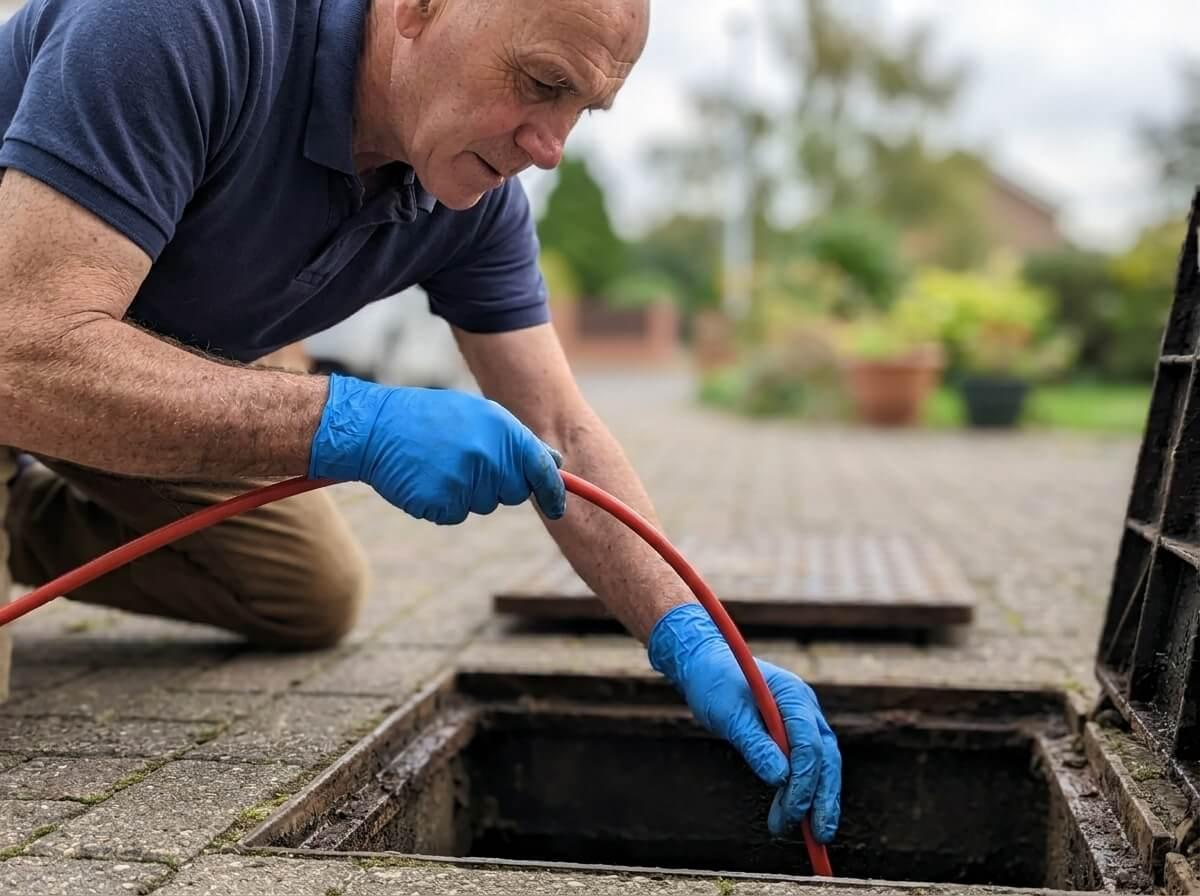
Find the inspection chamber, the square or rectangular cover in the garden, path or drive, usually near the bathroom or kitchen. Lift it with a screwdriver or a garden spade. If it is full of water and waste, the drain is blocked, and that blockage is very likely why your soil pipe is leaking. If it is empty or flowing freely, the problem is in the pipe itself.
Photograph it, then call
Take photos of the leak, any staining, damage to the ceiling or flooring, and the inspection chamber. They help with insurance, with your landlord or freeholder, and with getting the right parts on the van first time.
What Is a Soil Pipe, and Where Can It Leak?
The soil pipe is the large pipe, usually 110mm across, that carries waste from your toilet down to the underground drain. The vertical part is called the soil stack, or soil and vent pipe, because it also carries on up through the roof to let air in and smells out. On older houses the stack runs down the outside wall. On most houses built since the 1980s, and in almost every flat, it is inside, boxed in behind the toilet or running through a cupboard.
Several smaller pipes join it on the way down. The toilet connects through a pan connector or a branch. Basins, baths and showers join it through bosses, which are small sockets with rubber seals moulded into the stack. Near the bottom, the stack turns into the underground drain through a long curved bend called a rest bend. Each of those joins is a place where a leak can start, and almost every soil pipe leak I see is at a joint rather than in the middle of a length of pipe.

Where Is Your Soil Pipe Leaking? What It Means
Where the water is coming from tells you most of what you need to know. Find yours in the table, then read the section on blockages below, because a blockage is behind more soil pipe leaks than everything else put together.
| WHERE | WHAT YOU SEE | USUAL CAUSE | HOW URGENT |
|---|---|---|---|
| Behind the toilet, where the pan meets the pipe | Water on the floor behind the pan after a flush, a smell, a damp patch spreading under the flooring | A loose or perished pan connector, a pan that has moved, or a blockage further down pushing water back | Stop using that toilet now. Usually a same day repair |
| A joint on the boxed-in stack inside | A brown stain or drip on the boxing, the ceiling below or the floor at the bottom of the box | A ring seal that has perished or a pipe that has slipped out of its socket, often made worse by a blockage | Stop using the toilets on that stack. Call now if it is dripping into a ceiling |
| Where a sink, bath or shower waste joins the stack | Drips only when that appliance drains, a wet patch on the wall under the joint | A boss connector with a perished seal, a waste pipe that has pulled out, or a strap boss sealed with silicone | Stop using that appliance. Same day or next day |
| A joint on the external stack | Streaks or green staining down the wall from a joint, drips on the path, worse after flushing | A slipped or perished ring seal, missing brackets, or a pipe that has dropped | Not usually a flood risk, but a health and damp risk. Same day or next day |
| A crack or split along the pipe | A line in cast iron with rust weeping from it, or a split along a plastic pipe, often after frost or a knock | Corrosion in old cast iron, frost, sunlight-damaged plastic, or an impact from a ladder or wheelie bin | Needs a new section. Urgent if it is inside the house |
| At the base, where the stack goes into the ground | Water pooling at the foot of the pipe, wet soil, a smell, flies in warm weather | A cracked rest bend or a joint into the underground drain, or a blocked drain backing up | Check the inspection chamber. A blocked drain is a call-now job |
| From an access door or rodding cap | Water around a square or round cover on the stack, usually after someone has rodded it | A missing or damaged gasket, loose bolts, or a blockage just below | Usually a quick fix once the blockage is cleared |
| In the loft or around the roof vent | A wet patch round the pipe in the loft or the ceiling below it, often only when it rains | Failed flashing or a cracked collar where the vent pipe goes through the roof. Rainwater, not sewage | A roofer's job rather than a plumbing one. Book it in before the ceiling suffers |
The leak I am called to most is behind the toilet. It tends to show up as a damp patch that never dries, a floor that has started to feel soft, or a smell that bleach does not shift. If that sounds like yours, our guide to a toilet leaking from the base walks through telling a pan connector leak from a cistern or supply pipe leak.
Leaking Only When You Flush? Check for a Blockage First
This is the single most useful thing to understand about soil pipes. The joints are designed for waste that falls through the pipe and keeps going. They are not designed to hold water. A ring seal that has been dry and quiet for 30 years will start to weep the moment the pipe below it fills up.
So when a drain blocks, each flush has nowhere to go. The water backs up the stack, and it finds the weakest joint on the way: the pan connector, a boss, an old collar on a cast iron stack. Clear the blockage and, very often, the leak stops on its own. Repair the joint without clearing the blockage, and it leaks again next week, usually from the next joint up.
How to tell if your soil pipe is blocked
- ●The inspection chamber is full. Lift the cover nearest the house. Standing water or waste means a blockage downstream of it.
- ●Toilets flush slowly or the water rises in the pan. Classic sign of a blockage in the branch or stack.
- ●Gurgling from other fittings. A basin or bath that gurgles when the toilet is flushed is a sign the stack is struggling. See why your toilet is gurgling.
- ●Water coming up somewhere else. Dirty water in the shower tray or bath when the toilet flushes means the drain is backing up. Our guide to sewage coming up the drains covers that.
- ●The leak gets worse with each flush. If the drip turns into a run when two people use the bathroom in a row, think blockage.
Small blockages in the pan or branch can sometimes be cleared with a plunger, but a blocked stack or underground drain needs rods or a jetter. That is the work our drain unblocking service does every week, and it is usually the first thing I do on a soil pipe leak call.
7 Reasons a Soil Pipe Leaks
Once a blockage has been ruled out, the cause is almost always one of these.
A blockage pushing water out of a joint
Covered above. Wet wipes, sanitary products, nappies, kitchen fat and too much toilet roll at once are the usual culprits. If your toilet blocks again and again, our guide to why a toilet keeps blocking explains how to break the cycle.
Perished ring seals
Plastic stacks join with rubber ring seals in each socket. After 25 to 40 years the rubber hardens and shrinks, and it stops gripping the pipe. It often holds until something disturbs it, such as a blockage, a knock, or someone fitting a new bathroom.
A pipe slipping out of its socket
Soil pipes need a bracket at every joint and expansion room at each socket. Plastic grows and shrinks with temperature, so a pipe with a missing bracket can creep down over a few winters until it is barely inside the seal. On outside stacks, I often find brackets that have rusted through or were never fitted.
Cracked cast iron
Cast iron lasts a long time, but not forever. It rusts from the inside, especially at the bottom of the stack where it is wet the most, and old collars packed with putty or lead dry out and crack. Frost can split a pipe that has water sitting in it.
Split or brittle plastic
Sunlight slowly makes plastic pipe brittle, particularly on south-facing walls. A ladder, a wheelie bin or a frost can then crack it. Pale, chalky-looking pipe is a sign it has been in the sun a long time.
A badly made waste connection
A basin, bath or shower waste pushed into a boss without a proper seal, a strap boss glued with silicone, or a waste pipe cut short so it barely enters the socket. These are often fine until the stack is under strain, then they leak.
A loose or worn pan connector
The flexible rubber or plastic connector between the back of the toilet and the soil pipe. A pan that rocks, a connector that was never pushed fully home, or an old one that has gone hard will leak a little with every flush.
Temporary Fixes That Help, and Ones That Do Not
You may need to buy time until a plumber arrives, especially at night or over a weekend. Here is what each common stopgap can really do. None of them is a repair.
| STOPGAP | WHAT IT CAN DO | THE LIMIT |
|---|---|---|
| Stop using everything on that pipe | The only thing that stops a soil pipe leak completely. No water in, no water out | Hard to keep up for long in a house with one bathroom |
| Self-amalgamating tape | Wrapped tightly over a clean, dry joint or hairline crack on plastic, it can stop a weep for a few days | Will not hold if the pipe is blocked and filling up, and will not seal a joint that has pulled apart |
| Resin or fibreglass repair bandage | Sets hard round a cracked section of plastic or cast iron and can buy a week or two | The pipe must be clean and dry first. Messy, and makes the eventual repair harder |
| Silicone sealant | Almost nothing on a soil pipe. It may slow a weep on a dry outside joint for a day | Does not bond to wet, dirty or greasy pipe, and the next flush pushes it out |
| Pushing the pipe back into its socket | Sometimes works for a plastic pipe that has simply dropped, if the seal is still good | The pipe dropped for a reason. Without a bracket it will drop again, and an old seal rarely reseats |
| Clearing a blockage | If the leak only happens when the pipe backs up, clearing the blockage can stop it straight away | The joint that leaked has often been strained and may still need remaking |
A word on silicone. I take a lot of silicone off soil pipes. It looks like it should work, but it will not stick to a wet or greasy pipe, and the waste running past it lifts it a little more each day. Worse, it hides the joint, so the leak carries on into the boxing where nobody can see it.
How a Plumber Fixes a Leaking Soil Pipe
Here is what a proper soil pipe repair involves, in the order I do it.
Find the real source
Remove boxing or panels where needed, run water through each fitting in turn, and watch the joints. A leak that shows at the bottom of the boxing often starts higher up and runs down the outside of the pipe.
Clear any blockage
Rod or jet the stack and the drain from the inspection chamber, and check the water flows away freely before touching any joint.
Remake or replace the joint
A new ring seal, a new pan connector, a new boss adaptor or a short new section of pipe with slip couplers. On cast iron, the cracked section is cut out and replaced with plastic using purpose-made adaptors and clamps.
Bracket it properly
Every joint supported, with the right expansion gap, so the pipe cannot creep out of its socket again.
Test it
Flush every toilet and run every fitting on the stack, several times, while watching the repair and the inspection chamber.
Tell you what else I found
Other joints that are starting to go, brackets missing elsewhere, or a drain that needs more than a clear. You decide what, if anything, to do about it.
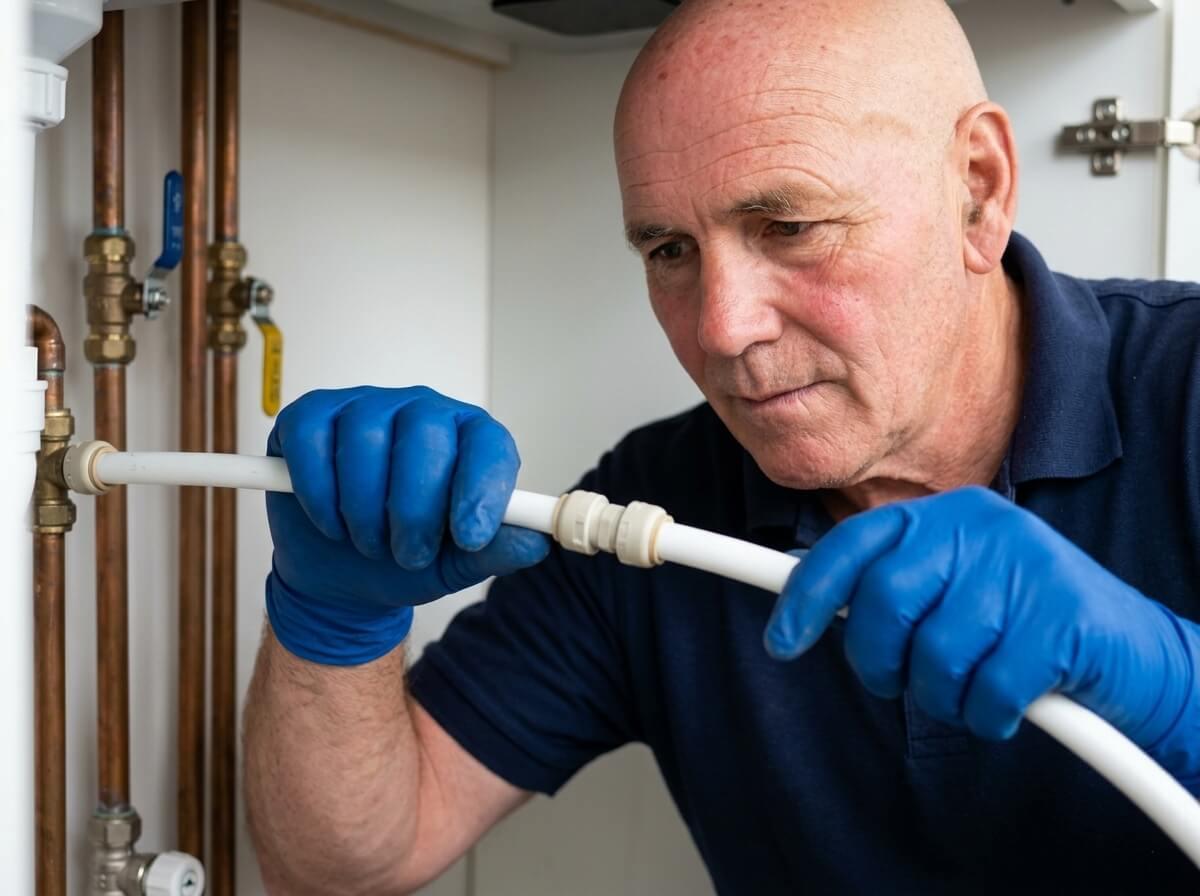
Repair the joint or replace the whole stack?
Most of the time, repairing one joint or one section is the right answer. A full stack replacement starts to make sense when an old cast iron stack is cracked in more than one place, when several ring seals are failing at once on a 40-year-old plastic stack, or when a bathroom refit means the boxing is coming off anyway. Philip will tell you which is which, and why, before any work starts.
Any new soil pipe has to meet the Building Regulations for drainage. The government’s Approved Document H sets out how stacks are sized, ventilated and given access for clearing. Like-for-like repairs do not normally need a building control application, but a new or moved stack may.
Cast Iron, Plastic or Asbestos? Know Your Soil Pipe
What your soil pipe is made of changes how it fails and how it is fixed. Most Ipswich homes have one of these four.
| MATERIAL | HOW TO SPOT IT | HOW IT FAILS | WHAT IT MEANS |
|---|---|---|---|
| Cast iron | Heavy, painted black or grey, with thick collars at each joint. Common on houses built before the 1970s | Rusts from the inside, cracks along its length or at the collars, and joints sealed with old lead or putty dry out | A cracked section is usually cut out and replaced in plastic with a proper adaptor |
| Plastic (PVC-U) | Smooth grey, black, white or brown pipe, about 110mm across, with push-fit ring seal sockets | Ring seals perish, pipes slip out of sockets when brackets are missing, and old pipe goes brittle in the sun | Usually the simplest to repair. New seals, couplers and sections are standard parts |
| Asbestos cement | Pale grey, slightly rough, with a matt chalky finish. Found on some homes built up to the 1980s | Cracks with age, frost or impact, especially near brackets and at the base | Do not drill, cut, sand or break it. Safe if left alone. Removal needs the right precautions |
| Lead | Dull grey, soft, with wiped joints that look like bulges. Mainly in older houses and some flats | Splits and pinholes with age, and joints to newer pipe come apart | Normally replaced in plastic rather than repaired |
Not sure? A magnet is a quick test. It sticks to cast iron and nothing else on the list. If it does not stick and the pipe is pale grey and chalky, treat it as asbestos cement until someone has checked.
Is a Leaking Soil Pipe an Emergency?
Not every soil pipe leak needs someone out at 2am, but some do. Here is how I would triage it.
Call now
- ✕Sewage dripping or running through a ceiling, or near a light fitting or wiring.
- ✕The drain is blocked and waste is backing up into the house or the only toilet.
- ✕The only toilet in the house cannot be used, and there is someone elderly, unwell or very young at home.
- ✕A leak in a flat that is going into the flat below.
Same day or next day
- ●A weep behind the toilet or from a boxed-in joint, contained with a bucket and towels.
- ●A drip from an external stack joint or a split in an outside pipe.
- ●A basin, bath or shower waste leaking where it joins the stack. Stop using that one appliance.
Book it in
- ✓Old staining on an external stack with no fresh drips.
- ✓Missing brackets or a pipe that looks like it has dropped, but is not leaking yet.
- ✓A smell near the stack with no visible water, covered in the next section.
Still unsure? Our guide to what counts as a plumbing emergency has a fuller triage table, and our guide to whether a blocked drain is an emergency covers the drain side of things.
Soil Pipe Smell but No Visible Leak?
A soil stack can let sewer gas into the house without a drop of water showing. The usual reasons are a cracked pipe or a joint above the level the waste reaches, a pan connector that is not sealed, an access cap with a missing gasket, or a stack that has been cut off in the loft instead of being taken through the roof. Traps that have dried out in a spare bathroom do the same thing. Run every tap and flush every toilet first, because that cures it more often than you would think. If the smell stays, our guide to a smell of sewage in the house goes through every cause in order.
Who Is Responsible for a Leaking Soil Pipe?
You own the house
The soil pipe is part of your property, inside and out, so the repair is yours to arrange. The underground drain is yours as far as your boundary or the point where it joins a neighbour’s drain. Since 2011, drains shared with neighbours and those beyond your boundary have generally been the water company’s responsibility, which around Ipswich is Anglian Water. Ipswich Borough Council’s page on drainage problems explains who to contact for each.
You rent
Your landlord is responsible. Under section 11 of the Landlord and Tenant Act 1985, landlords of most homes must keep drains, toilets and the pipes that serve them in repair. Tell your landlord or agent straight away, in writing, with photos, and stop using the affected toilet. If the blockage behind it was caused by something flushed that should not have been, the landlord may be able to recharge the clearing.
You live in a flat
The shared stack that runs through the building is usually the freeholder’s or management company’s responsibility under the lease, while the branch from your own toilet or bath to the stack is usually yours. Check your lease, report it to the managing agent, and if it is coming into your flat from above, see our guide to water leaking through the ceiling. In an emergency, stopping the damage comes first and the paperwork can follow.
What Affects the Cost of a Soil Pipe Repair?
Every job is different, so I always give a fair price agreed before any work starts. The things that make the biggest difference are:
- ●Whether there is a blockage. Clearing the drain is often the main part of the job and sometimes all of it.
- ●Access. An exposed joint behind a toilet is quick. A joint inside tiled boxing or high on an outside wall takes longer.
- ●The material. Plastic seals and couplers are standard parts. Cast iron needs cutting and adaptors. Asbestos cement needs the right precautions.
- ●How much is failing. One joint is a small job. Several joints on an old stack may make a new stack the better value.
- ●When you call. Night and weekend emergency callouts cost more than a booked visit, which is why the triage above matters.
Our guide to how much an emergency plumber costs explains how callout pricing works, and what to ask before anyone starts.
Will Insurance Pay for a Leaking Soil Pipe?
Most buildings policies pay for damage caused by escaping water, such as a ceiling, flooring or plaster ruined by the leak. Very few pay to repair a pipe or seal that has worn out with age, because that counts as wear and tear. Some policies also cover accidental damage to underground drains, which can help if the cause turns out to be a broken pipe below ground. Ring the claims line before major work if you can, keep photos and my report, and get the leak stopped first. Our guide to a burst pipe insurance claim covers what insurers ask for.
How to Stop Your Soil Pipe Leaking Again
- ✓Only flush the three Ps. Pee, poo and paper. Wet wipes, even ones labelled flushable, are the biggest cause of blocked stacks I see.
- ✓Keep fat out of the kitchen sink. It sets in the pipe and the stack, and catches everything else.
- ✓Look at the outside stack once a year. Streaks, staining, missing brackets, a pipe that has dropped, or green marks under a joint.
- ✓Keep things off it. Do not hang hoses or baskets on a soil pipe, and keep ladders and bins from knocking it.
- ✓Fix a rocking toilet early. A pan that moves will work its connector loose.
- ✓Leave an access panel. When the stack is boxed in, a removable panel at each joint turns a big job into a small one.
- ✓Get slow drains looked at. A slow or gurgling toilet is a soil pipe asking for help before it starts to leak.
Leaking Soil Pipe in Ipswich? Call Philip
I cover Ipswich, Felixstowe, Woodbridge, Kesgrave, Martlesham and the surrounding towns and villages 24 hours a day, usually with you in about 30 minutes for local emergencies. I clear the blockage, find the leaking joint, remake it properly and test it before I go. If the toilet itself will not clear, see our blocked toilet repair service. If the water has been going into the floor or walls and you are not sure how far, our leak detection service finds it before it turns into rot and mould. For anything else, see all our emergency plumbing services, or get in touch for a free, no-obligation quote.
Leaking Soil Pipe: The Key Points
- ●Stop using every toilet, sink and appliance that drains into the leaking pipe.
- ●Gloves on, contain it, ventilate, and switch off lights below at the consumer unit if water is near them.
- ●Lift the inspection chamber cover. A full chamber means a blockage, and that is usually why the joint is leaking.
- ●Most leaks are at joints: the pan connector, ring seals, bosses and old cast iron collars.
- ●Silicone does not fix soil pipes. Tape or a resin bandage only buys a few days.
- ●Never drill or cut a pale grey, chalky stack. It may be asbestos cement.
- ●Owners repair their own stack. Landlords must repair it for tenants. Shared stacks in flats are usually the freeholder’s.