Water leaking from a light fitting is one of the calls I take most seriously, because it is two problems at once. There is a leak somewhere above the ceiling, which is a plumbing job. And there is water inside an electrical fitting, which is a safety job. People usually notice it as a steady drip from a pendant shade, a downlight that has filled up like a goldfish bowl, or a brown ring spreading across the ceiling with the light in the middle of it.
The instinct is to flick the light off. Please don’t. Wet switches, wet fittings and live cables are a bad mix, and the switch on the wall does not make the fitting dead anyway. The safe order is power first, water second, then find the source. This guide walks you through exactly that, explains which switch to use on your consumer unit, shows you how to work out where the water is coming from, and gives you an honest answer on when the light is safe to use again.
Water Leaking From a Light Fitting? Do These 6 Things Now
Do them in this order. None of them need tools.
Leave the light switch alone
Whether the light is on or off, leave it exactly as it is. Do not touch the switch, the fitting, the bulb or the shade, and do not try to catch the water with your hands. Keep children and pets out of the room.
Turn off the power at the consumer unit
Go to your consumer unit (the fuse box), usually under the stairs, in a hall cupboard, in the garage or by the front door. Standing on a dry floor with dry hands, switch off the lighting circuit for that floor. If the labels are missing or you are not sure, use the main switch and turn off the whole house. If the consumer unit itself is wet, do not touch it. The table below explains what to look for.
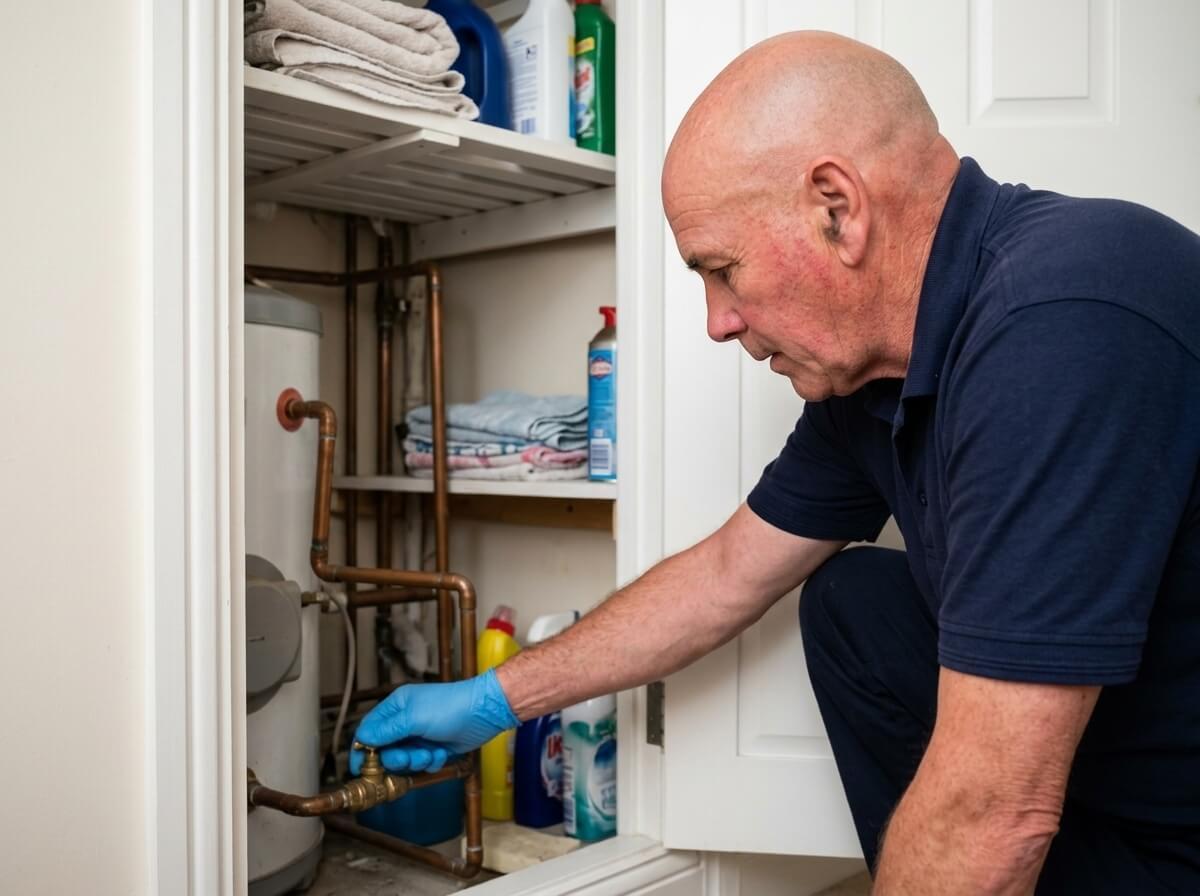
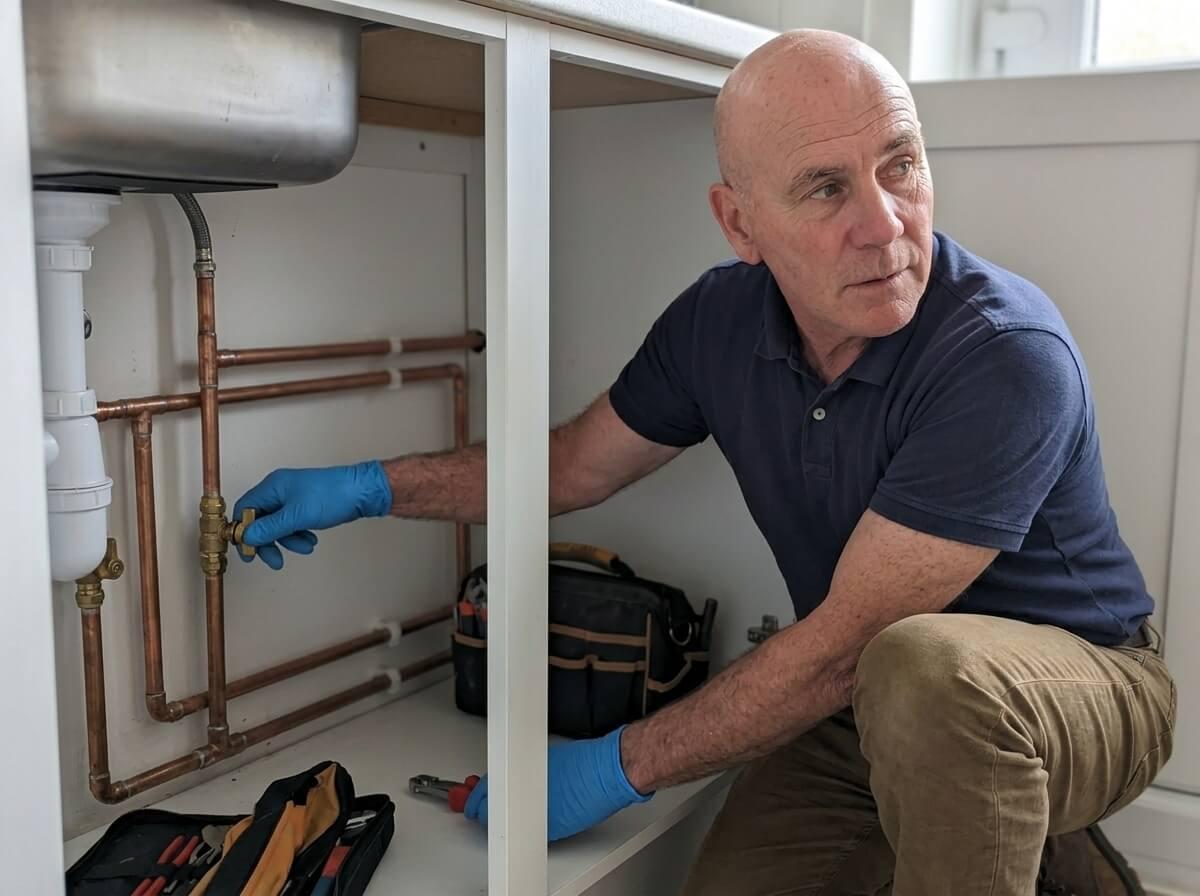
Turn off the water at the stopcock
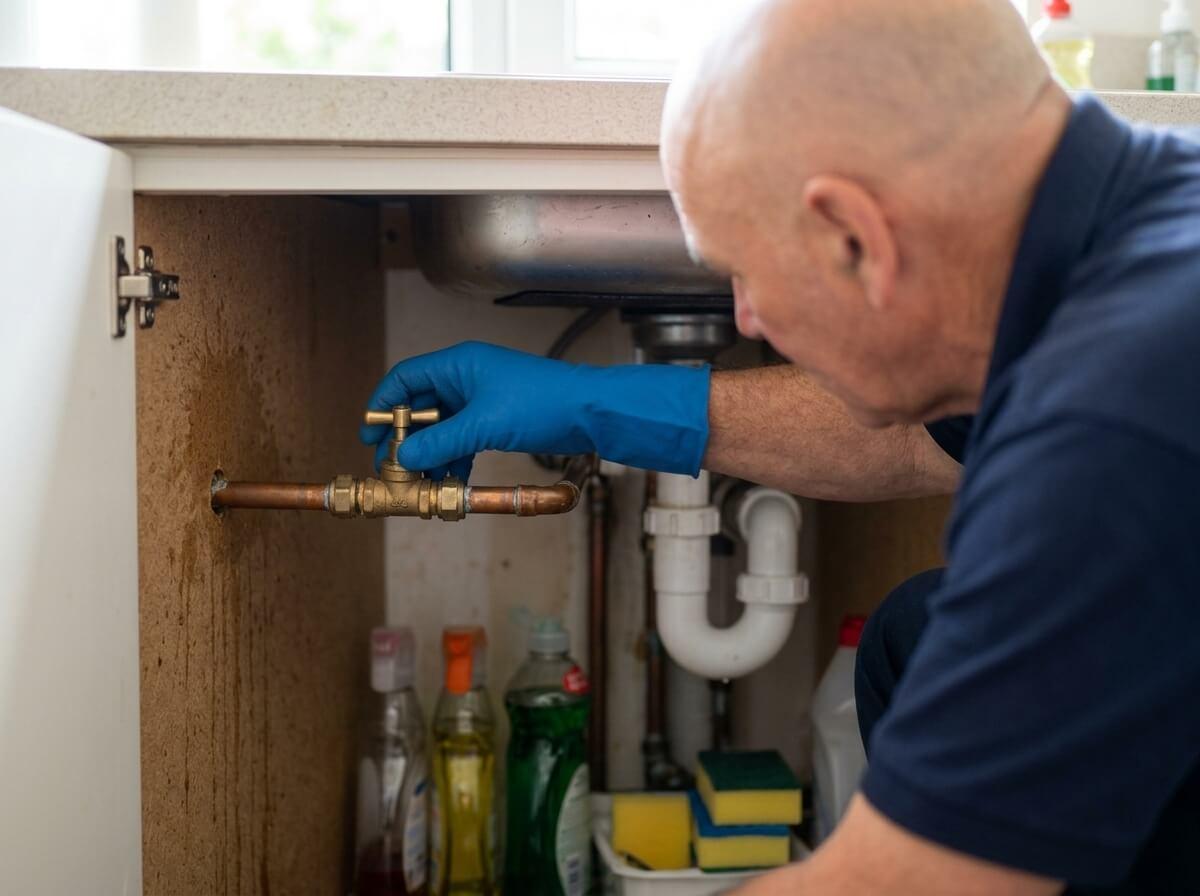
Turn the main stopcock clockwise until it stops. It is usually under the kitchen sink, but our guide on how to locate your stopcock covers the other places it hides. If the leak is in one bathroom and you can see an isolation valve on the pipe feeding the toilet, basin or shower, closing that can be enough. If you have a cold water tank in the loft, read step 3 of the next section too, because the stopcock will not stop everything.
Catch the water from the side and move things out of the way
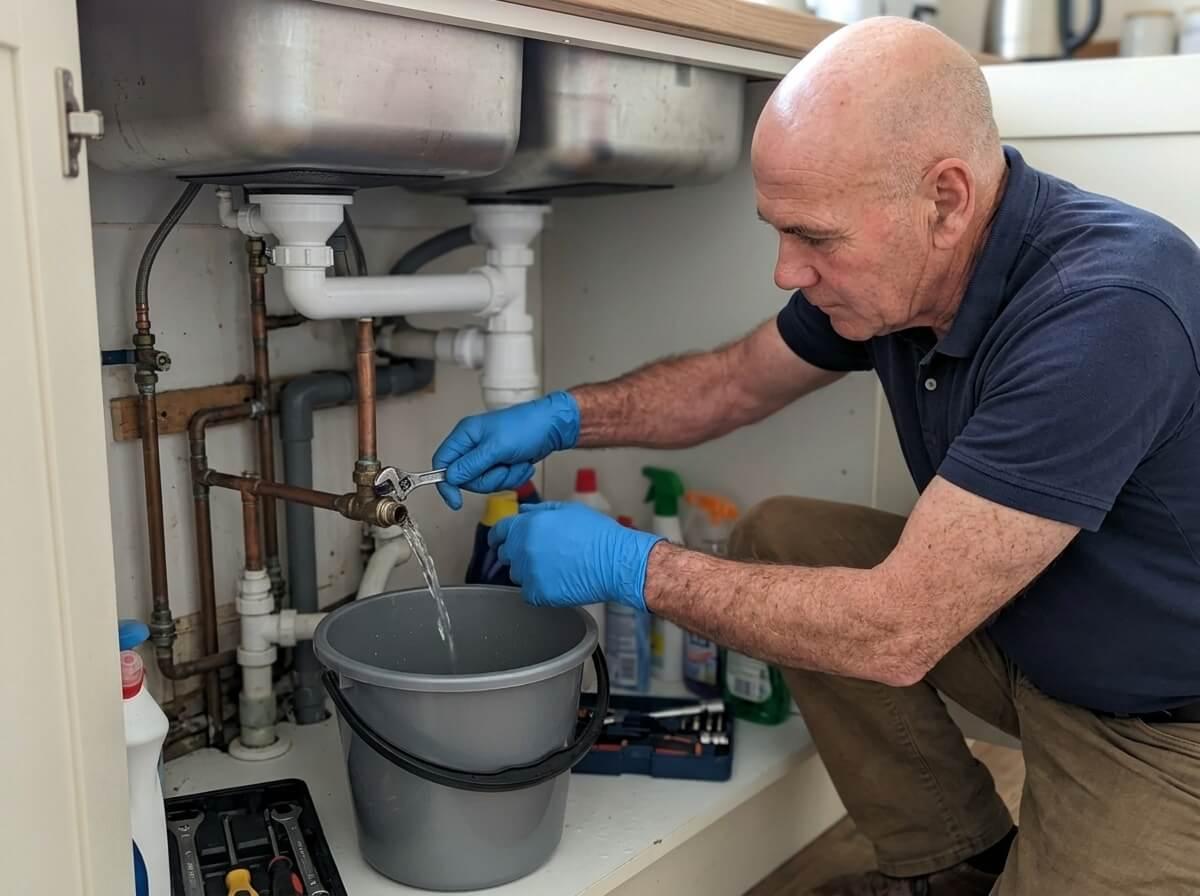
Put a bucket, bowl or washing up bowl under the drip, sliding it into place from the side rather than standing underneath. Move furniture, rugs, electrical items and anything precious out of the way. Put old towels down around the bucket to stop splashes soaking the carpet.
Keep out from under a bulging ceiling
If the ceiling around the light is sagging, bulging or cracking, it is holding back water and may come down. Keep everyone out from underneath it and close the door. Do not poke the bulge next to the light fitting. Our guide to water leaking through the ceiling explains when and how a bulge can be drained safely.
Take photos, then call
Photograph the light, the ceiling, the water and anything that has been damaged, plus the room above if you can get to it. Note the time. Those photos help your insurer, your landlord and me. Then call a plumber to stop the leak, and plan for an electrician to check the circuit before it goes back on.
Is Water in a Light Fitting Dangerous?
Yes, it can be. Tap water conducts electricity, and a light fitting is full of connections that sit at mains voltage. When water runs through it, it can create a path from a live part to the metal of the fitting, to the water dripping out, or to you. It can also cause a short circuit that heats the cables and connectors, and in the worst case starts a fire in the ceiling void, where you cannot see it.
Why the light switch does not make it safe
A light switch only breaks one wire to the bulb. In most British homes, the ceiling rose above a pendant light is also the junction where the lighting circuit loops on to the next light, so there are live cables inside it even with the switch off. Downlights and spotlights are often wired in a chain the same way. That is why the consumer unit, not the wall switch, is the only safe way to cut the power.
What it means if the lights tripped on their own
If the lights went off by themselves and a switch on the consumer unit has dropped down, that is the RCD or the breaker doing exactly what it is designed to do. Do not keep resetting it. Every reset puts power back into a wet circuit. Leave it off, and mention it when you call. If the whole house has gone dark, the RCD has probably tripped and taken several circuits with it.
Older houses carry more risk
Homes with an old fuse box and no RCD have far less protection, because nothing switches off automatically if electricity leaks to earth through the water. In older Ipswich terraces and 1950s and 1960s houses, I still see original fuse boards from time to time. If that is what you have, be extra careful, use the main switch, and do not turn it back on until an electrician has been.
Which Switch to Turn Off on Your Consumer Unit
Consumer units vary a lot, and the labels are often faded, missing or wrong. Find yours in the table. If you are in any doubt at all, use the main switch. A house with no lights for an hour is far better than a live, wet fitting.
| YOUR BOARD | WHAT IT LOOKS LIKE | WHAT TO SWITCH OFF |
|---|---|---|
| Modern board with RCDs and breakers | A row of small switches (MCBs) with one or two wider switches marked RCD or with a test button, plus a large main switch | Switch off the breaker labelled Lights or Lighting for that floor. If the labels are missing or worn, use the main switch |
| Board with RCBOs | Every circuit has its own slightly wider switch with a small test button on each one | Switch off the RCBO for the lighting circuit on that floor, or the main switch if you are not sure which it is |
| Older board with breakers but no RCD | Small switches but no test button anywhere on the board. Often grey or brown plastic, sometimes in a cupboard under the stairs | Use the main switch. With no RCD there is less protection if water reaches a live part, so do not take chances on labels |
| Old fuse box with rewireable fuses | White or brown fuse carriers you pull out, with fuse wire inside, and a separate main switch or lever | Turn off the main switch. Do not start pulling fuses out with wet hands or near the water |
| Board is wet, smoking, buzzing or in the water | Water running near or into the consumer unit, a burning smell, crackling, scorch marks | Do not touch it. Get everyone out of that area and call 105 for the network operator and an emergency electrician. Call 999 if there is smoke or fire |
Why Is Water Coming Through My Light Fitting?
The light is almost never the cause. It is simply the lowest hole in the ceiling. Water that escapes from a pipe, a bath or a tank above runs along joists and cables until it finds a gap, and the hole cut for a ceiling rose or a downlight is the easiest way out. That is why the drip often appears at the light even when the leak is a metre or two away.
The quickest way to narrow it down is to think about what is directly above the light, and when the water appears.
| ABOVE THE LIGHT | LIKELY SOURCE | CLUES |
|---|---|---|
| A bathroom or en suite | Failed shower tray or bath seal, leaking bath or shower waste, toilet pan connector, a weeping pipe joint under the floor | Worse straight after a shower, a bath being emptied or a flush. Often stops when nobody uses the bathroom |
| A kitchen, utility or toilet | Washing machine or dishwasher hose, sink waste, a compression joint under the sink, a flexi hose to a tap | Appears when the appliance is running or the sink drains. Check inside the cupboard above for damp |
| The loft (top floor ceilings) | Cold water tank, its overflow or float valve, a loft pipe, a frozen and split pipe, condensation from an extractor fan duct, or the roof | Tank or pipe leaks run constantly. Duct condensation shows after showers on cold days. Roof leaks follow heavy rain |
| An airing cupboard upstairs | Hot water cylinder, its valves or pipe joints, the expansion pipe, or a pump | Warm water, or a steady drip that carries on with the cold taps off. Look at the cylinder base and the floor of the cupboard |
| A bedroom or landing with radiators | A central heating pipe or joint under the floorboards, often after carpet gripper nails or new flooring | Can be warm when the heating is on. The boiler pressure gauge keeps falling |
| Someone else’s flat | Anything in the flat above: their bathroom, kitchen, appliances, pipework or heating | You cannot stop it from your side. Knock straight away, then call the landlord or managing agent |
A bathroom above a kitchen is the one I see most. Kitchen ceilings are full of downlights, and the bathroom above is full of water. A shower tray seal that has quietly failed can let a little water through every day for months, soaking the ceiling void until it finally finds a downlight and starts to drip. Our guides to a leaking shower and a bath leaking through the ceiling go into those in detail.
Three Quick Tests to Find the Source
With the power off and the water stopped, you can learn a lot in ten minutes without lifting a single floorboard. These tests tell me straight away what kind of leak I am looking for when you call.
1. The stopcock test
Turn off the main stopcock and watch the drip for 10 to 15 minutes. If it slows and stops, the leak is on a pipe fed directly from the mains: usually the cold supply to the kitchen, a toilet, a combi boiler or an unvented cylinder. If it carries on at the same rate, the water is coming from somewhere the stopcock does not control.
2. The loft tank check
Many Suffolk homes, particularly older ones with a hot water cylinder in the airing cupboard, have a cold water tank in the loft that feeds the hot taps, the bath and sometimes the toilets. Turning off the stopcock stops the tank refilling, but it does not stop the tank emptying. If the drip keeps going, look for a gate valve (a wheel tap) on the pipe coming out of the bottom of the tank and close it, or open the hot taps and the bath taps to drain it down quickly. Our guide to a cold water tank leaking in the loft shows how.
3. The use test
If the leak only shows up now and then, it is probably a waste or a seal rather than a pressurised pipe. With the lights still off at the consumer unit and a bucket under the fitting, run one thing at a time upstairs for a couple of minutes: the basin, then the bath taps with the plug out, then the shower aimed at the tray, then a flush. Wait in between. If the drip returns after one of them, you have found your culprit, and you can simply stop using it until it is fixed.
Is It a Leak or Condensation?
Not every drip from a light is a leak. Bathroom downlights and the light in an extractor fan are a classic spot for condensation, especially in cold weather. Warm, wet air from a shower goes up the fan duct into a freezing loft, condenses on the inside of the cold duct, and runs back down into the fan or the light below. I see a lot of this from November to March.
- ●Condensation is likely if: the drips appear only during or just after a shower or bath, mainly on cold days, the water is clear and clean, and the ceiling around the light is not stained or soft.
- ●A leak is likely if: the drip carries on when nobody has used the bathroom, it happens whatever the weather, there is a brown or yellow stain, the plaster feels soft, or you can hear water when everything is turned off.
Condensation still needs dealing with, because water in a light fitting is water in a light fitting. The usual fix is an insulated duct that runs downhill to the outside with no dips where water can collect, a condensation trap if the duct has to rise, and a fan that is actually big enough for the room. Leave the light off in the meantime and get it checked.
Downlights, Spotlights and Pendant Lights: Does It Matter?
The type of light makes a difference to how water gets in and how much damage it does.
- ●Pendant lights and ceiling roses. One hole and one fitting. Water tends to run down the flex and drip from the shade or the bulb holder. The ceiling rose is the part that usually needs checking, because that is where the cable connections are.
- ●Downlights and spotlights. Lots of holes, often wired in a chain, often under a bathroom. Water can sit in the void and come out of two or three lights at once, and the transformers or drivers above them can be damaged even when the light looks fine from below.
- ●Bathroom fittings with an IP rating. Lights over a bath or shower should be rated against water, usually IP44 or IP65. That protects them from splashes and steam in the room. It does not make them waterproof against water pouring in from the ceiling void above, so treat them exactly like any other wet light.
- ●Fire rated downlights. Many downlights have a fire hood or an intumescent seal to keep the ceiling’s fire protection intact. If water has damaged them, they need replacing like for like, not with a cheaper fitting.
When Can I Use the Light Again?
The honest answer is: not until the leak is fixed, the fitting and ceiling have dried out, and a qualified electrician has tested the circuit. Even if the light comes on and seems fine, water can leave behind corrosion, damaged insulation and tracking marks that fail weeks later.
Electrical Safety First, the UK electrical safety charity, advises that electrics affected by water should be checked by a registered electrician before they are used again. In practice, an electrician will take the fitting down, check the connections and the cable, and run an insulation resistance test on the circuit to prove it is safe. A fitting that was soaked is often simply replaced, because a new pendant or downlight costs less than the risk of keeping an old one.
- ✕Do not dry the fitting with a hairdryer or turn the light on to warm it up and dry it out.
- ✕Do not plug a dehumidifier into a socket on a wet circuit. Use a socket in a dry room on a different circuit.
- ✓Do open windows and doors to get air moving, and keep the heating on gently to help the ceiling dry.
- ✓Do ask about the whole circuit, not only the fitting that dripped. Water often travels to the next light along.
If the water was dirty, for example from a soil pipe or a toilet waste, the fitting and anything it soaked should be replaced rather than dried, and the ceiling cleaned and disinfected before it is repaired.
Plumber or Electrician: Who Should I Call First?
Most of the time you need both, one after the other. I am a plumber, not an electrician, so I will always be straight with you about which part is mine. My job is to find the leak, stop it and repair it properly. The electrician’s job is to test the lighting circuit and the fitting before the power goes back on.
| SITUATION | WHO TO CALL FIRST |
|---|---|
| Water dripping from the light, power off at the consumer unit, leak still going | Plumber first to stop the leak, electrician afterwards to test the circuit |
| Leak stopped by turning off the stopcock, light fitting full of water | Plumber to find and fix the leak, then electrician before that circuit goes back on |
| Consumer unit wet, smoking, crackling or you cannot safely reach it | Keep away. Call 105, an emergency electrician, or 999 if there is smoke or fire |
| Leak stopped long ago, ceiling dry, light now flickers or the RCD keeps tripping | Electrician. The plumbing side may be finished, but the fitting or cable is not |
| Water only appears in heavy rain | Roofer, with an electrician for the light. Plumbing is very unlikely to be the cause |
| Drips only on cold mornings or after long showers | Usually condensation. A plumber or electrician can check the extractor duct and the fan |
What Happens When I Arrive
Here is what a typical light fitting leak callout looks like, so you know what to expect.
Make sure it is safe to work
I check that the power to the affected area is off and that nobody is standing under a bulging ceiling. If the consumer unit itself looks wet or damaged, I will not touch it and will tell you to get an electrician out as well.
Trace the leak
I start in the room above: the bath panel, the shower tray, the toilet, the basin and any boxing in. Moisture readings on the floor and walls show where the water is heaviest. Sometimes a floorboard has to come up to see the pipe. If the source is not obvious, our leak detection service uses thermal imaging and moisture mapping to find it with as little damage as possible.
Repair it properly
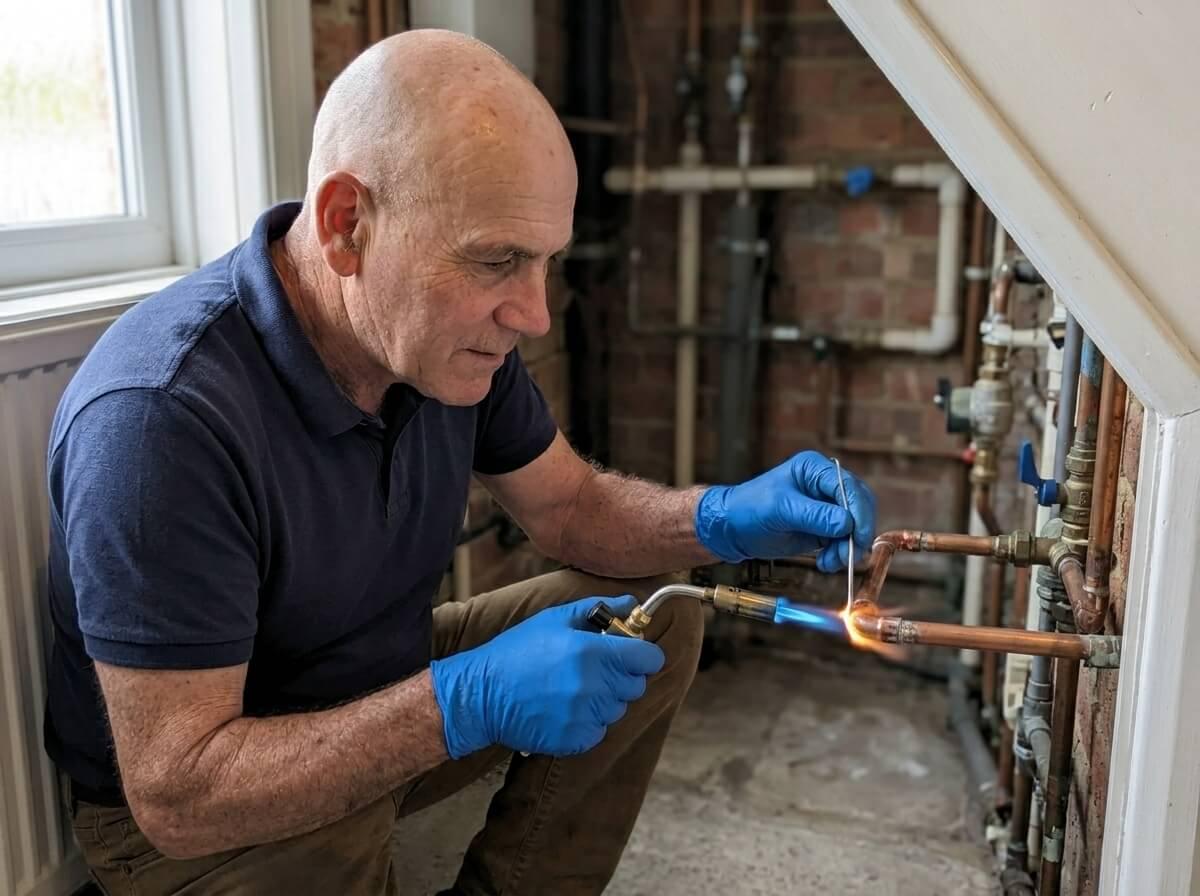
A weeping joint is remade, a split pipe is cut out and replaced, a failed shower seal is cut out and redone, a bath waste is resealed. For a split or burst section of pipe, see our burst pipe repair service. I agree a fair price with you before any work starts.
Test it and leave it dry
Once the repair is done, the water goes back on and the repair is checked under pressure and, where it is a waste or seal, with plenty of running water. I leave the floor open if the void needs to dry, and tell you what the electrician should check.
Ceiling Damage: Stains, Bulges and Repairs
Once the water is off, the ceiling usually tells the story of how long the leak has been going. A small, fresh drip leaves a damp patch that dries out. A slow leak that has been going for weeks leaves a brown ring, soft plaster and sometimes a musty smell.
- ●Plasterboard ceilings (most homes built from the 1960s on) soften and sag when wet. A small wet patch often dries out and only needs a stain block primer and paint. A board that has sagged, crumbled or gone soft needs cutting out and replacing.
- ●Lath and plaster ceilings (older Victorian and Edwardian homes) hold water for longer and can come away from the laths in big, heavy pieces. Keep out from under them and get advice before patching.
- ●Stains come back through ordinary emulsion. Let the ceiling dry fully, which can take a couple of weeks, then use a stain blocking primer before painting.
- ●Watch for mould. If the void stayed wet for a long time, mould can grow on the back of the board and the timbers. A musty smell after the leak is fixed is a sign to look further.
Insurance, Renting and Flats
Will my insurance pay?
Most buildings insurance covers sudden escape of water, which includes the damage to the ceiling and often the light fitting. Many policies also include trace and access cover, which pays for finding the leak. The repair to the leaking pipe or seal itself is often not covered, and slow leaks that have been going on for months can be excluded as wear and tear. Report it early, keep your photos and keep any damaged items until the insurer says otherwise. Our guide to a burst pipe insurance claim explains what usually gets paid.
If you rent
In England, your landlord is responsible for repairs to pipes, the electrics and the structure of the home, under section 11 of the Landlord and Tenant Act 1985. Make it safe first (power off, water off), then report it to your landlord or letting agent straight away, in writing as well as by phone, with photos. Tell them the power to the lights is off. Council and housing association tenants should use their landlord’s emergency repairs line.
If the water is coming from the flat above
You cannot stop a leak in someone else’s home, so knock on their door straight away and ask them to turn off their stopcock and stop using the bathroom. If nobody answers, call your landlord, managing agent or the building’s emergency line, as they may hold keys or know where the shut-off for that flat is. Make your own electrics safe in the meantime, and let your insurer know early.
How to Stop It Happening Again
Most of the leaks that end up coming through a light start small and give a warning first. A few simple habits catch them early.
- ●Check the shower and bath seals. If the silicone is black, cracked or coming away, cut it out and redo it before it lets water through. A shower tray that flexes when you stand in it will break any seal eventually.
- ●Look under the bath and basin once a year. Take the bath panel off and check the waste, the overflow and the pipe joints for drips, white crusty marks or green staining.
- ●Insulate pipes and ducts in the loft. Lagging stops pipes freezing and splitting in winter, and an insulated extractor duct stops condensation running back into the bathroom light. Our frozen pipes guide covers winter prep.
- ●Label your consumer unit. Know which switch is the upstairs lights and which is the downstairs lights before you need to. It saves vital seconds.
- ●Know where your stopcock is, and check it turns. A seized stopcock is no help in an emergency. Turn it a little once or twice a year to keep it free.
- ●Watch the ceiling under the bathroom. A faint ring, a hairline crack round a downlight, or paint that bubbles are early signs. Our guide to the signs of a hidden water leak lists the rest.
Emergency Help in Ipswich and Suffolk
I cover Ipswich, Felixstowe, Woodbridge, Kesgrave, Martlesham and the surrounding towns and villages 24 hours a day, usually with you in about 30 minutes for local emergencies. Turn the power off at the consumer unit and the water off at the stopcock, then call me. I will find the leak, stop it, repair it and test it, and tell you exactly what your electrician needs to check before the lights go back on. For anything else, see all our emergency plumbing services, or get in touch for a free, no-obligation quote.
Water Leaking From a Light Fitting: The Key Points
- ●Do not touch the light switch, the fitting or the bulb. The switch does not make the fitting safe.
- ●Turn off the lighting circuit at the consumer unit from a dry spot, or the main switch if you are unsure.
- ●Never touch a wet, smoking or buzzing consumer unit. Call 105, an electrician, or 999 if there is smoke or fire.
- ●Turn off the stopcock, and drain the loft tank if the drip carries on.
- ●Catch the water from the side and keep everyone out from under a bulging ceiling.
- ●Use the stopcock, loft tank and use tests to narrow down the source, and rule out rain and condensation.
- ●Leave the light off until the leak is fixed, the ceiling is dry and an electrician has tested the circuit.