A macerator toilet is brilliant right up until it is not. You flush, the pan fills, and instead of the familiar whirr from the box behind the toilet there is silence. Or a low hum. Or a grinding noise that makes you wince. Sometimes the first sign is water rising in the shower tray next door. A macerator toilet blocked like this is a different problem from an ordinary blocked loo, because there is a motor, a set of blades and a mains electrical supply sitting right where the waste is.
That changes what you can safely do. The usual blocked toilet tricks, a drain rod, a toilet auger or a bottle of unblocker, can wreck a macerator or hurt you.I have been a plumber in Ipswich for more than forty years, and I get called to these units in cloakrooms, loft conversions, garage conversions and annexes all the time. This guide takes you through making it safe, working out what has gone wrong from what you can see and hear, the few fixes that are genuinely safe to do yourself, and when it needs a plumber or the manufacturer’s engineer.
Macerator Toilet Not Working? Do These 5 Things First
Stop flushing
Every flush puts another six litres or so into a unit that cannot get rid of it. If the pump is not working, that water ends up on the floor, in the shower tray or back out of the vent. Tell everyone in the house not to use the toilet, or the shower, basin or bath in the same room, until you know what is going on.
Switch it off at the spur
A macerator is wired into a fused connection unit on the wall nearby, not plugged into a socket. It usually has a switch and a red light. Turn it off. If you cannot find it, or it has no switch, turn the circuit off at the consumer unit. This stops the motor starting while you look into the pan, and stops it burning itself out against a blockage.
Turn off the water to anything feeding it
Close the isolation valve on the pipe to the toilet cistern, the small screw-slot valve under or beside it. Turn it a quarter turn so the slot sits across the pipe. If a basin or shower drains into the same unit, stop using them. My isolation valve guide shows the different types and what to do if one will not turn.
Check for water around the unit
Look behind and beside the toilet, and around the macerator box. If there is water on the floor, mop it up, keep it away from the spur and any sockets, and do not touch the electrics with wet hands. Water on the floor near a powered unit is the one thing that turns this into a safety job rather than a plumbing job.
Listen and look before you do anything else
Power back on for a few seconds only, with the lid of the toilet down. Does the unit do nothing at all, hum, grind, or run and run? Is the water in the pan going down, staying put or rising? Write down what you hear. That one observation tells me more on the phone than anything else, and it tells you which part of this guide to read next. Then switch it off again.
How a Macerator Toilet Works
A normal toilet empties by gravity into a 100 mm soil pipe. A macerator toilet is fitted where that is not possible: in a basement, a cloakroom under the stairs, a loft room or an extension a long way from the soil stack. Saniflo is the best-known brand, which is why so many people call any macerator “a Saniflo”, but there are several makes and they all work in much the same way.
- ●The toilet flushes into a sealed box. The pan outlet pushes into a rubber sleeve on the side of the unit, which sits behind or beside the toilet. Some units are built into the toilet itself, and some sit behind a wall panel.
- ●A pressure switch starts the motor. As water fills the box, air is squeezed against a rubber membrane, which trips a switch. The motor starts. When the level falls, the switch turns the motor off again.
- ●Rotating blades break up the waste. A cutter on the motor shaft breaks waste and toilet paper into a slurry small enough to pump.
- ●An impeller pumps it up and away. The slurry is pushed through a small-bore pipe, usually 22 mm or 32 mm, up and then along to the soil stack. The manual for one common model says horizontal runs must fall at least 1 in 100, and any vertical lift should come first, at the start of the run.
- ●A non-return valve stops it coming back. A flap valve on the outlet stops the water in the pipe falling back into the unit when the motor stops.
- ●A vent with a carbon filter lets air in and out. The filter stops smells escaping and needs changing about once a year.
On the same manual, a normal flush should see the motor run for 5 to 10 seconds, sometimes in a few short bursts. If it runs for more than 20 seconds, the manufacturer says to check that the pipework is clear and the hose is not kinked. That 20 second figure is the most useful number in this guide: time your unit with your phone when it is working well, so you know what normal sounds like.

Macerator Fault Finder: What Your Toilet Is Telling You
These are the patterns I ask about when somebody rings to say their Saniflo is not working. Find the row that matches what you can see or hear. The last two columns tell you whether it is usually something you can sort yourself, and how quickly it needs dealing with.
| WHAT YOU NOTICE | LIKELY CAUSE | DIY FIX? | URGENCY |
|---|---|---|---|
| Pan fills up after a flush and the unit stays completely silent | No power to the unit: switched off at the spur, a blown 5 amp fuse in the spur, or a tripped circuit. Less often, a failed motor or pressure switch. | Sometimes | Sort this week |
| Water sits in the pan, drains very slowly, then pumps away in short bursts | A partial blockage in the pan outlet or rubber connector, or a clogged air vent under the carbon filter. | Usually | Sort this week |
| Unit hums or buzzes but the motor does not turn | Something jammed in the blades or the impeller, or a seized motor. The unit often feels hot. | Call a plumber | Sort this week |
| Rattling, grinding or crunching noise when it runs | A foreign object in the unit: a cotton bud, a bottle top, a toy, a hair grip. | Call a plumber | Sort this week |
| Runs for much longer than usual (over about 20 seconds) after each flush | A partial blockage in the pump or discharge pipe, a kinked hose, too long a pipe run or too many bends, or scale build-up. | Sometimes | Sort this week |
| Runs non-stop and will not switch off | A blocked or frozen discharge pipe, a failed non-return valve letting water fall back, or a stuck pressure switch. | Call a plumber | Switch off and call |
| Switches itself on every few minutes with nobody using it | A cistern, tap or shower dripping into the unit, a boiler condensate pipe connected to it, or a leaking non-return valve. | Sometimes | Sort this week |
| Water backing up into the shower tray, bath or basin | The unit cannot pump away fast enough: a blocked pump, blocked or frozen discharge pipe, or a failed non-return valve. | Call a plumber | Switch off and call |
| Water or waste coming out of the vent or the lid while it runs | Heavy waste build-up, a worn membrane or pressure switch, a perished rubber outlet, or a motor near the end of its life. | Call a plumber | Switch off and call |
| Foam coming out of the vent | Too much toilet cleaner or bleach in the pan. Prolonged foaming can overheat the motor. | Usually | Not urgent |
| Water on the floor around or behind the unit | A loose or split rubber sleeve on the pan spigot, a leaking hose clip, or a cracked case. | Sometimes | Switch off and call |
| Trips the electrics when it starts | Water getting into the motor or the wiring, or a motor that has failed. Do not reset it more than once. | Call a plumber | Switch off and call |
| Unpleasant smell from the toilet or the unit | Limescale and waste in the water left in the bottom of the unit, or a carbon filter more than a year old. | Usually | Not urgent |
| Hums or runs in a cold snap but nothing pumps away | The discharge pipe has frozen where it runs outside or through a cold loft, garage or void. | Sometimes | Switch off and call |
Where Is the Blockage? Pan, Unit or Pipe
Every blocked macerator I go to comes down to one of three places, and the fix is completely different for each. Working out which one you have saves a lot of wasted effort.
1. Blocked in the pan or the connector
The water stays high in the pan, or drains away very slowly, and the unit hardly runs because very little water is reaching it. This is a blockage in the pan outlet or in the rubber sleeve that joins the pan to the unit. Too much toilet paper in one go is the usual cause. This is the one type of macerator blockage that is often safe to clear yourself, using the method in the next section.
2. Blocked or jammed inside the unit
The water leaves the pan, the unit tries to run, but it hums, grinds, rattles or cuts out. Something has wrapped round the blades or jammed the impeller. Wipes, sanitary products, cotton buds and dental floss are the usual suspects. The motor may get hot and trip its thermal cut-out, which resets itself once it cools, so the unit can seem to work and then fail again. Clearing this means opening the unit.
3. Blocked in the discharge pipe
The motor runs normally, but for far longer than usual, or it never stops, and the water in the unit does not go down. The waste is getting chopped up but cannot get out. The cause is a partial blockage in the small-bore pipe, a pipe that has frozen outside, a stuck non-return valve, or scale narrowing the pipe over years of hard Suffolk water. If there is a basin or shower connected to the unit, this is when water starts coming up through it.
How to Unblock a Macerator Toilet Safely
This is for a blockage you think is in the pan or the connector. If the unit is humming, grinding or running non-stop, skip to the next sections, because plunging will not help and can make it worse.
Power off at the spur, gloves on
Make sure the spur is switched off and the red light is out. Put on long rubber gloves and lay old towels round the base of the toilet.
Bail out some of the water if the pan is full
Use a small plastic jug or cup to lower the level in the pan into a bucket, so there is room to work without it spilling over.
Try warm water and washing-up liquid
Squeeze in a good squirt of washing-up liquid and pour in a bucket of warm, not boiling, water from waist height. Leave it for 20 to 30 minutes. Boiling water can crack a pan and soften the rubber sleeve behind it. If the level drops on its own, the paper has broken up.
Gentle cup plunging only
A simple cup plunger, pushed slowly and gently over the pan outlet a few times, can shift a paper blockage in the trap. Keep it gentle. A macerator is a sealed system, and hard plunging can push water up the vent, past the non-return valve or out of the rubber sleeve.
Power on and test once
Switch the spur back on. The unit should start, run for a few seconds and stop. Flush once with the lid down and time it. If it runs for 5 to 10 seconds and the pan clears, you are done. If it hums, grinds or keeps running, switch it straight back off.
Can You Plunge a Macerator Toilet?
Gently, on the pan, with the power off: yes. Hard, repeated plunging: no. On an ordinary toilet a plunger pushes the blockage down into a wide soil pipe. On a macerator it pushes water into a sealed box with a pressure switch, a rubber membrane and a vent. Push too hard and you can damage the membrane, which then lets water reach the switch, or force waste out of the vent onto the floor behind the toilet.
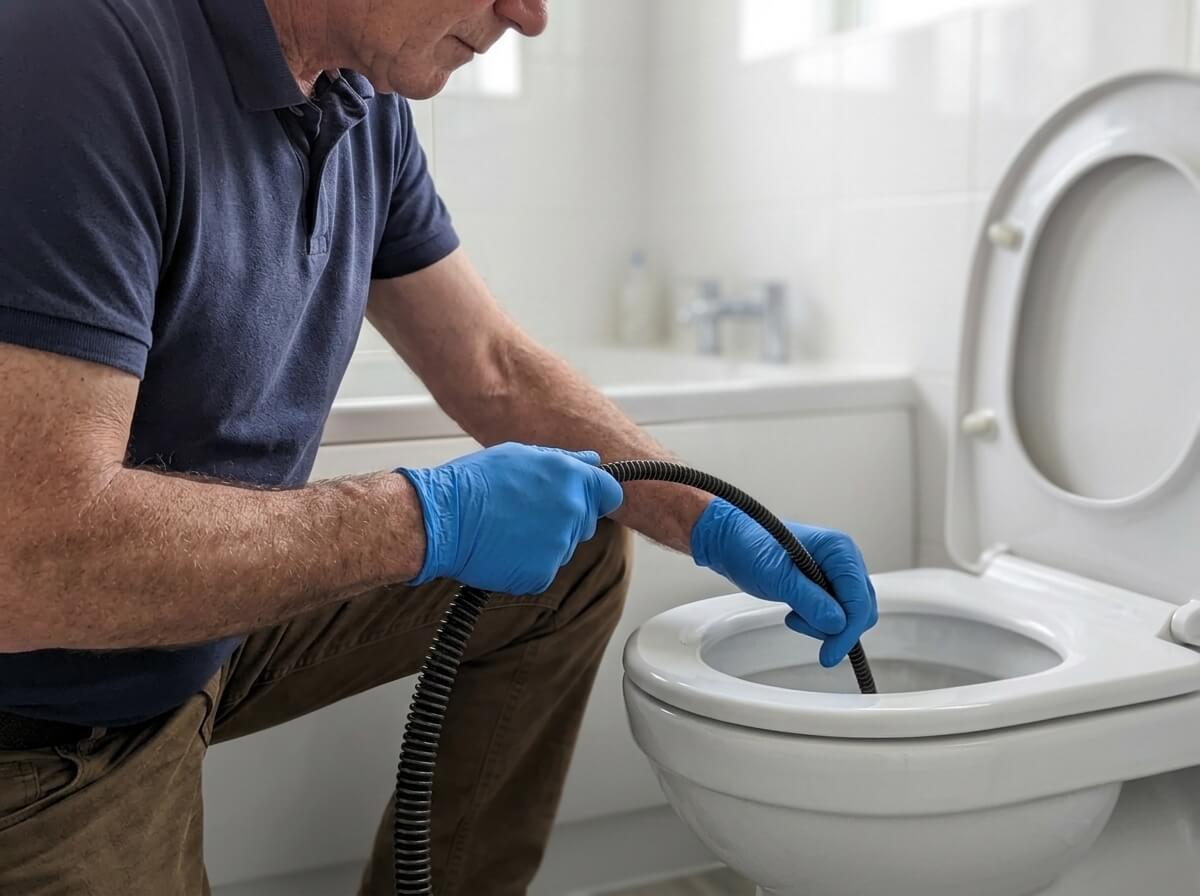
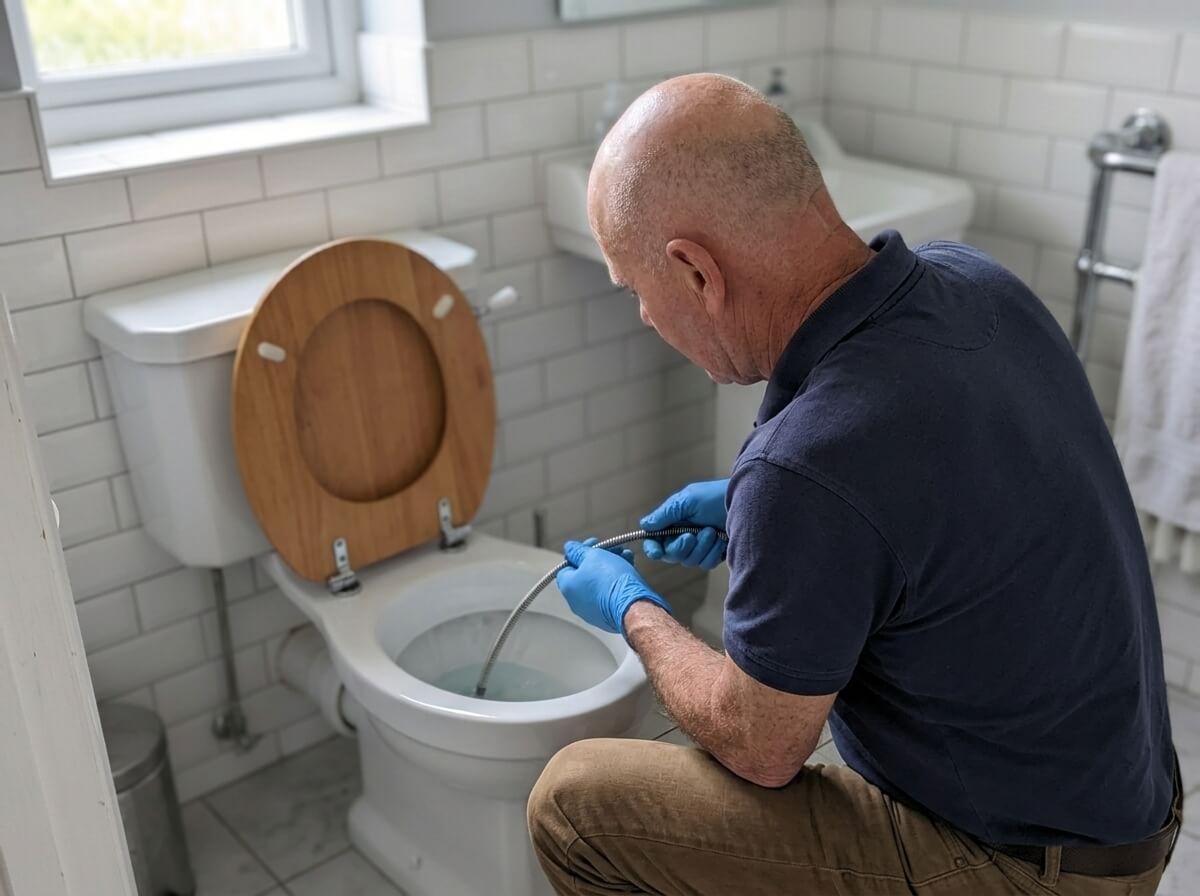
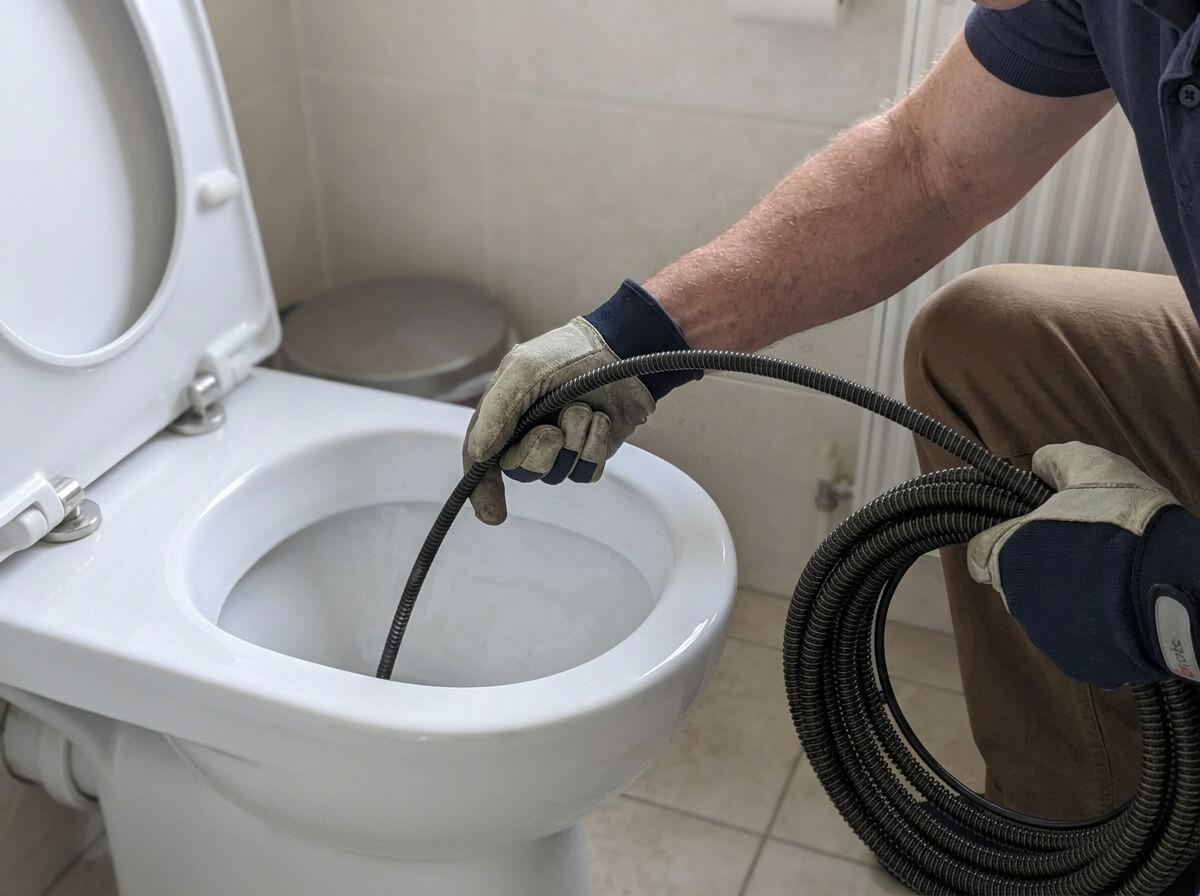
Never put a drain rod, plumber’s snake or toilet auger through the pan into the unit. The cable will catch in the blades, and you can bend the cutter or pull the rubber connector off. If a few gentle goes with a cup plunger have not moved it, stop. The blockage is further in than you can safely reach.
Saniflo Keeps Running or Will Not Stop
A unit that runs for ages after every flush, or never switches off at all, is telling you the water is going in but not coming out fast enough. It is one of the most common macerator calls I get, and you should not ignore it, because a motor that runs against a blockage overheats and wears out.
- ●Check nothing is still running into it. A cistern that is passing water into the pan will trigger the unit again and again. Take the lid off the cistern and look. My guide to a toilet that keeps running shows how to find and fix that.
- ●Look for a kinked hose. If the unit has been moved, or something has been stacked behind the toilet, the flexible discharge hose can kink. Straightening it is sometimes all it needs.
- ●Think about the weather. If it has been freezing and the discharge pipe runs outside, the pipe may have frozen. There is more on that below.
- ●Partial blockage or scale in the pipe. Years of hard water leave scale in the pump and the pipe. The unit still works, just more slowly each month, until one day it cannot keep up.
- ●Failed non-return valve. If the flap is broken or held open by debris, the water in the pipe falls straight back into the unit every time the motor stops, so it starts again. You may hear water rushing back after each run.
- ●Stuck pressure switch or damaged membrane. If the switch thinks the box is full when it is not, the motor will not turn off. This is a job for an engineer.
If it will not stop, switch it off at the spur and leave it off. Turning it back on every so often to “see if it has cleared itself” just cooks the motor.
Macerator Switches On by Itself
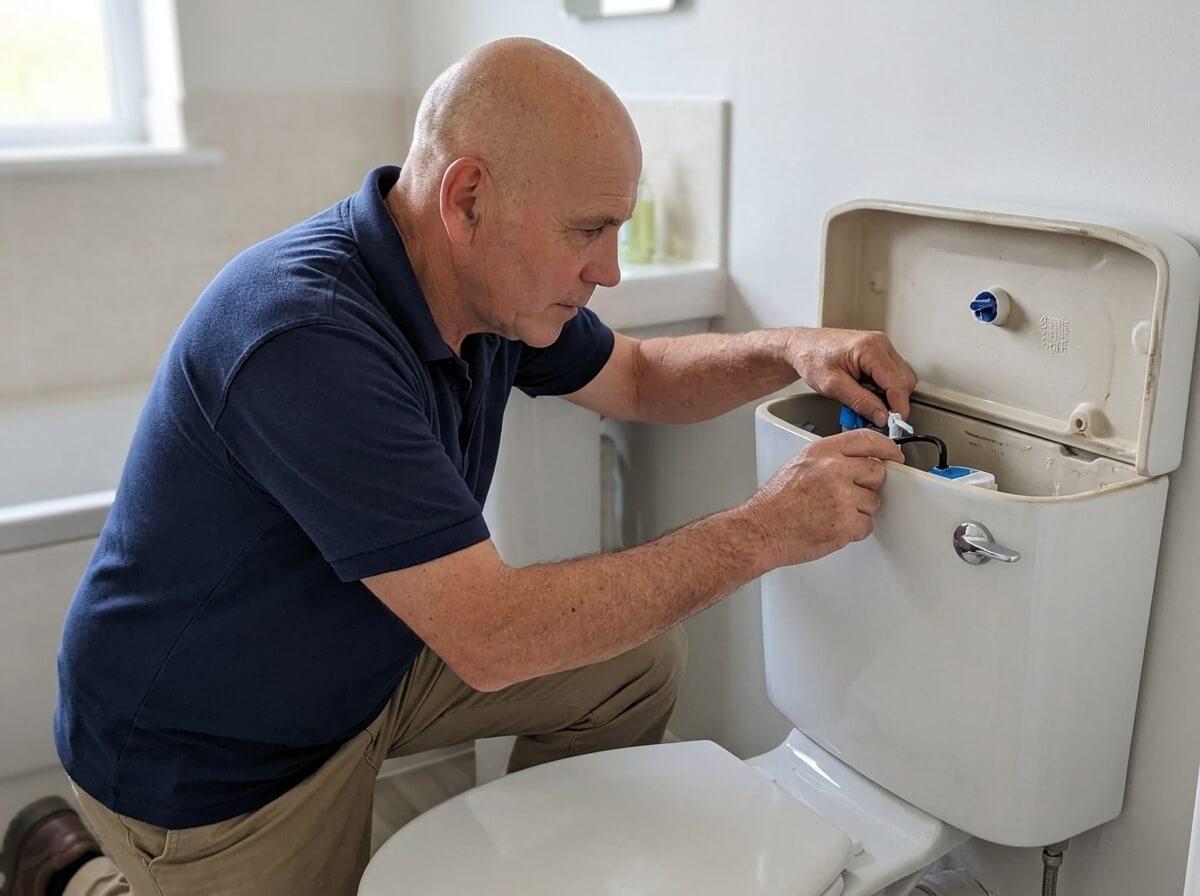
A unit that wakes up for a few seconds every so often, when nobody has been near it, is reacting to water getting in from somewhere. The manufacturer’s manual is clear on this: there should be no water dripping from the toilet cistern, because that will make the unit start repeatedly. Check these in order:
- ●The cistern. Water trickling down the back of the pan is the most common cause by a mile.
- ●Any tap or shower draining into it. A dripping basin tap or shower head will do the same.
- ●A boiler condensate pipe. Some installs run a condensing boiler’s condensate into the macerator. It will trigger the unit regularly while the heating is on, which is normal if the unit is designed to take it.
- ●The non-return valve. If nothing is dripping, water may be falling back from the discharge pipe.
It is not an emergency, but it is wasted water and wasted wear on the motor. Fix the drip and the problem usually goes with it.
Humming, Grinding or Rattling Noises
A healthy macerator makes a steady whirr for a few seconds. Anything else means something is wrong inside the unit.
- ●A hum but no whirr. The motor is getting power but cannot turn. Something is jammed in the blades or the impeller, or the motor has seized. Switch it off straight away. A stalled motor gets hot fast.
- ●Grinding, crunching or rattling. There is a solid object in the box. I have pulled out bottle tops, hair grips, a child’s toy car, a tooth brush head and more cotton buds than I could count. It will not grind its way through them.
- ●Running, stopping, running. Short bursts are normal on some models. Constant stopping and starting on a single flush, with the pan clearing slowly, points to a partial blockage or a clogged vent.
Any of these means opening the unit to get the object out or clear the impeller. On many installations that means draining down the discharge pipe and moving the toilet or the unit. It is messy, and the manufacturer says it should be done by someone approved to work on the unit, so this is where I would ask you to stop and call.
Water Coming Up the Shower, Basin or Bath
Many macerators serve a whole small bathroom: the toilet, a basin and a shower, all into the one unit. When the unit cannot pump away, the water takes the easiest way out, and that is usually up through the shower tray because it is the lowest outlet in the room. You might see clean water, grey water or, if the toilet has been used, worse.
Stop using everything in that room and switch the unit off at the spur.Do not run the shower to “flush it through”. If dirty water has come up, keep children and pets out, and clean with hot soapy water and disinfectant once it has drained. If water is coming up through the drains in a house that does not have a macerator, it is a different problem, and my guide to sewage coming up the shower or bath covers that.
Water Leaking Around the Unit or Out of the Vent
Water on the floor round a macerator is the fault I most want to hear about straight away, because the unit is electric and the spur is usually close by.
- ●Leaking at the pan connection. The rubber sleeve that joins the pan spigot to the unit can split, shrink or slip off, especially if the toilet has been knocked or the floor flexes. A plumber can refit or replace the sleeve and clip.
- ●Leaking from the discharge hose. A loose hose clip or a split in the flexible section of the outlet hose.
- ●Water from the vent while it runs. A worn membrane, a perished rubber outlet inside the unit, a heavy build-up of waste, or a motor at the end of its life. This needs the unit opened or replaced.
- ●Foam from the vent. Too much toilet cleaner or bleach. Stop adding cleaner, let it settle, and run it in short bursts. Prolonged foaming can make the motor overheat and cut out.
If a leak has been going for a while, especially in a loft room or an upstairs extension, check the ceiling below for staining. My guide to water leaking through the ceiling explains what to do if it has got through.
Macerator Tripping the Electrics
If the unit trips the fuse in its spur or the RCD on your consumer unit when it starts, water has usually got into the motor or the wiring, or the motor has failed. Reset it once. If it trips again, leave it off, switch the circuit off at the consumer unit and stop using the toilet.
Do not keep resetting it, and do not swap the fuse for a bigger one. The manual for the common domestic models says the unit must be wired into a fused, unswitched connection fitted with a 5 amp fuse, never a plug and socket, and that all work on the cable, pressure chamber and motor needs a qualified Saniflo servicing agent with special tools. A tripping macerator is almost always a replacement motor or a replacement unit.
Frozen Macerator Discharge Pipe
This one catches people out every winter. The small-bore pipe from a macerator often runs outside the house to reach the soil stack, or through an unheated garage, loft or roof void. On a hard frost, the water left sitting in it can freeze solid. The unit then runs and runs, or hums, and nothing goes anywhere.
Switch the unit off
Stop the motor running against a blocked pipe, and stop anyone using the toilet, basin or shower connected to it.
Find the cold section
Follow the pipe from the unit to where it joins the soil stack. The frozen bit is usually outside, where it runs along a wall or across a flat roof, or in an unheated space.
Warm it gently
Wrap it in towels soaked in warm water, hold a hot water bottle against it, or use a hairdryer on a low setting, kept moving. Work from the soil stack end back towards the unit. Never use a blowtorch, a heat gun or boiling water on plastic pipe.
Lag it once it is clear
The manufacturer’s manual says all external pipework should be adequately lagged. Proper pipe lagging on that run is cheap and saves the same problem every cold snap.
If the pipe has split, or you cannot reach it, call a plumber. My guide to frozen pipes has more on thawing pipes safely and stopping them freezing.
Why Does My Macerator Toilet Smell?
A macerator is designed to keep a few centimetres of water in the bottom of the unit all the time. Over months, limescale builds up on the blades and the walls of the box, waste sticks to the scale, and it starts to smell. Ipswich has hard water, so this happens faster here than in a lot of the country.
- ●Descale it. Saniflo’s manual recommends a household descaler such as its own. Switch off the power, pour descaler into the pan, flush once, leave it for one to two hours, switch the power back on and flush twice to rinse. It suggests doing this about every three months, more often in hard water.
- ●Change the carbon filter. The manual says once a year. An old filter stops trapping smells.
- ●Check for leaks. A sewage smell in the room along with damp round the unit means a seal is leaking, not just a dirty unit.
If the smell is in more than one room, or there is no macerator anywhere near it, it is likely something else entirely. My guide to a smell of sewage in the house walks through the other causes.
What You Can and Cannot Put Down a Macerator Toilet
Most blocked macerators I see were not faulty. Something went down them that should not have. The manufacturer’s manual says only toilet paper, faecal matter and waste water are covered by the guarantee, and lists the rest as foreign bodies.
| ITEM | SAFE? | WHY |
|---|---|---|
| Toilet paper | ✓ Yes | Designed to break up quickly in water. Use normal amounts, not wads. |
| Human waste and water | ✓ Yes | What the unit is built for. |
| Wet wipes, including 'flushable' ones | ✕ No | They do not break down in time and wrap round the blades. The most common cause of a blocked macerator I see. |
| Sanitary towels, tampons and applicators | ✕ No | Swell in water and jam the blades or the pump. Not covered by the guarantee. |
| Cotton buds, cotton wool and dental floss | ✕ No | Pass through the blades and tangle in the pump or the non-return valve. |
| Kitchen roll, tissues and nappies | ✕ No | Made to stay strong when wet, so they do not break up. |
| Condoms | ✕ No | Wrap round the blades. Listed by the manufacturer as a foreign body. |
| Hair, food, fat and cooking oil | ✕ No | Hair tangles and fat sets in the small-bore pipe. |
| Cat litter | ✕ No | Sets like cement in a small pipe. |
| Drain unblocker, caustic soda, acid cleaners | ✕ No | Attack the seals, membrane and motor, and invalidate the guarantee. |
Wipes labelled “flushable” deserve a special mention. They may eventually break down in a sewer, but they do not break down in the few seconds they spend in a macerator. The government is banning wet wipes that contain plastic, which will help the sewers, but a plastic-free wipe still wraps round a blade. Anglian Water, which runs the sewers across Ipswich and Suffolk, asks everyone to keep it clear and only flush the three Ps: pee, poo and paper. For a macerator, that rule is not a suggestion.
Is a Blocked Macerator Toilet an Emergency?
It depends what else is going on. Here is how I triage it on the phone.
Call straight away, day or night
- ●It is the only toilet in the house, or in an annex where someone lives.
- ●Water or sewage is coming up through a shower, bath or basin.
- ●Water is leaking onto the floor round the unit, or through a ceiling below.
- ●The unit is tripping the electrics.
- ●It is running non-stop and you cannot switch it off at the spur.
Book in soon
- ●It hums, grinds or will not run, but you have another toilet and it is switched off safely.
- ●It runs for much longer than it used to after each flush.
- ●It keeps switching itself on, and you cannot find the drip.
Not urgent
- ●A smell that goes after descaling and a new filter.
- ●Foam from the vent after a heavy dose of toilet cleaner, that settles once you stop.
For other plumbing problems, my guide to what counts as a plumbing emergency has the full triage table.
What Not to Do With a Blocked Macerator
- ✕Do not keep flushing. Each flush adds water to a unit that cannot empty.
- ✕Do not use drain unblocker or caustic soda. They attack the seals and the membrane and invalidate the guarantee. They also leave the unit full of chemicals for whoever opens it.
- ✕Do not use a rod, snake or auger. It will catch on the blades.
- ✕Do not put your hand in the unit. Not with the power on, and not with it off unless it is properly isolated and you know the unit.
- ✕Do not pour in boiling water. It can crack the pan and soften the rubber connector.
- ✕Do not keep resetting a unit that trips the electrics. Once, then leave it off.
- ✕Do not leave a stalled motor switched on. A hum means it is overheating.
- ✕Do not pull the unit away from the wall. The discharge pipe is full of waste water, and pulling the unit can split the hose or the pan connector.
Who Fixes a Macerator: Plumber or Saniflo Engineer?
This is a fair question, and the honest answer is that it depends where the fault is.
- ✓Under guarantee? Contact the manufacturer first. Guarantees depend on the unit being installed and used as the manual says, and opening the unit yourself, or having someone unapproved do it, could affect a claim. Find the model and serial number on the label before you ring.
- ✓Work inside the unit. The manufacturer says dismantling the motor, cable or pressure chamber should be done by an approved service agent, as special tools are needed.
- ✓Everything around the unit. A plumber can clear the pan and the connector, find and clear blockages in the discharge pipe, replace a non-return valve that is mounted on the outside, sort out a leaking pan connection or hose, thaw and lag a frozen pipe, fix the cistern or tap that keeps setting it off, and replace a worn-out unit with a new one.
In practice, most calls start with a plumber, because nobody knows yet which of those it is. When I come out, the first thing I do is find out whether the fault is in the unit or around it. If it is inside a unit that is still under guarantee, I will tell you and you can go back to the manufacturer. If it is in the pan, the pipe or the cistern, I fix it there and then.
Repair or Replace the Macerator?
In my experience a domestic macerator that only ever sees toilet paper, and is descaled now and then, lasts ten years or more. One that has had wipes and sanitary products through it can be worn out in a few. These are the signs it is time to think about replacing rather than repairing:
- ●The motor hums but will not turn, even with nothing jammed in it.
- ●It trips the electrics because water has got into the motor.
- ●Water comes out of the vent every time it runs.
- ●It is out of guarantee and over ten years old, and the repair is a new motor or pressure chamber.
If you are replacing it, it is worth asking whether the toilet could go onto a gravity connection instead, sometimes with a new run of soil pipe. It is not always possible, but when it is, it ends the problem for good. Building regulations guidance in Approved Document G generally allows a macerator WC only where there is also access to a toilet that drains by gravity, so if the macerator is your only toilet, that is worth knowing too.
How I Fix a Blocked or Broken Macerator Toilet
- ●Make it safe. Power isolated at the spur, water off to the cistern and anything else feeding the unit.
- ●Find where the fault is. Pan, unit or pipe. I listen to it run, time it, check the spur and fuse, and look at the pan connection, the hose and the route of the discharge pipe.
- ●Clear the pan and connector if that is where the blockage is, and check the rubber sleeve and clip are sound.
- ●Clear the discharge pipe from the soil stack end where it can be reached, check the non-return valve, and thaw and lag it if it has frozen.
- ●Fix whatever is setting it off. A passing cistern, a dripping tap, a leaking shower.
- ●Tell you straight if the unit itself has failed, whether it is worth going back to the manufacturer under guarantee, and what a replacement involves.
- ●Test it properly. Several flushes, timing the run, checking for leaks at every joint.
Before I start, I explain what I have found and agree a fair price with you, so there are no surprises. You can read more about my blocked toilet repair service, and if the problem turns out to be further down the line, in the soil stack or the drain outside, my drain unblocking service covers that. If a leak from the unit has been going on quietly and you are worried about the floor or a ceiling, my leak detection service will find out how far it has gone.
How to Stop Your Macerator Blocking Again
- ●Toilet paper only. Put a lidded bin and a small sign in the room, especially in a guest cloakroom.
- ●Descale every three months or so, more often in hard water, with a descaler made for macerators.
- ●Change the carbon filter every year. Put a reminder in your phone.
- ●Go easy on toilet cleaner. Normal amounts, and never pour drain chemicals into it.
- ●Fix drips quickly. A passing cistern or dripping tap makes the motor start all day.
- ●Lag any outside pipe before winter.
- ●Going away? The manual recommends turning off the water supply to the toilet if you are away for a long time.
- ●Know where the spur is, and make sure everyone in the house does too.
Macerator Toilet Blocked in Ipswich? Call Philip
Most of what goes wrong with a macerator comes down to something that should not have gone down it, a drip that keeps setting it off, or a pipe that cannot get the water away. Switch it off at the spur, stop using it, and if you have another toilet, call in the day and I will book you in promptly. Call me straight away, day or night, if it is your only toilet, water is coming up the shower or out onto the floor, or it is tripping the electrics.
I cover Ipswich, Felixstowe, Woodbridge, Kesgrave, Stowmarket and the surrounding towns, and I answer the phone myself, 24 hours a day, seven days a week, on 07977 857224. You can see everything else I cover on the emergency plumbing services page.