
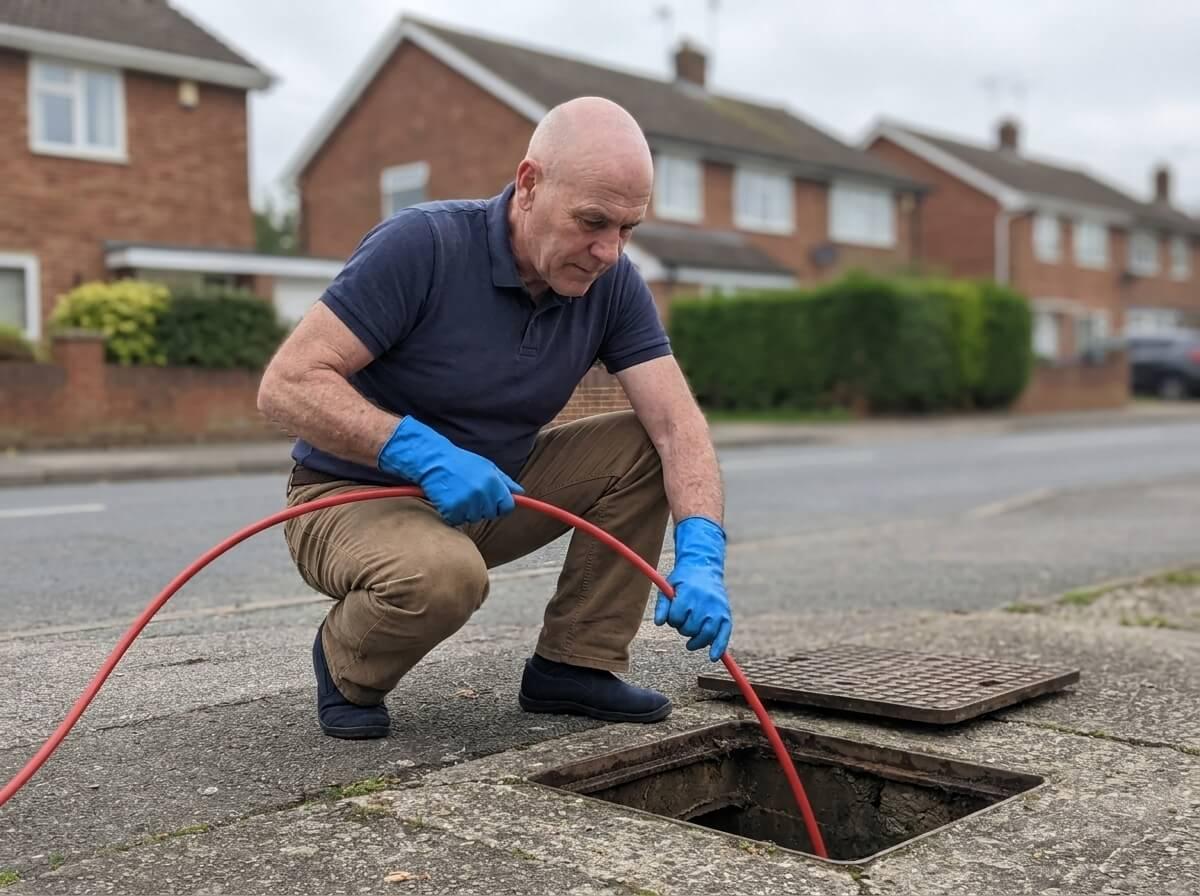
A collapsed drain rarely announces itself with a bang. It starts as a drain that is a bit slow, then a toilet that needs plunging more often than it should, then a blockage that comes back a fortnight after it was cleared. By the time most people suspect a collapse, it has usually been going on for months, and the water leaking out of the broken pipe has been quietly softening the ground around it.
I have been plumbing in Ipswich for more than forty years, and a good share of the drains I clear in the older parts of town, the Victorian terraces, the inter war semis and the post war estates, are slow or blocking for a reason that rods alone will not fix. This guide shows you how to read the signs, what to do in the first hour if the drain is backing up, how to find out whose problem it is before you spend a penny, and how collapsed drains are actually repaired. If waste is backing up into the house right now, start with the next section.
Drain Backing Up or Collapsed? Do These 6 Things Now
Whether it turns out to be a blockage or a broken pipe, the first hour is the same. These steps stop the problem getting worse and give you the information a plumber or Anglian Water will ask for.
Stop running water and flushing toilets
Every flush, shower and washing machine cycle sends more waste towards the break, and if the pipe is blocked it has nowhere to go but back up into the lowest toilet, shower or gully. Tell everyone in the house, and turn off the dishwasher and washing machine.
Keep everyone off any dip or hole
If the ground has sunk over the drain, keep children, pets and cars away from it. A small hole on the surface can sit over a much bigger void where the soil has washed into the broken pipe. Put something over it or around it so nobody steps in it in the dark.
Lift the manhole covers and look
Lift the inspection chamber covers on your property, starting with the one nearest the road. A chamber full of water with an empty one further down tells you the problem is between the two. If every chamber on your side is empty but the drain is still backing up, the problem is likely beyond your boundary. The manhole test in the blocked drains responsibility guide walks through it step by step.
Take photos and notes
Photograph the chambers, any sewage, the dip in the ground, damp walls and damage inside. Note the date the problems started and how many times the drain has been cleared. Your insurer, your landlord or Anglian Water will want all of this, and so will the person who surveys the drain.
Do not keep rodding or jetting it yourself
Rods can clear a simple blockage, but if they keep stopping at the same hard point, or soil and bits of pipe come back on them, stop. Forcing rods or a hired jetter into a broken pipe can drag the broken pieces further in, push a partial collapse into a full one and wash more soil out from under your garden.
Call the right people
If the problem is in a shared section, the lateral drain or the sewer, call Anglian Water on 03457 145 145, free, 24 hours a day. If it is on your own drain, or you are not sure, call a plumber. If you rent, tell your landlord straight away, in writing. If sewage has come into the house, the sewage coming up the drains guide covers the clean up safely.
What Is a Collapsed Drain?
Your home’s underground drain is a pipe, usually 100 millimetres across, that carries everything from your toilets, sinks, bath and shower out to the public sewer. In older homes it is made of short lengths of clay pipe joined with mortar or rubber collars. In homes built from the 1980s onwards it is usually smooth plastic. A collapsed drain is one where part of that pipe has broken, cracked, shifted or caved in, so waste can no longer flow through it properly.
The word “collapsed” makes it sound all or nothing, but there is a range. Drainage surveyors grade the damage, and in plain terms most drains I see fall somewhere along this line:
- ●Cracked. A crack along or around the pipe. It still flows, but water leaks out and roots can get in.
- ●Displaced joint. Two lengths of pipe have shifted out of line, leaving a lip that catches paper and wipes. The classic cause of a drain that keeps blocking.
- ●Fractured or broken. Pieces of pipe wall have broken away. Soil falls into the pipe and waste leaks into the ground.
- ●Deformed. The pipe has squashed out of round. Common in old pitch fibre pipes, which soften and flatten with age.
- ●Fully collapsed. The pipe has caved in and is blocked by its own broken pieces and the soil above. Nothing gets through.
Only the last one is a true collapse, but all of them can end up there if they are left. The earlier the damage is caught, the more likely it can be repaired from the manholes without digging anything up.
The 10 Signs of a Collapsed Drain
You cannot see an underground drain, so you have to read the clues it leaves above ground. One sign on its own may just be a blockage. Two or three together, especially a drain that keeps blocking, is when I start to suspect the pipe itself. Find the sign that matches what you are seeing:
| WHAT YOU NOTICE | WHAT IT USUALLY MEANS | HOW URGENT |
|---|---|---|
| The same drain blocks again within days or weeks of being cleared | Something in the pipe is catching waste: a broken section, a displaced joint or roots. The single most common sign of a collapse. | Book a plumber this week |
| Toilet, shower or sink drains slowly everywhere at once | A restriction in the main drain after all the branches join, either a blockage or a partly collapsed pipe. | Same day to this week |
| Water or sewage backing up into the bath, shower or a downstairs toilet | The main drain is fully or almost fully blocked. A collapse can do this suddenly. | Call now |
| Sewage smell outside, or inside with no obvious cause | Waste leaking out of a cracked or broken pipe into the ground, or sitting in a dip. | Same week |
| A dip, sinkhole or soft patch in the lawn, path or driveway along the drain line | Water escaping from a broken drain has washed soil away. The hole can be deeper than it looks. | Call now, and keep people off it |
| Paving or block paving sinking or rocking over the drain run | Loss of support underneath, often from a leaking drain or a collapsed section. | Same week |
| Rats in the garden, the house or the toilet | Rats live in sewers and can only get into a private drain through a gap. A broken pipe is the usual way in. | Same week, alongside pest control |
| Damp patches low on internal walls or a damp, smelly floor near the drain | A leaking drain close to or under the house soaking the ground and the brickwork. | Same week |
| New cracks in walls near where the drain runs | Possible ground movement. A leaking drain can soften or wash out the soil under foundations. | Get the drain checked before any structural survey |
| Gurgling from plugholes or the toilet after flushing | Air being pushed back through the system by a restriction further down. | Within a week or two |
The repeat blockage is the one to take most seriously. A healthy drain that has been cleared properly should stay clear for a long time. If yours blocks again within a few weeks, something inside it is catching waste, and rodding it again treats the symptom while the cause gets worse. The sewage smell guide covers smells in more detail, and why your toilet is gurgling explains what those noises mean.
Blocked or Collapsed? How to Tell the Difference
Most collapsed drains first show up as an ordinary blockage, so it is worth knowing what separates the two. This is what I look for when I lift the covers and put the rods in:
| CLUE | SIMPLE BLOCKAGE | LIKELY COLLAPSE OR BREAK |
|---|---|---|
| After it is cleared | Flows freely and stays clear for months or years. | Flows again but blocks again within days or weeks. |
| What comes out on the rods | Wipes, fat, paper, silt or leaves. | Bits of clay pipe, soil, stones, roots or mortar. |
| The rods themselves | Push through once the blockage moves. | Keep hitting the same solid point at the same distance. |
| Outside | Nothing to see beyond the full chamber. | A dip, sinkhole, sinking paving, smells or rats along the line of the pipe. |
| Water level in the chambers | Full upstream, empty downstream, then drains away once cleared. | Same pattern, but often with soil or debris in the empty chamber below. |
| Age and type of pipe | Any age. | Much more likely in clay pipes from before the 1970s or old pitch fibre pipes. |
None of these clues is proof on its own. The only way to know for certain is to put a camera down the pipe, which I cover further down. But if two or three of the right hand column match what you are seeing, it is worth getting the drain looked at properly rather than just cleared again.
The Manhole Test: Where Is the Problem?
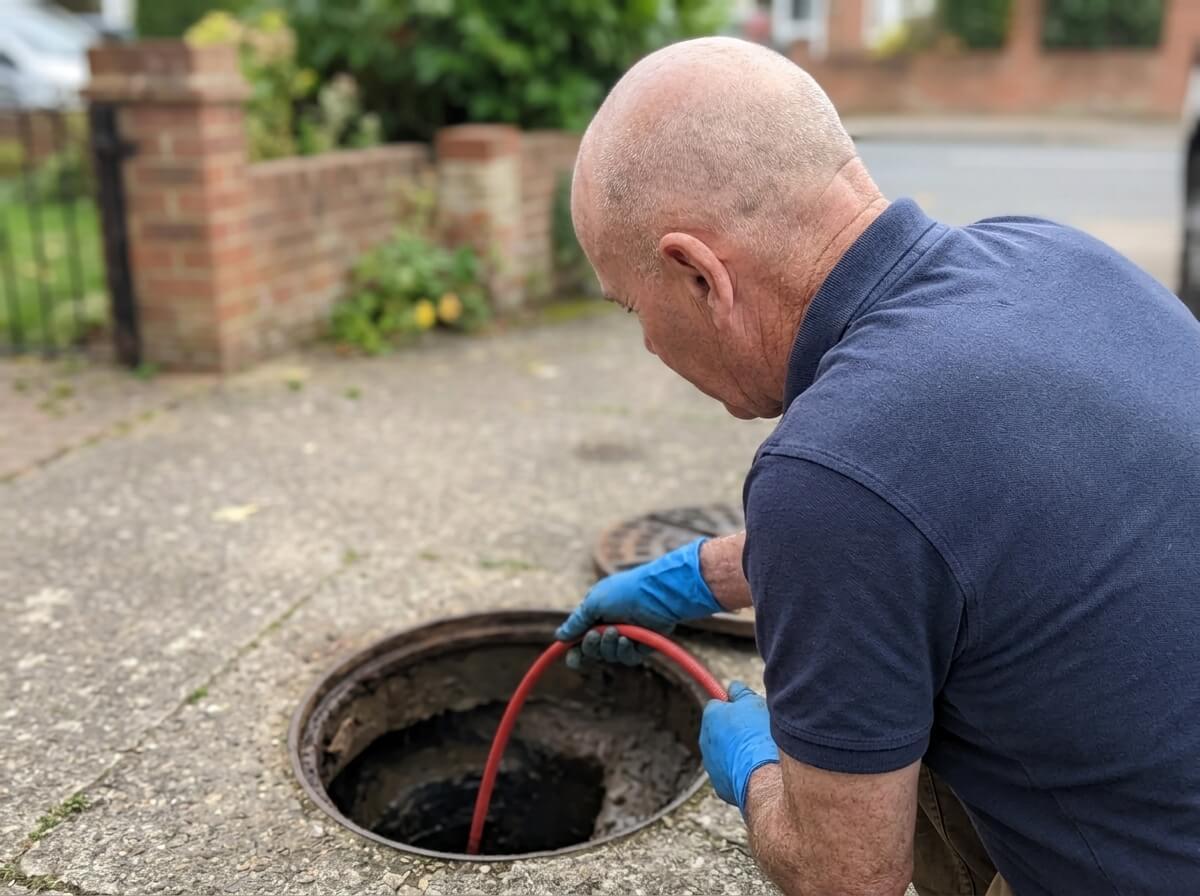
Before anyone talks about collapses, repairs or insurance, you need to know roughly where the problem is, because that decides who deals with it. You can do this yourself in a couple of minutes with a screwdriver or a garden spade to lift the covers.
- ●Find every inspection chamber. Look in the front and back garden, the driveway and along the side of the house. They are usually square or rectangular metal or plastic covers. Older houses may have one near the road and one at the back.
- ●Lift them, starting nearest the road. Use a flat blade under the edge and lift with your legs, not your back. Some old covers are rusted in. If one will not move, leave it.
- ●Read the water levels. A full chamber means the problem is downstream of it. An empty chamber means the problem is upstream. The fault is between the last full chamber and the first empty one.
- ●Look for soil and debris. Soil, stones or broken clay in the bottom of a chamber that should be clean is a strong hint that a pipe has broken further up.
- ●Check whether it is shared. If pipes from next door come into your chamber, or your drain runs into theirs, that section is probably a shared sewer and Anglian Water’s responsibility.
What Causes Drains to Collapse?
Drains do not usually fail for one reason. It is more often age plus something else: roots finding a weak joint, ground movement in a dry summer, or years of a lorry tyre running over a shallow pipe. These are the causes I come across most in and around Ipswich.
Age and old clay pipes
Clay drains last a long time, but the joints are the weak point. Pipes laid before the 1960s were often joined with sand and cement mortar, which cracks and crumbles over decades. Once a joint opens, water leaks out, soil washes in, and the two lengths of pipe slowly drop out of line. Many of Ipswich’s Victorian and Edwardian terraces still have their original drains.
Pitch fibre pipes
From the 1950s to the 1970s, a lot of homes were built with pitch fibre drains, made from wood fibre soaked in tar. They were cheap and light, but with age they soften, blister on the inside and squash out of round. If your home was built in that era and the drain is slow or keeps blocking, deformed pitch fibre is one of the first things I would want to rule out.
Tree and shrub roots
Roots go looking for water, and a leaking joint is a free supply. Fine roots get in through the smallest gap, then thicken and form a mat that catches paper and wipes. Over time they can crack the pipe open. Willows, poplars, sycamores and leylandii hedges are the usual suspects, but almost any tree near a drain can do it.
Ground movement and Suffolk clay
Parts of Suffolk sit on clay that shrinks in long dry summers and swells again when the rain comes back. That movement puts stress on rigid clay pipes and their joints. Ground that has been dug before, such as the backfill around an old trench, can also settle and leave a pipe unsupported.
Weight from above
Drains under driveways and parking areas take a lot of load, especially if they are shallow or were never designed to sit under vehicles. Skips, scaffold lorries and delivery vans parked over a drain can crack it. So can heavy machinery during building work.
Building work, extensions and new paths
Extensions, conservatories and new patios often go over or next to existing drains. If the drain is not protected, rerouted or bridged properly, the extra weight or the digging nearby can damage it. Builders sometimes clip a drain with a digger and backfill without anyone knowing. I cover the rules on this further down.
Repeated blockages and heavy handed clearing
Fat, wipes and sanitary products do not collapse a drain on their own, but repeated blockages put pressure on weak joints, and aggressive jetting at high pressure into an already damaged clay pipe can make a crack worse. Keeping what goes down the drain to the three Ps (pee, poo and paper) protects the pipe as well as stopping blockages.
Is a Collapsed Drain an Emergency?
Sometimes. A damaged drain that is still flowing can usually wait a few days for a proper look. A drain that has stopped completely, or is threatening people’s safety, cannot. This is how I would triage it:
Call straight away if
- ●Sewage is coming up into the house through a toilet, shower, bath or floor gully.
- ●Nothing in the house will drain and you have no other toilet to use.
- ●A hole or sinkhole has opened up over the drain line, especially near a path, driveway or the house.
- ●Sewage is overflowing from a manhole across a garden where children or pets play.
- ●Water is pooling against the house wall or running under the floor.
Book in within a few days if
- ●The drain is slow but still working, or has blocked more than once in a few months.
- ●There is a persistent smell outside, or rats have appeared in the garden.
- ●Paving is slowly sinking over the drain run.
- ●A buyer’s survey or a CCTV report has flagged damage but nothing has failed yet.
If you are not sure which list you are on, the is a blocked drain an emergency guide goes through it in more detail, and what counts as a plumbing emergency covers everything else in the house.
Who Is Responsible for a Collapsed Drain?
This is the question that saves people the most money, so it is worth getting right before anyone starts digging. In England, the rules changed on 1 October 2011, when most private sewers and lateral drains that were connected to the public sewer were transferred to the water companies. Around Ipswich that means Anglian Water. The result is simpler than most people expect:
| WHERE THE DAMAGE IS | WHO IS RESPONSIBLE | WHO TO CALL |
|---|---|---|
| Drain inside your boundary that serves only your home | You, the property owner | A plumber or drainage contractor, and your buildings insurer |
| Drain inside your boundary that also carries a neighbour's waste | Anglian Water (a shared sewer, since 1 October 2011) | Anglian Water on 03457 145 145 |
| Lateral drain: your pipe from the boundary to the sewer, often under the pavement | Anglian Water | Anglian Water on 03457 145 145 |
| Public sewer in the road | Anglian Water | Anglian Water on 03457 145 145 |
| Rented home, any private section | The landlord | Your landlord or letting agent, in writing |
| Flat or leasehold building, shared private drains | Usually the freeholder or management company (check the lease) | The managing agent |
| New estate where the sewers have not yet been adopted | Usually the developer until adoption | The developer, then Anglian Water to check adoption status |
| Septic tank, cesspit or treatment plant and its pipework | The owner of the system | A plumber for pipework, a tank specialist for the tank |
The two questions to ask are simple. Is the damaged section inside your boundary? Does it carry waste from your home only?If the answer to both is yes, the repair is yours. If the answer to either is no, it is almost always Anglian Water’s, and they will investigate and repair their section free of charge. The main exceptions are drains on new estates that have not been adopted yet, private pipework that never connects to the public sewer, and septic tanks and cesspits. Citizens Advice has a clear summary of who is responsible for repairing drains and sewers.
If you rent
In a rented home, repairs to the drains, pipes and the structure of the property are your landlord’s job, not yours. Report it in writing as soon as you notice a problem, keep a copy, and let them arrange the survey and repair. If it is backing up into the house and you cannot reach them, the landlord plumbing responsibilities guide explains what to do and who pays.
Flats and leasehold houses
In a block of flats, the drains that serve more than one flat are usually shared, so the private parts belong to the freeholder or management company, and anything that connects to the public sewer may now be Anglian Water’s. Check your lease, tell the managing agent, and do not commission a repair on shared drains yourself.
Can a Collapsed Drain Cause Subsidence?
It can. Water leaking out of a broken drain over months or years can wash fine soil and sand away from under a wall, or soften clay so it can no longer carry the weight above it. Leaking drains are one of the recognised causes of subsidence, and loss adjusters often ask for the drains near a cracked wall to be surveyed early in a subsidence claim.
It also works the other way. If the ground under a house moves, from tree roots drying out clay or from other causes, it can crack the drains that run beside it. So a cracked wall and a broken drain near each other do not always tell you which came first. That is a job for a surveyor and your insurer. What you can do is make sure nothing is leaking: get the drain checked, and if it is broken, get it repaired before any structural work on the wall.
Does Home Insurance Cover a Collapsed Drain?
Often, but not always. Most UK buildings insurance policies include cover for accidental damage to underground services, which normally means the drains, pipes and cables you are responsible for. A drain broken by a sudden event, such as a vehicle crushing it or ground suddenly giving way, usually falls under that. Insurers commonly exclude damage caused by gradual wear and tear, which is how many old drains fail, and some policies treat root damage or defects that were already there when you bought the house differently.
Every policy words this differently, so before you call, find the section on underground services or accidental damage. Then:
- ●Ring the claims line early. Most insurers want to be told before a repair is carried out, and some will send their own drainage contractor.
- ●Keep your evidence. Photos, dates, the receipts for any previous clearing, and any CCTV report all help the claim.
- ●Ask about trace and access. Some policies pay for finding the fault and making good, even if the pipe repair itself is excluded.
- ●Check the shared and public parts first. If Anglian Water is responsible, there is nothing to claim. They repair their section free.
- ●Do not sign up to drain cover after the fact. Standalone drain cover plans will not pay for a problem you already knew about when you took them out.
Contents damage from sewage coming into the house is normally a separate part of the claim. The insurance claim guide covers how to document damage and deal with the loss adjuster, and the water damage guide covers drying out afterwards.
How a Collapsed Drain Is Confirmed: The CCTV Drain Survey
Signs and rods can make a collapse very likely, but a camera survey is what proves it, shows exactly where it is and decides how it is repaired. Insurers, landlords and Anglian Water will usually want one before agreeing to anything.
A small waterproof camera on a flexible rod is pushed down the drain from an inspection chamber. It records video of the inside of the pipe, along with the distance from the chamber, so every defect can be pinned to a spot in the garden. A good report will show you:
- ●The pipe material and size, and which way it runs.
- ●Each defect: cracks, fractures, displaced joints, roots, deformation, sagging sections where water sits, and full collapses.
- ●The exact distance of each defect from the chamber, so a repair can be targeted.
- ●Where your drain joins any shared section or the lateral drain, which settles who is responsible.
- ●A recommendation for each defect, with stills and the video footage.
Always ask for the footage, not just the written summary. It lets you get a second opinion, and it is what your insurer will want. The drain usually needs to be cleared first so the camera can see, which is why a survey often follows straight on from clearing a blockage.
How Is a Collapsed Drain Repaired?
Not every collapsed drain means a trench across your lawn. A lot of damaged drains can now be repaired from the inside, working from the manholes. Which method is right depends on how badly the pipe is damaged, how long the damaged section is and whether the pipe still holds its shape.
| METHOD | WHAT IT IS | BEST FOR | DISRUPTION |
|---|---|---|---|
| Patch repair (localised lining) | A short resin soaked sleeve is pulled into the damaged spot and inflated so it cures against the old pipe. | A single crack, a displaced joint or a short broken section where the pipe still holds its shape. | Low. Done from the manholes, usually in a few hours. |
| Full relining (cured in place pipe) | A resin liner runs the whole length between two chambers and cures into a new pipe inside the old one. | Long runs with several cracks, root entry at many joints, or old pitch fibre that has started to deform. | Low. No digging if the pipe is still open enough to get the liner through. |
| Excavate and replace | The ground is dug out, the broken section is cut out and new plastic pipe is laid and backfilled. | A full collapse where the pipe has lost its shape, a badly sagging section, or where lining is not possible. | Higher. Paving, lawn or driveway has to come up and be reinstated. |
| Root cutting, then lining | Roots are cut out with a cutter on the jetter, then the pipe is lined so they cannot get back in through the joints. | Clay drains near trees and hedges where roots have pushed in but the pipe has not fully broken. | Low to medium, depending on how many joints are affected. |
| Rebuild or replace the inspection chamber | A broken brick manhole or failed chamber base is rebuilt, or replaced with a modern plastic chamber. | Collapsed brickwork, a broken benching or a chamber that leaks into the ground. | Medium. Limited to the area around the chamber. |
Lining: a new pipe inside the old one
Lining works by pulling a flexible tube soaked in resin into the drain and pressing it against the old pipe until it sets hard. The result is a smooth, jointless pipe inside the original one, with no gaps for roots or leaks. It needs the old pipe to still be open enough to get the liner through and to hold roughly its shape, which is why catching damage early matters so much.
Digging up and replacing
When a section has fully caved in, has sagged so badly that water sits in it, or is too deformed to line, the only option is to dig down to it, cut out the broken section and lay new plastic pipe on a proper bed. It is more disruptive, but it is a permanent fix and the new pipe is often better than the original. Any drain work is expected to meet the Building Regulations; the government’s Approved Document H on drainage sets out the standards.
What Affects the Cost of Fixing a Collapsed Drain?
There is no honest single price for a collapsed drain, because two jobs that look the same from the garden can be completely different underground. These are the things that move the cost up or down:
- ●Who is responsible. If it is Anglian Water’s section, it costs you nothing. Check this first.
- ●How bad the damage is. A single cracked joint that can be patched is a small job. A fully collapsed run is not.
- ●Length of the damaged section. Lining and replacement are both priced largely by length.
- ●Depth of the drain. Shallow drains are quicker to dig. Deep ones need more digging and shoring.
- ●What is on top. Lawn is easy to reinstate. Block paving, concrete, tarmac or a conservatory floor is not.
- ●Access. Narrow side passages, no manhole near the damage, or a drain under a neighbour’s garden all add time.
- ●Your insurance. Accidental damage cover can pay for some or all of it, less your excess.
Whoever you use, a fair quote for drain work should tell you:
- ●Exactly where the damage is and how they know (with the CCTV footage).
- ●Why they have chosen that repair method over the others.
- ●Whether the price includes reinstating paving, lawn or driveway.
- ●Whether a post repair camera survey is included to prove the fix.
- ●What guarantee comes with the work.
Be wary of anyone who quotes for a full excavation before they have put a camera down the pipe, or who will not give you the footage. The emergency plumber cost guide explains how call outs are usually charged and the warning signs of overcharging.
How Long Does a Collapsed Drain Take to Fix?
Clearing the blockage so the house can drain again is usually done on the first visit. After that, the timeline depends on who is responsible and how the repair is done:
- ●Clearing and getting water flowing: usually the same visit, often within an hour or two.
- ●CCTV survey: about an hour on site for a typical house, often straight after clearing.
- ●Patch repair or short lining: usually a few hours, from the manholes.
- ●Excavate and replace a short section: typically one to two days including reinstating the surface.
- ●Insurance claims: add time for the insurer to approve the work, which can be days or weeks.
- ●Anglian Water sections: they aim to respond quickly to sewage flooding, but planned repairs to their pipe are on their timetable.
In the meantime, if the drain has been cleared and is flowing, you can usually use the house normally while you wait, but keep an eye on the chambers and go easy on water use if it starts to slow again.
What Not to Do
- ✕Do not keep rodding a drain that stops at the same hard point every time. You can push broken pipe further in and make the collapse worse.
- ✕Do not hire a high pressure jetter and blast an old clay drain you suspect is broken. It can wash out the soil around it.
- ✕Do not pour caustic drain cleaners into a backed up drain. They will not clear a collapse, and they make the water dangerous for anyone who has to work on it.
- ✕Do not climb into an inspection chamber or put your head down one.
- ✕Do not fill in a sinkhole over a drain with soil and carry on. The void underneath is still there, and so is the leak.
- ✕Do not agree to a dig before a camera survey has shown where, and how bad, the damage is.
- ✕Do not pay for repairs to a shared drain, lateral drain or sewer before checking with Anglian Water.
- ✕Do not keep flushing wipes, fat or sanitary products into a drain you know is damaged.
Extensions, Driveways and Building Over a Drain
A lot of collapsed drains I see are near something that was built later: an extension, a conservatory, a new driveway or a garden room. If you are planning work like this, the drain has to be thought about before the foundations go in, not after.
- ●Find out what is under the plot. Lift the covers, map the drain runs and check whether any of them are shared or public sewers. A CCTV survey before you build costs far less than lifting a new floor later.
- ●Building over a public sewer needs permission. Building over or within three metres of a public sewer normally needs an agreement with Anglian Water. Ipswich Borough Council’s building control team explains building over or near sewers.
- ●Private drains under new work need protecting. Building control will want drains under or near new foundations to be bridged, sleeved or rerouted so the weight does not land on the pipe.
- ●Driveways need the right pipe. If a new driveway goes over an old shallow clay drain, have it checked and, if needed, replaced or protected before the paving goes down.
Buying a House? Get the Drains Checked
A standard homebuyer survey looks at the building, not the pipes underneath it. If you are buying an older house, especially one with mature trees nearby, a pitch fibre era build or a history of blockages, a CCTV drain survey before you exchange is money well spent. If it finds damage, you can ask the seller to fix it or adjust the price, and you will not be relying on an insurance policy that may exclude problems that were already there when you bought.
How to Protect Your Drains From Collapsing
You cannot stop a drain from ageing, but you can stop most of the things that turn a tired drain into a broken one.
- ●Only flush the three Ps. Pee, poo and paper. Wipes, even ones labelled flushable, cotton buds and sanitary products catch on joints and cause the repeated blockages that strain them.
- ●Keep fat out of the sink. Let it cool, scrape it into the bin and wipe pans before washing them.
- ●Plant trees well away from drains. As a rough rule, keep thirsty trees at least as far from the drain as their eventual height.
- ●Do not park heavy vehicles over drains. Skips and scaffold lorries especially. Ask for boards or a different spot.
- ●Lift the covers once a year. A clean chamber with water running freely through it is a good sign. Soil, roots or standing water are early warnings.
- ●Act on the second blockage. One blockage can be bad luck. Two in a few months is a reason to get the drain looked at.
If sinks or the toilet keep blocking, the guides to a toilet that keeps blocking and an outside drain overflowing are good next reads.
How I Deal With a Suspected Collapsed Drain
When I am called out to a drain that keeps blocking or is backing up, the first job is always to get your house draining again. I lift the chambers, find out where the water stops, and clear the drain with rods or the right equipment for the job. While I am doing that I am watching what comes back on the rods, how the chambers behave and whether the pipe feels sound.
Then I tell you plainly what I think. If it was a simple blockage, I will say so and tell you how to stop it happening again. If it looks like a broken or collapsed section, I will tell you where I think it is, whether it looks like your drain or Anglian Water’s, and what the next step should be, whether that is a camera survey, a call to Anglian Water or a call to your insurer. If the section is theirs, I will tell you exactly what to say when you ring them. You get a fair price agreed before any work starts, and a free, no-obligation quote for planned work.
You can read more about how I clear drains on the drain unblocking service page.
Collapsed Drains: The Key Points
- ●A drain that blocks again soon after being cleared is the most common sign of a broken or collapsed pipe.
- ●Other signs: slow drainage everywhere, sewage smells, rats, damp low on walls and dips or sinkholes along the drain line.
- ●If it is backing up, stop using water, keep people off any hole, lift the covers and call for help.
- ●Your drain is yours only if it is inside your boundary and serves only your home. Shared, lateral and public sections are Anglian Water’s.
- ●Buildings insurance often covers accidental damage to underground drains, but gradual wear and tear is commonly excluded.
- ●A CCTV survey confirms the damage. Many drains can then be lined from the manholes without digging.
Drain Backing Up in Ipswich? Call Philip
If your drain is backing up, keeps blocking, or you have spotted the signs of a collapse, stop using water and call me. I will get your drain flowing again, usually arriving in about 30 minutes for local emergencies, and give you an honest view on whether the pipe is damaged and whose job the repair is.
I cover Ipswich, Felixstowe, Woodbridge, Kesgrave, Stowmarket and the surrounding towns, and I answer the phone myself, 24 hours a day, seven days a week, on 07977 857224. See everything else on the emergency plumbing services page, or get in touch for a free, no-obligation quote.