A blocked drain is bad enough. Not knowing whose job it is makes it worse. The toilet will not go down, there is a smell in the garden, the manhole is brimming, and you are left wondering whether to ring a plumber, your landlord, the council or the water company, and who is going to send you the bill.
The good news is that for most homes the answer comes down to two questions: is the blockage inside your boundary, and does that pipe serve only your home? I have been clearing drains in Ipswich for more than forty years, and a big part of the job is telling people, honestly, when a blockage is not theirs to pay for. This guide covers what to do right now, how to find out where the blockage is in two minutes, who is responsible for every part of the drainage, and what happens with rented homes, flats and new-build estates.
Blocked Drain Right Now? Do These 6 Things First
Stop running water
Every flush, shower, bath and washing machine cycle sends more water into a drain that cannot take it, and it comes back up at the lowest point, usually a downstairs toilet, a shower tray or a gully outside. Tell everyone in the house and turn off the washing machine and dishwasher until you know what is going on.
Ask your neighbours
This is the quickest clue you will get. If next door has a slow toilet, a smell or a full manhole too, the blockage is almost certainly in a shared drain or the sewer, and it is Anglian Water’s to clear. If they are fine, it is more likely to be in your own drain.
Lift your manhole covers
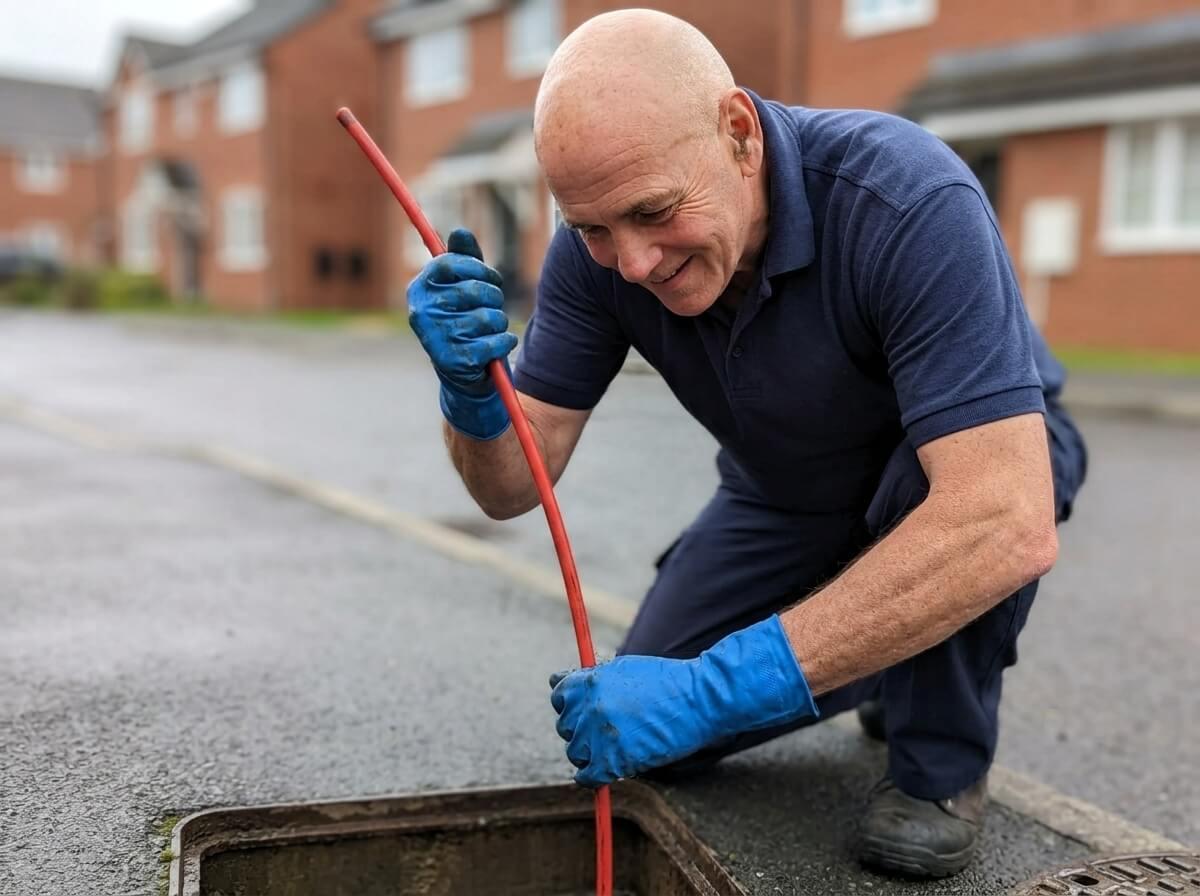
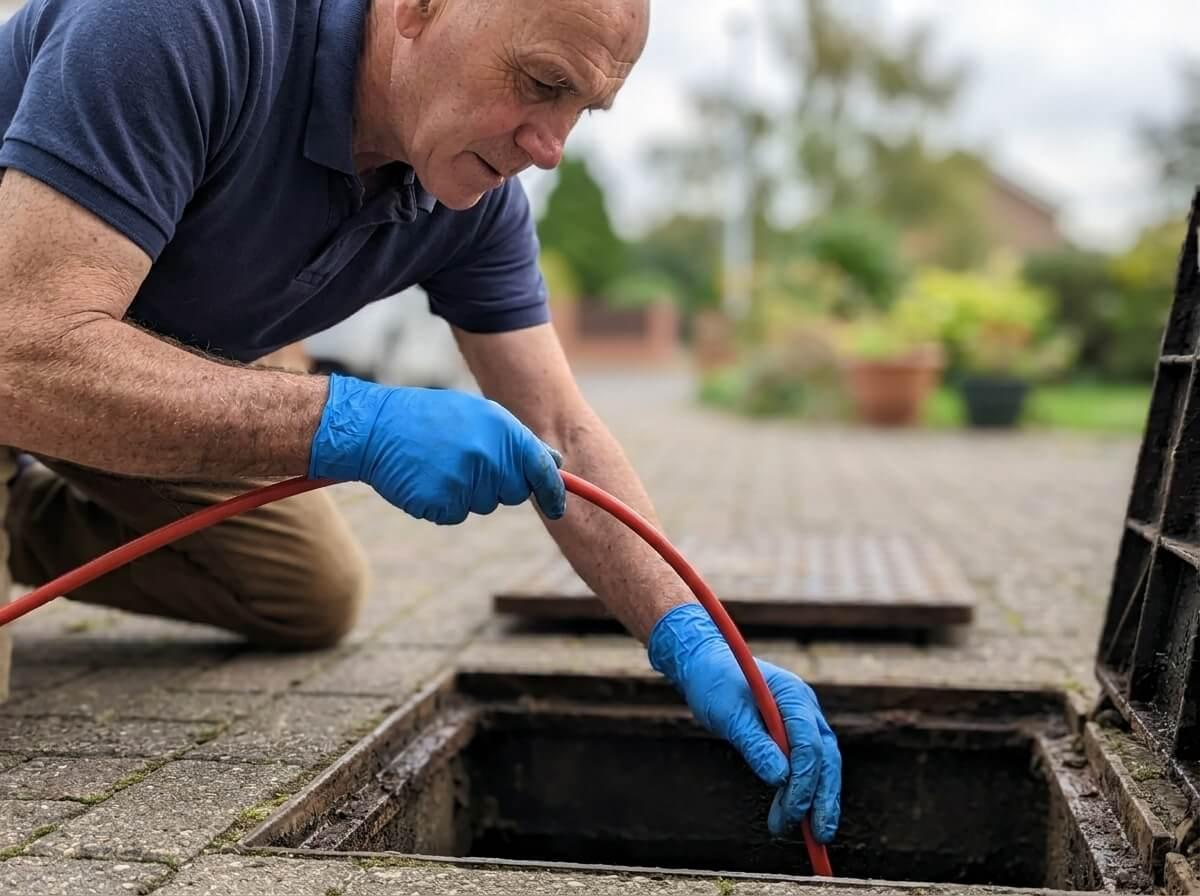
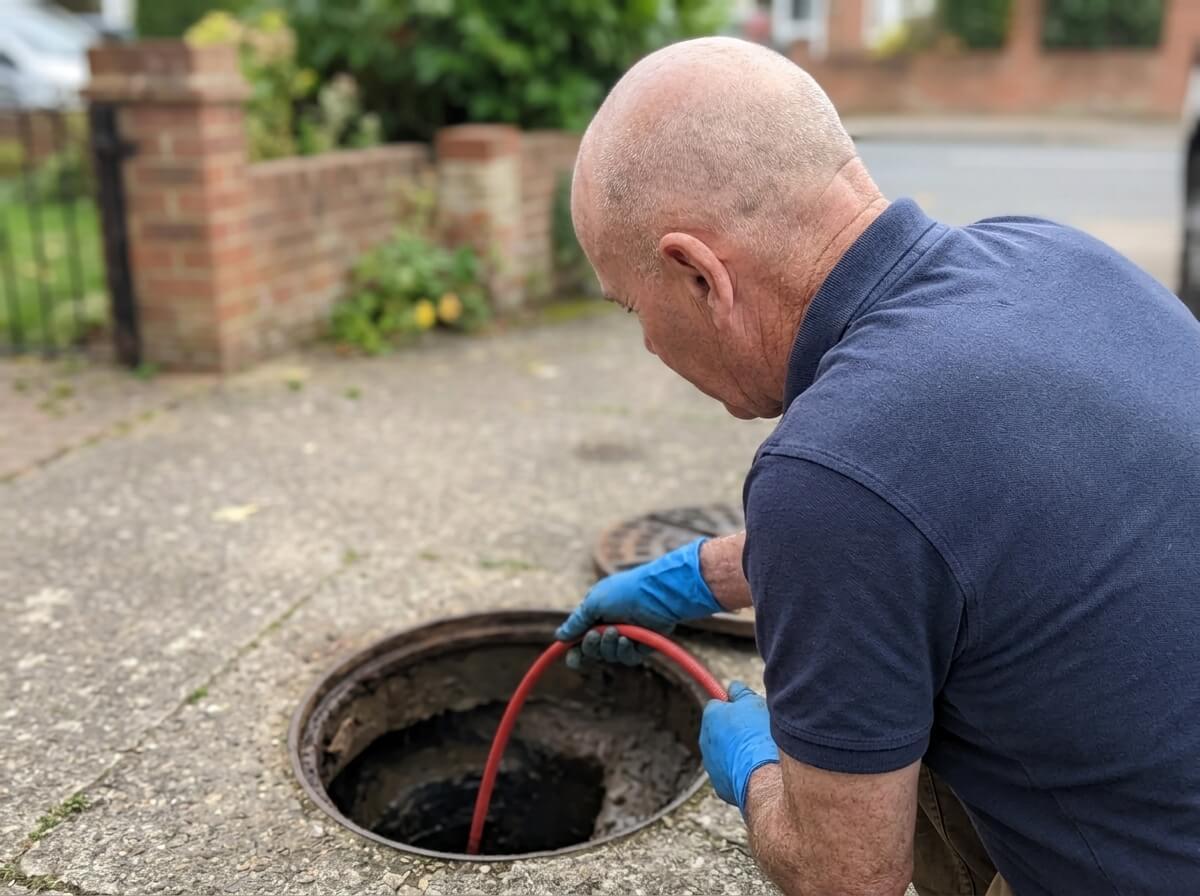
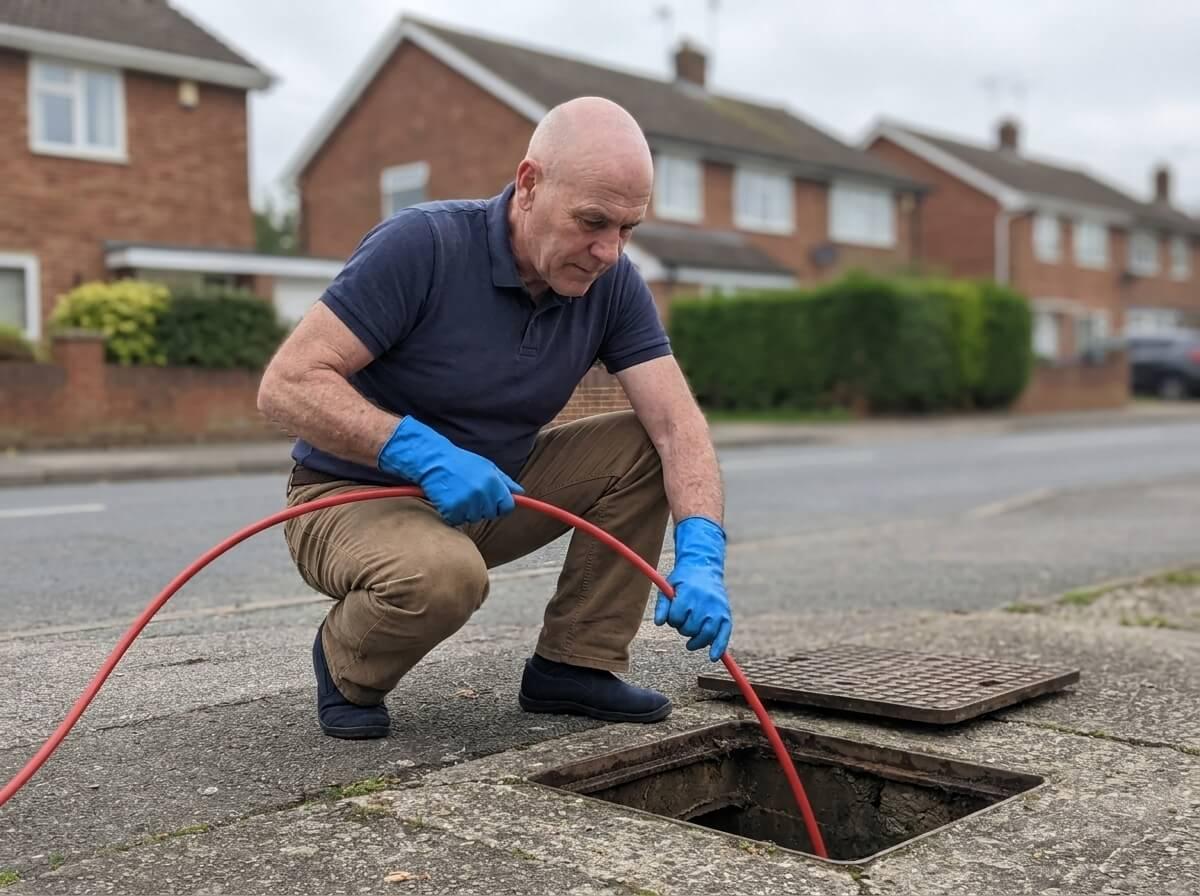
Find the inspection chambers in your garden, drive or path and look inside. Full, empty or flowing tells you where the blockage is. The manhole test below shows you how to read them. Wear gloves, lift with a screwdriver or spade under the edge, and never climb in.
Keep sewage away from people and pets
If dirty water has come into the house or the garden, keep children and pets away from it, wear rubber gloves and boots, and wash your hands well afterwards. Do not walk it through the house. My sewage coming up the drains guide covers the clean-up safely.
Do not pour chemicals down it
Drain unblocker will not shift a blockage in an underground drain, and it makes the job dangerous for whoever has to clear it. Anglian Water will not thank you for it either if it turns out to be their sewer.
Call the right people
Shared drain or sewer: Anglian Water. Your drain: a plumber. Rented home: your landlord or letting agent, then a plumber if they cannot be reached and sewage is coming in. Road drain: Suffolk Highways. Not sure: a plumber can tell you in one visit, and if it is not yours, will tell you who to ring.
Drains, Lateral Drains and Sewers in Plain English
The rules use three words that mean very specific things. Once you know them, the rest makes sense.
- ●A drain is the pipe that takes waste water from one building (and anything attached to it, like a garage) towards the sewer. If it only serves your home and is inside your boundary, it is a private drain and it is yours.
- ●A lateral drain is the part of that same drain that runs outside your boundary, usually under the pavement or road, to reach the sewer. Even though only your home uses it, it belongs to the water company.
- ●A sewer is a pipe that takes waste from more than one building. That includes the shared pipe that runs along the back of a row of terraced houses as well as the big pipe under the road. Most are public sewers looked after by the water company.
- ●An inspection chamber, or manhole, is the access point where pipes meet or change direction. Most homes have one or more under a cover in the garden, drive or path.
Why 1 October 2011 matters
Before 2011, homeowners were responsible for shared drains and lateral drains, and neighbours often ended up arguing over who should pay to clear the pipe at the back of a terrace. On 1 October 2011, the Private Sewer Transfer Regulations moved every private sewer and lateral drain that was connected to the public sewer on 1 July 2011 over to the water companies in England and Wales. Most sewage pumping stations serving more than one home followed on 1 October 2016. As Ofwat and Citizens Advice both explain, you are now only responsible for the drain that serves your property alone, inside your boundary.
The main exception is newer homes. Drains on estates built after 1 July 2011 were not transferred automatically. They only become Anglian Water’s once they are formally adopted, usually through a Section 104 agreement with the developer. Until then the developer or a management company is normally responsible for them.
Who Is Responsible for Which Part of the Drain?
This is the table I wish every householder had stuck on the fridge. Find the part of the drainage that is blocked, and it tells you who is responsible and who to ring.
| WHERE THE BLOCKAGE IS | WHO IS RESPONSIBLE | WHO TO CALL |
|---|---|---|
| Sinks, baths, showers, toilets, traps, waste pipes and the soil stack inside or on the walls of your home | You, the owner (your landlord if you rent) | A plumber |
| The underground drain from your home to your boundary, serving only your home | You, the owner (your landlord if you rent) | A plumber or drainage contractor |
| A drain shared with a neighbour that connects to the public sewer, even where it runs through your garden | Anglian Water, since 1 October 2011 | Anglian Water on 03457 145 145 |
| Your own drain once it passes your boundary, under the pavement or road (a lateral drain) | Anglian Water | Anglian Water on 03457 145 145 |
| The public sewer under the road or footpath | Anglian Water | Anglian Water on 03457 145 145 |
| Road gullies and kerbside drains that take rainwater off the road | Suffolk County Council (Suffolk Highways) | Report it to Suffolk Highways online |
| Gutters, downpipes and a soakaway on your land | You, the owner | A plumber or roofer |
| A septic tank, cesspit or treatment plant, and the pipes to it | You, shared with anyone else who uses it | A plumber for the pipes, a tank emptying company for the tank |
| Drains and sewers on a new estate built after 1 July 2011 that have not been adopted yet | The developer or the estate management company, until Anglian Water adopts them | Your developer or management company first |
| A sewage pumping station serving more than one home, in use before 1 July 2011 | Anglian Water, since 1 October 2016 | Anglian Water on 03457 145 145 |
| A pumping station or macerator serving just your home | You, the owner | A plumber or the manufacturer's engineer |
| Drains under a block of flats, inside the site boundary | Usually the freeholder or management company, depending on the lease | Your managing agent first, out of hours a plumber |
The Manhole Test: Find Out Where the Blockage Is in 2 Minutes
This is exactly what I do first when I arrive at a blocked drain, and you can do it yourself. Start at the chamber nearest the house and work towards the road, lifting each cover in turn. Waste flows downhill from the house towards the sewer, so the first empty chamber you find after a full one tells you the blockage is between the two.
| WHAT YOU SEE | WHAT IT MEANS | WHO TO CALL |
|---|---|---|
| Your first chamber (nearest the house) is full, and the next one towards the road is empty or flowing | The blockage is in the pipe between those two chambers. If both are inside your boundary and only take your waste, it is your drain. | A plumber |
| Every chamber in your garden is full, including the last one before the boundary | The blockage is probably past your boundary, in the lateral drain or the sewer. Check the last chamber for an interceptor trap first (see below). | Anglian Water |
| Your neighbour's chamber is full too, or several houses have slow toilets or smells | The blockage is almost certainly in a shared drain or the public sewer. | Anglian Water |
| Every chamber is empty and flowing, but a toilet, sink or bath in the house will not drain | The blockage is in the pipework inside the house or in the short pipe from the fitting to the first chamber. | A plumber |
| Only one sink, bath or shower is slow and everything else is fine | A local blockage in that trap or waste pipe. The underground drain is not involved. | DIY first, then a plumber |
| Water is coming up out of a road gully or the kerbside drain in heavy rain | A highway drain problem, not your drain. | Suffolk Highways |
| You cannot find a manhole, or the cover will not lift | No way to tell from the surface. A plumber can find and open the chambers, or Anglian Water can check whether a sewer is involved. | A plumber or Anglian Water |
The interceptor trap catch
Lots of older houses in Ipswich, especially Victorian and Edwardian terraces and 1930s semis, have an interceptor trap in the last chamber before the boundary. It is a U-bend in the floor of the chamber with a short pipe (the rodding arm) above it, closed off with a clay or plastic stopper. When that stopper drops out, it falls into the trap and blocks it, and the chamber fills. It looks exactly like a blocked sewer, but the trap is inside your boundary, so it is your drain. If your last chamber is full and you can see a stopper on a chain, or an open arm with no stopper, that is very likely the cause. I clear dozens of these.
Which way does the drain run?
In most homes the drain runs from the back of the house, under the garden or side path, out to the sewer in the road at the front. In many terraces it runs the other way, out the back, into a shared sewer along the gardens or a rear alley. If you are not sure, flush a toilet with a friend watching the chambers: the one the water appears in first is nearest the house. Anglian Water can also tell you where the public sewers are near your home.
Who Is Responsible in Your Type of Home
Detached house
Usually the simplest. Everything from your fittings to your boundary is yours, and the lateral drain under the pavement and the sewer in the road are Anglian Water’s. A detached house on an older plot can still share a drain with the house next door, so check for a shared chamber.
Semi-detached house
Semis often share a drain with the other half. Your own pipes up to the point where they join your neighbour’s are yours. From the junction onwards the pipe is shared, so it is Anglian Water’s, even if that shared chamber sits in your front garden.
Terraced house
Most terraces drain into a shared sewer that runs along the back or front of the row. Your branch up to where it joins the shared run is yours. The shared run is Anglian Water’s. If several houses in the row have problems at once, report it to Anglian Water before you pay anyone.
Flat or maisonette
The waste pipes inside your flat are usually yours if you own it. The soil stack and drains shared by the building are normally the freeholder’s or management company’s, but it depends on your lease, so check it or ask your managing agent. Once a pipe leaves the site, or joins a drain from another building, it is Anglian Water’s. If water from a blocked stack is coming into your flat from above, my leak from the flat above guide explains who pays.
New-build house (built after July 2011)
Check your purchase paperwork for a Section 104 agreement or ask the developer. Until the drains and sewers on the estate are adopted, the developer or estate management company is usually responsible for shared pipes, and Anglian Water may not be able to help. Your own drain inside your boundary is yours either way.
Rented home
Your landlord is responsible for anything the owner would be responsible for. Under section 11 of the Landlord and Tenant Act 1985 they have to keep the drains and sanitation in repair and working. Report it to them or the letting agent straight away, in writing as well as by phone. The exception is a blockage you clearly caused, such as wipes, nappies or fat, where your tenancy may let them pass the cost on. Shared drains and sewers are still Anglian Water’s, so you or your landlord can report those directly. My landlord plumbing responsibilities guide covers timescales, out-of-hours problems and what to do if your landlord does not respond.
Septic tank, cesspit or treatment plant
Common in the villages around Ipswich. There is no public sewer involved, so the tank, the pipes to it and the soakaway or outlet are the responsibility of the owner, shared between everyone who uses it if more than one home is connected. A full tank backs up just like a blocked drain, so if your chambers are full and the tank has not been emptied for a year or more, book an emptying first.
Who Pays for a Blocked Drain?
- ✓Your own drain: you pay. You can choose any plumber or drainage contractor. Ask for a fixed price before they start.
- ✓A shared drain, lateral drain or public sewer: Anglian Water clears it at no charge to you. Your sewerage bill pays for it.
- ✓Rented home: your landlord pays, unless the blockage was caused by something you put down the drain.
- ✓Unadopted drains on a new estate: usually the developer or management company, through the estate service charge.
- ✓A private sewer or septic tank shared by several homes: everyone who uses it shares the cost, normally in equal parts unless your deeds say otherwise.
Will my insurance pay?
Simply clearing a blockage is usually seen as maintenance and is not covered by buildings insurance. Many policies do cover accidental damage to underground pipes, such as a collapsed or cracked drain, and some include the cost of finding the damage. Home emergency cover often includes a call-out for a blocked drain inside your boundary. Check your policy, and keep the plumber’s report and any photos if the blockage turns out to be caused by a broken pipe.
Is It an Emergency, or Can It Wait?
- ✕Sewage coming up through a toilet, shower or floor drain inside the house
- ✕Your only toilet will not flush away
- ✕A manhole overflowing onto a path, patio or into the house
- ✕Someone in the house is elderly, unwell or has a baby
- ✓Everything drains, but slowly
- ✓Gurgling from plugholes or the toilet
- ✓A smell from a manhole or gully with no overflow
- ✓One sink or bath slow, everything else fine
Anglian Water treats sewage coming into a home as a priority, so tell them clearly if that is happening when you report it. If you cannot tell whose it is and sewage is coming in, do not wait to find out: get a plumber out, because the first job is the same either way, finding the blockage. For more on judging urgency, see is a blocked drain an emergency? and outside drain overflowing.
How to Report a Blocked Sewer to Anglian Water
Anglian Water is the sewerage company for Ipswich and almost all of Suffolk. You can report a blocked sewer on the Anglian Water website or by calling 03457 145 145, 24 hours a day. Your water supply may come from a different company (Essex & Suffolk Water serves parts of the county), but sewers are still Anglian Water’s. Have this ready when you call:
- ●Your address and postcode, and where the chambers are (front garden, drive, shared path)
- ●Which chambers are full and which are empty, from the manhole test
- ●Whether neighbours are affected, and which house numbers
- ●Whether sewage is inside the home, and whether anyone vulnerable lives there
- ●Photos of the chambers, if you can take them safely
Their team will check the sewer records and, if it is theirs, send a crew to clear it. If they find the blockage is in your private drain, they will tell you, and you will need a plumber or drainage contractor. Keep a note of your reference number.
When the Council Gets Involved
- ●Road gullies and highway drains: Suffolk County Council looks after the drains that take rainwater off public roads. Report blocked or flooding gullies through Suffolk Highways.
- ●Neglected private drains: if a neighbour’s blocked private drain is overflowing and they will not deal with it, the local council can step in. In Ipswich that is Ipswich Borough Council, which says it will take formal action if owners do not meet their responsibilities. Outside the town it is East Suffolk, Babergh or Mid Suffolk council. Councils can serve notice requiring a blocked drain to be cleared, and can do the work and recharge the owner if it is ignored.
- ●Rented homes: if your landlord will not clear a blocked drain, the council’s private sector housing team can take action against them.
What Causes Blocked Drains (and Who Gets Blamed)
Most shared drain and sewer blockages I see come from the same few things: wet wipes (including the ones labelled flushable), fat and cooking oil that sets hard in the pipe, sanitary products, and tree roots getting into old clay joints. Inside your own drain you can add a dropped interceptor stopper, a collapsed or dipped pipe, and silt or builder’s rubble after work on the house.
Responsibility is about where the pipe is, not who caused the blockage. But if a private drain you share with a neighbour (on an unadopted estate, for example) keeps blocking with wipes from one house, it is fair to talk to them. And if you rent, a blockage you caused can end up on your bill. My toilet keeps blocking guide covers what should and should not go down a toilet.
What Not to Do
- ✕Do not keep flushing to “push it through”. It just moves the overflow somewhere worse.
- ✕Do not pour caustic drain cleaner or acid into a chamber or a blocked toilet.
- ✕Do not rod or jet a shared drain or the public sewer yourself. It is not yours, and you can damage it.
- ✕Do not pay anyone to clear a blockage until you know whose drain it is, unless sewage is coming in.
- ✕Do not climb into a chamber or leave a cover off.
- ✕Do not ignore a blocked drain because it is “not yours”. Report it, so it gets cleared before it overflows.
How I Deal With a Blocked Drain
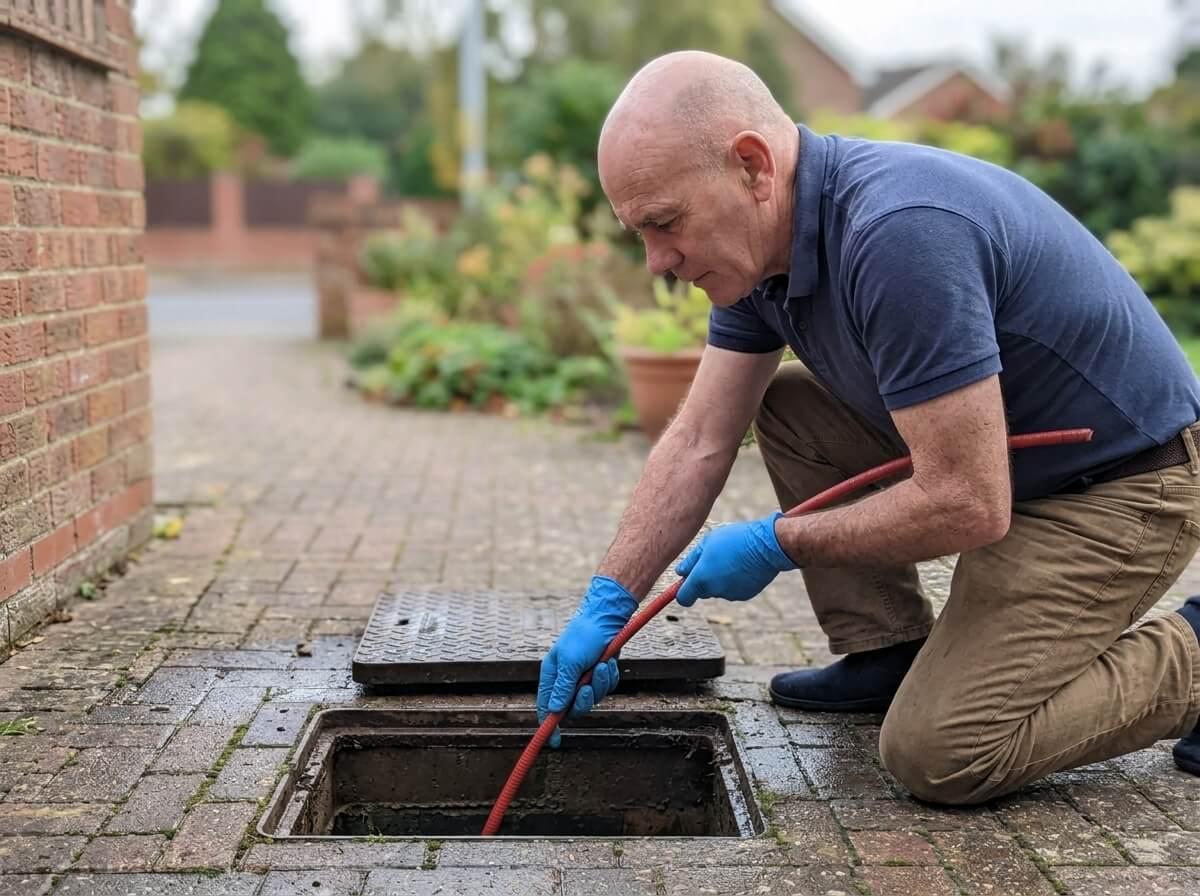
When you call me, I will ask what you can see and hear, whether neighbours are affected, and whether sewage is inside. If it sounds like Anglian Water’s sewer, I will tell you there and then and save you the call-out. If it sounds like yours, or nobody can tell, I come out, lift the covers, find where the blockage is and clear it with drain rods, then run water through to check it is flowing. I show you where it was, and if it is not in your drain I tell you who to report it to. You get a fair price agreed before work starts, and if something like a broken pipe or a missing interceptor stopper caused it, I will explain how to stop it happening again. See my drain unblocking and blocked toilet repair pages for more.
Blocked Drain in Ipswich? Call Philip
Stop running water, ask your neighbours and lift the covers. If it points to a shared drain or the sewer, report it to Anglian Water on 03457 145 145. If it is your drain, you rent and your landlord cannot be reached, or sewage is coming into the house and you cannot tell whose it is, call me straight away, day or night.
I cover Ipswich, Felixstowe, Woodbridge, Kesgrave, Stowmarket and the surrounding towns, and I answer the phone myself, 24 hours a day, seven days a week, on 07977 857224. You can see everything else I cover on the emergency plumbing services page.