You notice it on the way to the car. The block paving is wet when it has not rained. There is a puddle round the little meter cover by the pavement, or a patch of front lawn that squelches in August. Maybe water is actually bubbling up between the slabs. And the first question everybody asks me is the same: is this my problem, or the water board’s?
I have been plumbing in Ipswich for more than forty years, and outside leaks are some of the most misunderstood jobs I get called to. People wait weeks for the water company to come, only to be told the pipe is theirs. Others pay to dig up a drive for a leak that was in the pavement and would have been fixed for nothing. This guide shows you exactly where the line is, how to test which side your leak is on in ten minutes, what to do right now to stop the water, and how a supply pipe leak is found and repaired properly.
Water Leak Outside? Do These 5 Things First
Look at where the water is coming out
Stand at the front door and walk towards the road. Is the water in the road, the pavement or the verge, inside your boundary in the garden or drive, or right against the house? Is it clear or dirty? Does it smell? Take a couple of photos with something for scale. Where it surfaces is the biggest clue to whose pipe it is, although water can travel along a pipe trench before it comes up.
In the road or pavement? Report it to the water company
If the water is coming up outside your boundary, it is almost certainly the water main or the communication pipe to your house, which the water company owns. Report it on their 24 hour leakline or online map. For Anglian Water the free leakline is 0800 771 881. You do not need a plumber, and you will not be charged.
Turn off the stopcock and watch the meter
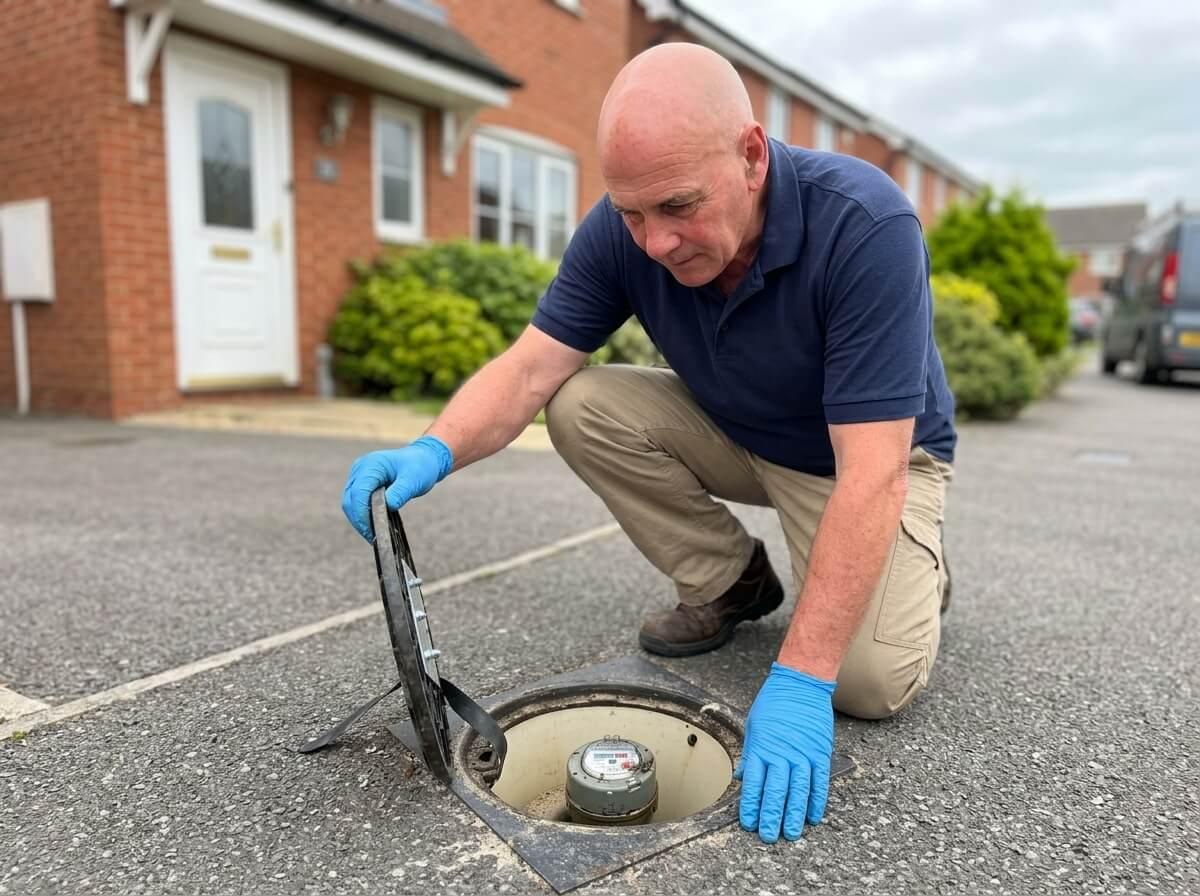
If the water is on your side, turn off the stopcock inside the house, usually under the kitchen sink. Then lift the meter cover near the boundary and watch the dial for a few minutes. If it is still moving, water is escaping between the meter and the house. The full test is below.
Water flowing hard? Close the outside stop tap
If water is running across the drive, getting under the house or towards the front door, close the outside stop tap in the chamber by the boundary, with a stop tap key if you have one. That turns off everything to the house, but stops the leak while you get help. If the stopcock indoors will not turn, see the stuck stopcock guide before you force it.
Keep the water away from the house and the electrics
Clear a route for the water away from walls and air bricks if you can, and keep it out of the meter box and outdoor sockets. If water is coming up through the floor, getting into a cellar or near electrics, switch the power off at the consumer unit if it is safe to reach, and call a plumber straight away.
Who Is Responsible for a Water Leak Outside Your House?
In England and Wales, the water reaching your kitchen tap passes through five lengths of pipe, and they are not all owned by the same people. The dividing line is almost always your property boundary, usually marked by the outside stop tap or the water meter in a small chamber in the pavement or just inside the front garden.
| THE PIPE | WHERE IT RUNS | WHO OWNS IT | WHO TO CALL |
|---|---|---|---|
| Water main | Under the road or pavement, serving the whole street | Water company | Water company leakline. Free to report and free to fix. |
| Communication pipe | From the main to your boundary, ending at the outside stop tap or meter | Water company | Water company leakline, including a leaking outside stop tap or meter in the pavement. |
| Supply pipe | From the boundary, under your garden or drive, to where it enters the house | You, the property owner | A plumber who does underground leak detection and supply pipe repair. |
| Shared supply pipe | One pipe feeding two or more homes before it splits, common under older terraces | Every property it serves, jointly | A plumber, with the cost usually split between the owners it serves. |
| Internal plumbing | Everything after the pipe comes up through the floor, from the stopcock on | You, the property owner | A plumber. See the leaking pipe and hidden leak guides. |
Two things catch people out. First, you own your supply pipe all the way to the boundary, even where it runs under a neighbour’s garden or a shared drive to get there. Second, where the outside stop tap sits inside your boundary, the water company’s responsibility usually ends at that stop tap, not at the fence line. The exact split varies a little between water companies, so if it is close, ask yours before anybody digs.
Most homes in and around Ipswich are supplied by Anglian Water, but check the name on your bill, because a few parts of Suffolk are served by a different company. Scotland works differently again, so this guide is for England and Wales.
Where Is the Water Coming Up? Leak Finder
When somebody rings me about water outside, I ask where it is, what it looks like and when it appears. Find the row that matches what you can see. The last two columns show who normally pays and how quickly it needs dealing with.
| WHAT YOU CAN SEE | LIKELY CAUSE | WHO PAYS? | URGENCY |
|---|---|---|---|
| Water bubbling up through the pavement, road or grass verge | A leaking water main or communication pipe in the public highway. | Water company | Act today |
| Water filling the meter chamber or around the outside stop tap cover | A leaking meter seal, stop tap or joint in the chamber. If the chamber is in the pavement, it is almost always the water company's. | Check first | Within days |
| A wet patch in the front garden or drive that never dries out | A leak on your supply pipe somewhere between the boundary and the house. | Usually you | Within days |
| Water running across the drive or welling up in a steady stream | A split or burst supply pipe, often after a hard frost, tree roots or ground works. | Usually you | Act today |
| Damp along the bottom of the front wall, or water under a suspended floor | The supply pipe leaking where it enters the house, often an old lead or iron joint. | Usually you | Act today |
| A bright green strip of lawn in a dry summer | Slow leak on the supply pipe watering the grass along its route. | Usually you | Within days |
| Low or falling water pressure in the house, plus a damp patch outside | A supply pipe leak large enough to rob the house of flow. | Usually you | Act today |
| Dirty, smelly water around a manhole cover or gully | A blocked or broken drain or sewer, not a water pipe at all. | Check first | Act today |
| Water only appears after heavy rain | Surface water, a blocked gully, a failed soakaway or a broken downpipe connection. | Usually you | Book in, not urgent |
| Water appearing from next door's side of the fence | Their supply pipe, a shared supply pipe, or yours crossing their land. | Check first | Within days |
Is It Mains Water, Rainwater or a Drain?
Not every wet patch outside is a leaking water pipe, and it is worth ruling out the alternatives before anyone starts digging. These checks take a few minutes.
- ●Look and smell. Mains water is clear and has no smell. Grey, brown or smelly water, toilet paper, or water rising round a manhole cover is a drain or sewer, and the outside drain overflowing guide is the one you need.
- ●Check the weather. Water that only appears after heavy rain and dries up in a dry spell is surface water: a blocked gully, a broken downpipe connection, a failed soakaway or a high water table. A mains leak runs whatever the weather.
- ●Do a chlorine test. Buy a pot of swimming pool test strips that measure total chlorine. Dip one in the puddle and one in a glass of water from the kitchen tap. Treated mains water carries a small amount of chlorine, so if both show a reading, you are almost certainly looking at mains water. Rainwater and groundwater normally read zero.
- ●Watch the meter. The surest test of all. If nothing in the house is using water and the meter is still turning, water is going somewhere it should not.
The Meter Test: Is the Leak on Your Side?
This is the test I do first on every outside leak. You need a torch, something to lift the meter cover with, and ten minutes when nobody is running water.
Stop all water use in the house
Turn off every tap. Make sure the washing machine, dishwasher, outside tap and garden hose are off, no toilet is filling, and no cistern is running into the pan. If you have a water softener, check it is not regenerating.
Find the meter and read it
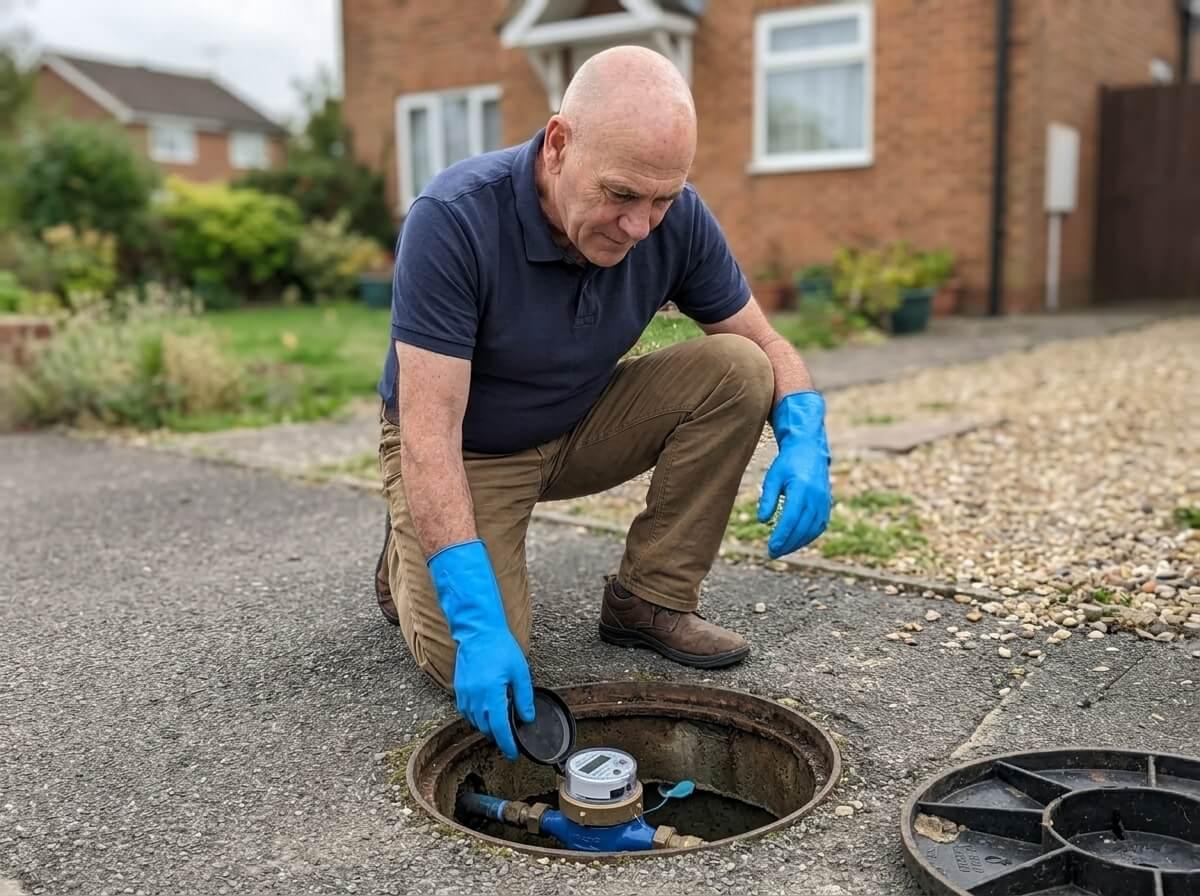
The meter is usually in a small chamber with a round or square cover in the pavement or just inside your front boundary. Lift the cover, clean the glass, and photograph the reading. Most meters also have a small red dial or a flashing symbol that moves with even a trickle of flow.
Wait, then read it again
Leave it 30 minutes, ideally an hour, with no water used, then read it again. If the numbers have moved, or the small dial is turning, water is escaping somewhere after the meter.
Now turn off the inside stopcock and repeat
Turn off the stopcock where the pipe comes into the house and repeat the test. If the meter is still moving with the stopcock off, the leak is on the underground supply pipe between the meter and the house. If it has stopped, the leak is inside the house, and the hidden water leak guide will help you find it.
Meter still and water still coming up?
If the meter is not moving at all but water keeps appearing outside, the leak is probably before the meter, on the water company’s pipe or a neighbour’s. Report it to the water company and tell them about the test you did.
No meter? Close the outside stop tap and see whether the water stops appearing within an hour or two. If it does, the leak is on your side. If it carries on, it is the water company’s pipe, or a neighbour’s. Some older Ipswich houses have the meter inside, or no outside stop tap that anyone can find, which is when a plumber with a pressure test kit saves a lot of guesswork.
Is a Water Leak Outside an Emergency?
A small damp patch that never dries is not going to flood the house tonight, but it is still costing you water and washing out the ground around the pipe. Leaks under pressure only ever get bigger. Treat it as an emergency and call a plumber or the water company now if:
- ●Water is flowing, bubbling up in a stream, or running across the drive or the pavement.
- ●Water is getting into the house, under a suspended floor, into a cellar, or up through the floor slab.
- ●Water pressure in the house has dropped, or you have lost water altogether. The no water in the house guide covers that side of it.
- ●The ground is sinking, a slab has dropped, or a hole is opening up. Running water washes out the soil and can undermine paths, drives and even foundations.
- ●Water is near electrics, outdoor sockets, garden lighting or the electricity meter box.
- ●It is freezing. Water across a path or drive becomes sheet ice overnight, and a split pipe after a frost often gets worse as it thaws.
Shared Supply Pipes in Older Ipswich Homes
Many Victorian and Edwardian terraces, and some post war semis, were built with one supply pipe that runs along the backs or fronts of several houses before branching off to each one. If your house is one of them, you may share the stop tap, the meter chamber, or a length of underground pipe with your neighbours.
If a shared section leaks, every household it serves is jointly responsible for the repair, and the water company will usually expect you to agree between you how the cost is split. Turning off a shared stop tap turns off your neighbours too, so knock on their door first if it is not a real emergency. A shared supply is also a good reason to consider a new separate supply pipe when you next have a leak, so the problem is never shared again.
Old Lead and Iron Supply Pipes
If your house was built before about 1970, the supply pipe may still be lead or galvanised steel. You can often tell by looking at the pipe where it comes up through the floor by the stopcock. Lead is dull grey, soft, and shows a bright silver mark if you gently scratch it. Galvanised steel is grey and rough with threaded joints. Modern supply pipe is blue plastic, often called MDPE.
Old pipes leak more often, usually at joints, bends and where they pass through walls, and they are often laid shallower than modern pipes, so they suffer in frosts and when drives are dug up. Lead is also a health concern for drinking water. If your outside leak turns out to be on an old lead or iron pipe, replacing the whole supply pipe is normally better value than patching it. Ask your water company whether it runs a lead replacement scheme: some will replace their own lead communication pipe at the same time, at no cost to you.
Your Water Bill and the Leakage Allowance
On a water meter, every litre that leaks out of your supply pipe passes through the meter and is billed, along with sewerage charges worked out from it. A pipe leaking a steady trickle can waste thousands of litres a week, and the first sign is often a huge bill.
The good news is that most water companies, Anglian Water included, offer metered customers a one-off leakage allowance once a leak on an underground supply pipe has been repaired. At the time of writing, Anglian Water’s guidance is that customer supply pipe leaks should be found and fixed within 30 days, and that leaks left unrepaired can lead to enforcement under the water fittings regulations. To make a claim, you will usually need:
- ●The plumber’s invoice showing where the leak was and what was repaired.
- ●Meter readings taken before the repair and again a week or two after, to show normal use has returned.
- ●Proof you acted quickly once you knew about the leak. The allowance is usually a one-off, and a leak left for months may not qualify.
Rules change and every company has its own terms, so check your water company’s current leakage allowance policy before you rely on it.
Will Home Insurance Pay for It?
Often, at least in part. Many buildings policies include accidental damage to underground service pipes, and many include trace and access cover, which pays for finding the leak and making good the hole. What they usually do not pay for is the water lost, wear and tear on a pipe that has simply reached the end of its life, or damage from a leak you knew about and left.
Check the underground services and escape of water sections of your policy. If you can, call the insurer before any major digging, and keep photos, meter readings and the plumber’s written findings. Some water companies also promote separate supply pipe cover schemes, which are worth reading carefully against what your buildings policy already includes.
How a Plumber Finds an Underground Water Leak
The expensive way to find a leak outside is to dig until you hit water. The water often surfaces metres away from the actual hole in the pipe, because it runs along the soft backfill in the pipe trench. This is how I find it instead, through our leak detection service:
- ●Confirm the leak and its size. A meter test and a pressure test on the supply pipe tell me how much water is escaping and confirm it is on your pipe, not inside the house.
- ●Trace the pipe route. Supply pipes rarely run in a straight line from the stop tap to the stopcock. I trace the route first so I am listening in the right place.
- ●Listen with a ground microphone. Water escaping under pressure makes a hiss that travels through the ground. A ground microphone picks up the loudest point along the route.
- ●Use tracer gas on plastic pipe. Plastic pipe carries sound poorly. With the pipe drained, I fill it with a safe mix of hydrogen and nitrogen, which escapes through the hole and rises through soil, tarmac and concrete to a detector at the surface.
- ●Dig one small hole. Once the leak is pinpointed, one small excavation in the right place, rather than a trench the length of the drive.
Repair or Replace the Supply Pipe?
Once the leak is found, there are two ways to fix it, and the right one depends on the pipe more than the leak.
Repairing the leak
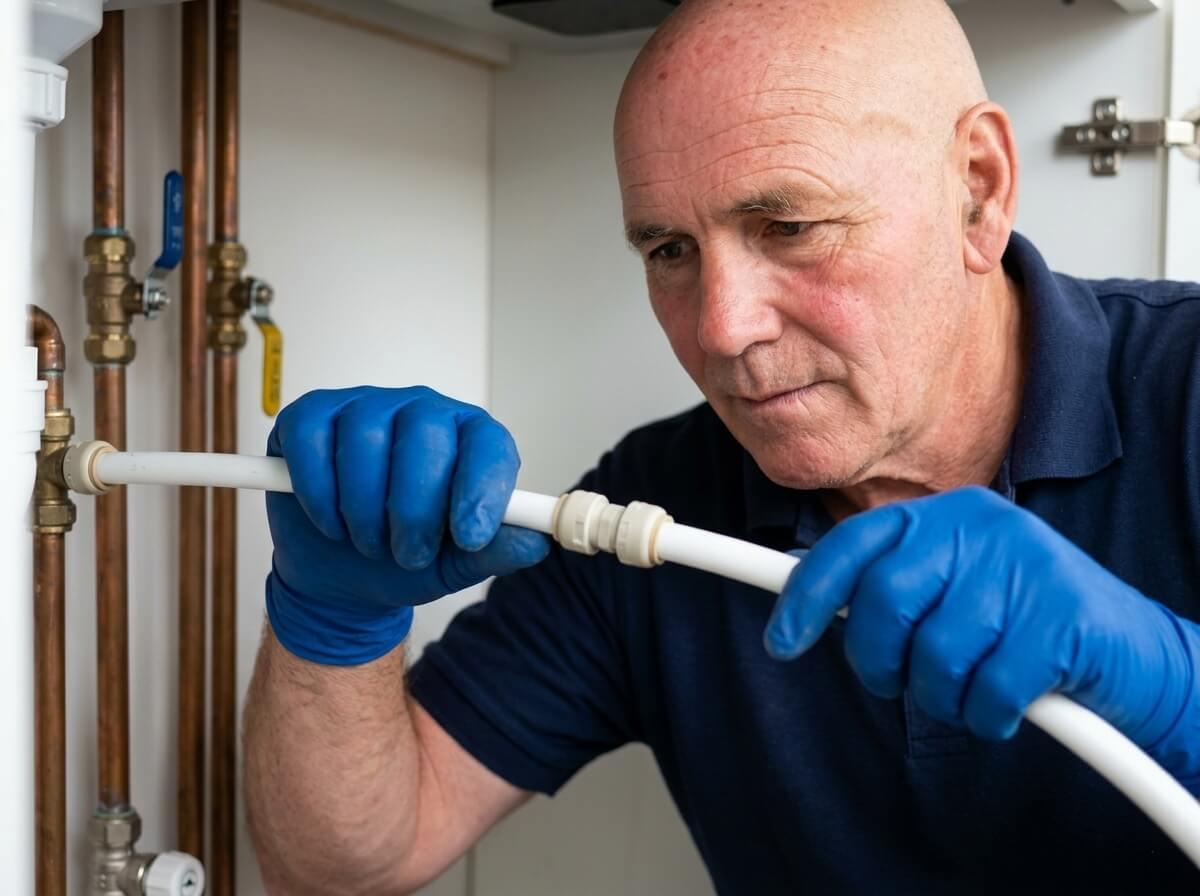
On modern blue plastic pipe with a single leak, usually from a damaged section, a failed joint or a tree root, I cut out the damaged part and fit a new section with proper fittings made for buried pipe. The pipe is bedded in sand, the hole is backfilled and compacted, and the surface is made good. It is usually done in a day.
Replacing the supply pipe
For lead, galvanised steel, early plastic, a pipe that has leaked before, a shared supply, or a house with poor water pressure, a new supply pipe is often the better answer. It does not have to mean a trench across the garden. In the right ground, a new pipe can be pulled through the old route or pushed under lawns and drives with a mole, with only a pit at each end. A new supply pipe should be laid at least 750mm and no more than 1350mm deep, and ducted where it enters the house, to meet the water fittings regulations. Your water company may also want to be told about the work, so check before it starts.
What Not to Do
- ✕Do not dig blind. The water rarely comes up directly over the hole, and gas pipes, electric cables and drains share the same ground. Never dig near the front of a house without knowing what is there.
- ✕Do not wait for it to dry up. A pressurised pipe leak does not seal itself. It washes out the ground, grows, and the water lost on a meter is billed to you.
- ✕Do not assume the water company will come. If the leak is on your side, they will usually tell you it is private, and the 30 day clock is still running.
- ✕Do not pay to dig up a drive for a public leak. Do the meter test first. If the leak is on the water company’s side, it is fixed at no cost to you.
- ✕Do not force the outside stop tap with a bar. Old stop taps snap, and a broken one in the pavement is a bigger problem than the leak. Use a proper stop tap key, or call the water company.
- ✕Do not wrap tape round a buried pipe and bury it again. Tape, putty and epoxy that work on an indoor pipe do not survive underground at mains pressure.
Who Pays in a Rented Home?
In England, landlords must keep the installations for the supply of water in repair, under section 11 of the Landlord and Tenant Act 1985. That includes the supply pipe the property owns. As a tenant, your job is to report the leak straight away, by phone and in writing, with photos, and to turn off the water if it is getting into the house. Either of you can report a leak in the pavement or road to the water company, and that costs nothing.
How to Stop It Happening Again
- ●Know where your outside stop tap is, and keep a stop tap key somewhere you can find it in the dark.
- ●Read the meter now and then. Do the overnight meter test once or twice a year. A meter that moves while you sleep is a leak you have caught early.
- ●Watch your bills. A sudden jump in a metered bill is very often the first sign of a supply pipe leak.
- ●Tell builders where the pipe runs before any new drive, wall, fence post or extension goes in. Ground works are one of the most common causes of outside leaks.
- ●Keep trees away from the pipe route, and replace an old lead or iron supply pipe before it fails, rather than after.
- ●Insulate exposed pipe where the supply comes up into the house through a cold void or garage.
Water Leak Outside Your House in Ipswich? Call Philip
If the water is coming up in the road or pavement, call the water company: it is their pipe and their bill. If it is in your garden, your drive or by the house, call me. I will confirm whose side it is on, find the leak without digging up half the garden, repair or replace the supply pipe, and give you the written findings your water company and insurer will want. You will get a fair price, agreed before I start.
I cover Ipswich, Felixstowe, Woodbridge, Kesgrave, Stowmarket and the surrounding towns, and I answer the phone myself, 24 hours a day, seven days a week, on 07977 857224. For a split or burst pipe, see our burst pipe repair service, or everything else on the emergency plumbing services page.