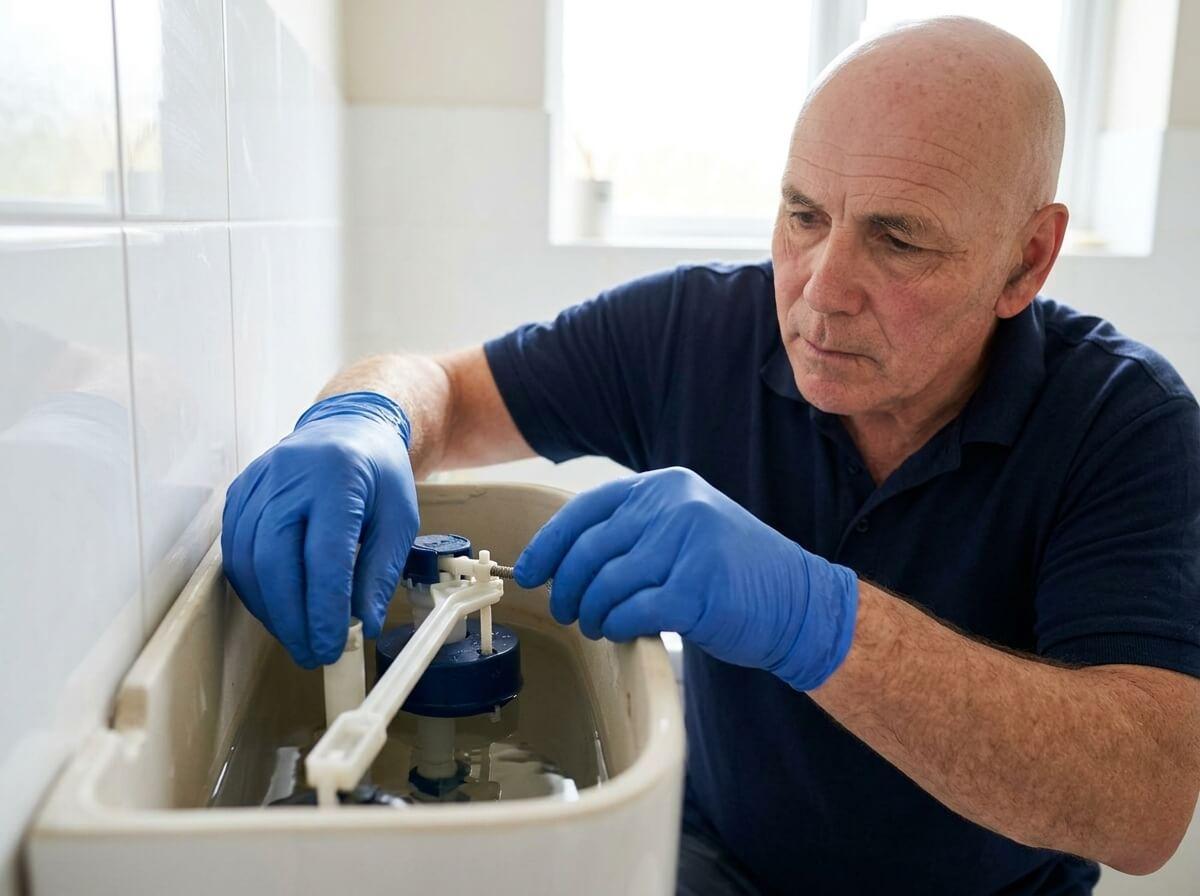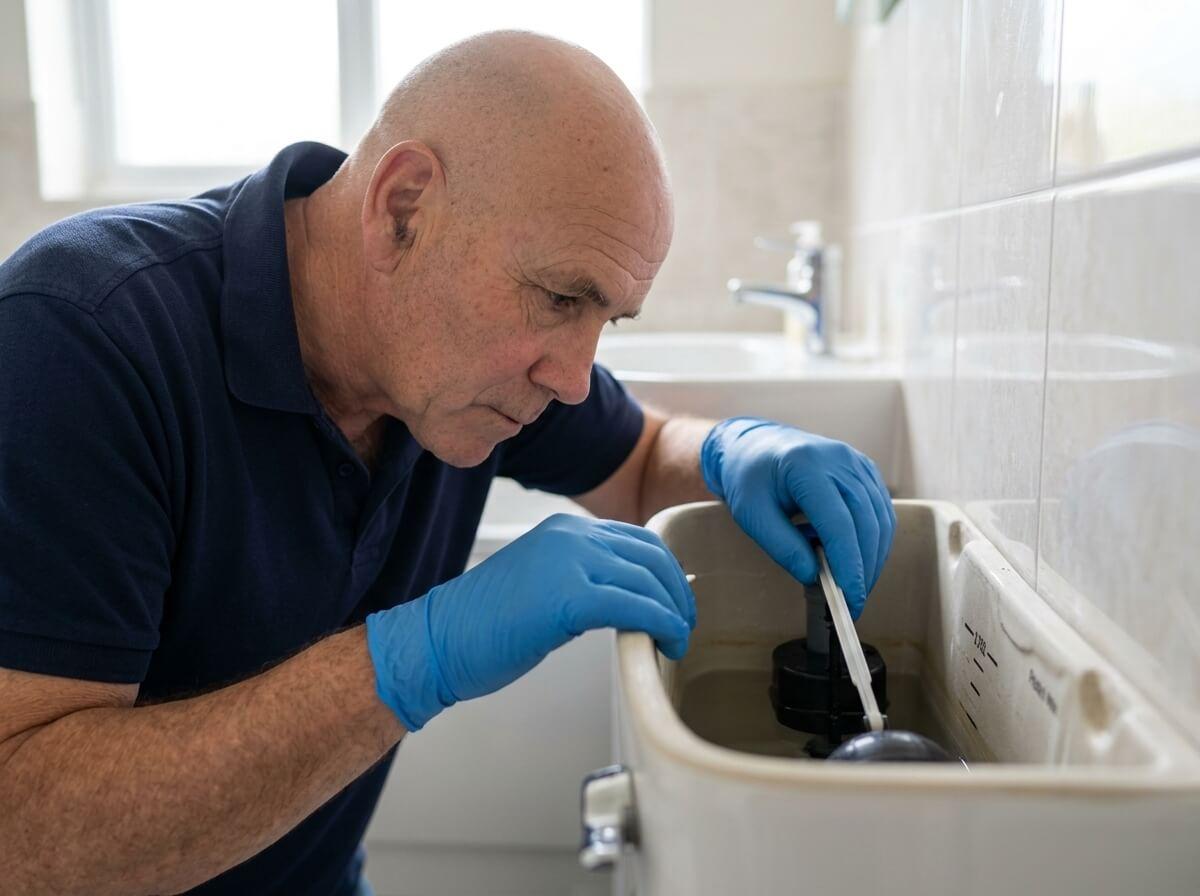
Most people find a cracked toilet in one of two ways. Either there is a crack and a bang, usually when something heavy slides off the cistern lid, or there is a puddle behind the toilet that will not go away and, after a lot of wiping and peering with a torch, a thin dark line in the china that was not there before.
Either way, it is unsettling. A cistern holds around six to nine litres and refills itself from the mains every time it empties, so a crack below the water line can keep leaking all night. A cracked pan is worse in a different way, because it is the part you sit on. The good news is that a cracked toilet is quick to make safe, and replacing it is one of the more straightforward jobs I do. This guide covers the first five minutes, how to tell a real crack from harmless crazing, which cracks are urgent, and the honest answer on whether glue and sealant are worth trying.
Cracked Toilet or Cistern? Do These 5 Things Now
None of these need tools beyond a flat screwdriver. Do them in this order.
Turn off the water to the toilet
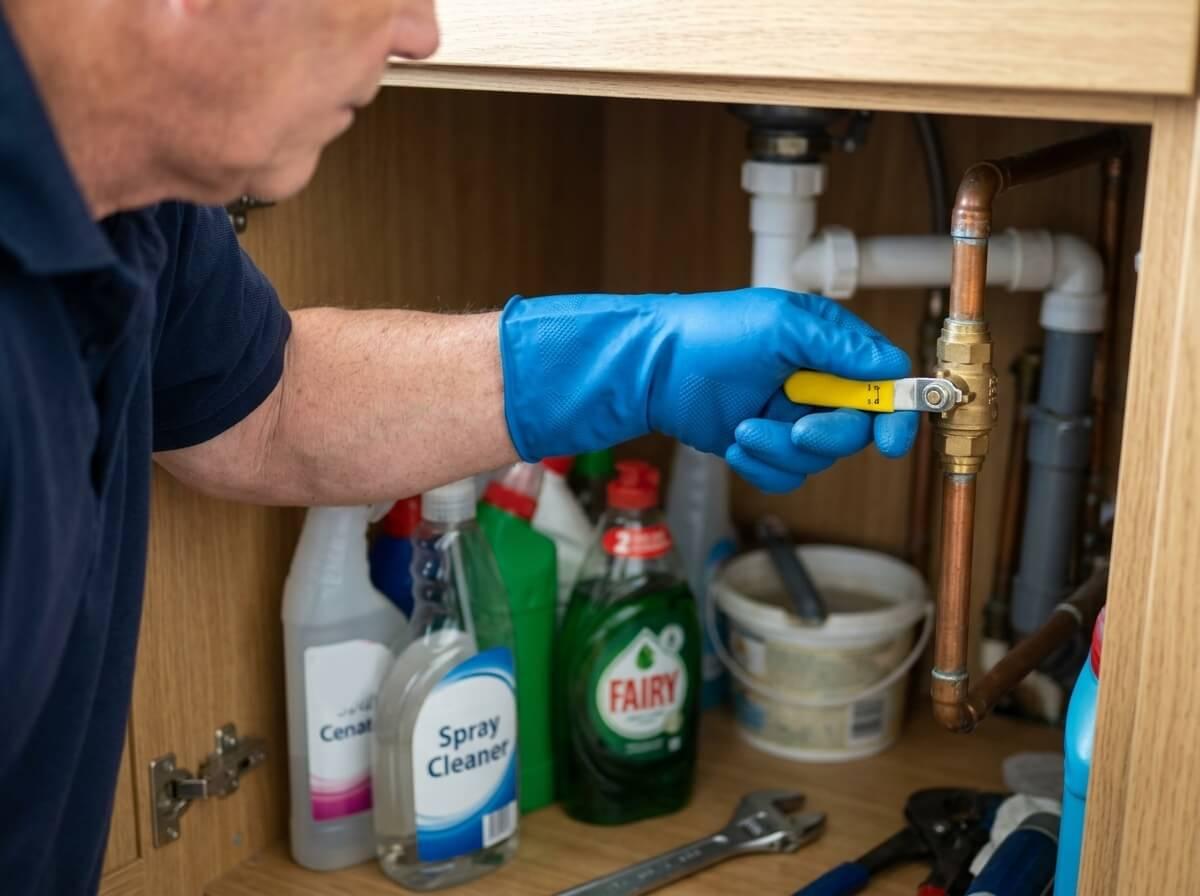
Follow the small pipe that feeds the cistern, usually coming up from the floor or out of the wall at one side. Most have an isolation valve on them: a small fitting with a slot or a little lever. Turn the slot a quarter turn with a flat screwdriver so it sits across the pipe, not along it. Our guide to the isolation valve shows what they look like. No valve, or it will not turn? Turn off the main stopcock instead, usually under the kitchen sink.
Empty the cistern
Flush once. With the water off, the cistern will not refill, so most of the water goes into the bowl rather than out of the crack. Sponge or cup out the last few centimetres left in the bottom into a bucket. A cistern that is empty cannot leak.
Contain the water and protect what is below
Towels round the base, a bowl or tray under the drip. If the bathroom is upstairs, check the ceiling below. If water has reached a light fitting, do not touch the switch: turn the lights off at the consumer unit and follow our guide to water leaking through the ceiling.
Decide whether the toilet can still be used
If only the cistern is cracked, the toilet can still be flushed by pouring a bucket of water briskly into the bowl. If the pan is cracked at the foot, round the floor fixings, at the outlet or anywhere below the water line, stop using it, keep children away, and put a note on the door.
Photograph it, then call
Photograph the crack, the toilet as a whole, any water damage and the make or model if you can see one inside the cistern or on the back of the lid. Those photos help with insurance, with your landlord, and with getting the right replacement on the van first time.
Where Is the Crack? What It Means
Where the crack is matters far more than how big it looks. A long crack in the lid is nothing. A short one in the foot of the pan can be dangerous. Find yours in the table.
| WHERE | WHAT YOU SEE | WHAT IT MEANS |
|---|---|---|
| Cistern lid | A crack or chip in the loose lid on top. No water involved | Cosmetic. Safe to use. A replacement lid can be ordered if the model is known |
| Cistern, above the water line | A line in the top half of the cistern. Dry, or only damp when the cistern is filling | Not urgent today, but it will grow. Plan a replacement cistern |
| Cistern, below the water line | A wet line, drips running down the outside, a puddle behind the toilet, the cistern slowly emptying | Turn the water off now. The cistern needs replacing and can split further without warning |
| Cistern base or bolt holes | Water appears between the cistern and the pan, or at a bolt, often after someone tightened them | Check it is not just the doughnut washer or bolt seals first. A cracked base means a new cistern |
| Pan, rim or outside of the bowl | A visible line in the china, dry to the touch, no water on the floor | Usually safe for now if it is solid. Watch it, and plan a replacement |
| Pan, inside the bowl below the water | The water level in the bowl drops between flushes, and the floor or pan connector goes damp | Stop using it if you can. The pan needs replacing |
| Pan foot or around the floor screws | A crack near the floor fixings, the pan rocks or creaks when you sit on it | Stop using it. A pan cracked here can give way under someone's weight |
| Pan outlet at the back | Dirty water on the floor behind the toilet, but only after a flush. A smell | Stop using it. Clean up with gloves and disinfectant. The pan needs replacing |
The cistern below the water line is the one I am called out to most. It leaks constantly, because the cistern is full all the time, and it tends to show up as a puddle behind the pan that people assume is condensation or a loose pipe until the line in the china finally gets noticed.
Is It Really Cracked? Four Quick Checks
A lot of “cracked” toilets are not cracked at all. Before you order anything, rule out the three things that most often get mistaken for a crack: crazing in the glaze, condensation, and a leaking joint or washer.
1. The fingernail test
Dry the area and run a fingernail across the line. Crazing is a fine web of lines in the shiny glaze only, a bit like a cracked egg shell, and your nail glides straight over it. Crazing is cosmetic, it does not leak, and plenty of older toilets have it. A real crack is usually a single line, often darker or grey from dirt getting into it, and your nail catches on it.
2. The dry tissue test
Dry the outside of the china completely with a towel, then hold a piece of dry toilet roll along the line for a minute. If it comes away damp in a neat line, water is coming through. Do it again just after a flush, while the cistern refills, because some cracks only weep under the extra pressure of filling.
3. The food colouring test
Put a few drops of food colouring in the cistern and leave the toilet unused for half an hour. Coloured water on the outside of the cistern means a crack or a failing seal. Coloured water appearing in the bowl means a leaking flush valve, which is a different and much cheaper fix, covered in our guide on how to stop a toilet cistern overflowing. To test the pan, mark the water level in the bowl with a pencil and check it an hour later. A level that has dropped, with no blockage and no gurgling, points to a crack in the trap.
4. Rule out condensation and joints
In autumn and winter the mains water coming into the cistern is very cold, and a cold cistern in a steamy bathroom sweats. That gives you drips all over the outside of the cistern, worse after showers, and no single wet line. Water that only appears where the cistern meets the pan, or at a bolt, is often the doughnut washer or the bolt seals rather than the china. Water at the back of the pan after a flush can be the pan connector. Our guide to a toilet leaking from the base takes you through each of those leaks.
Why Toilets and Cisterns Crack
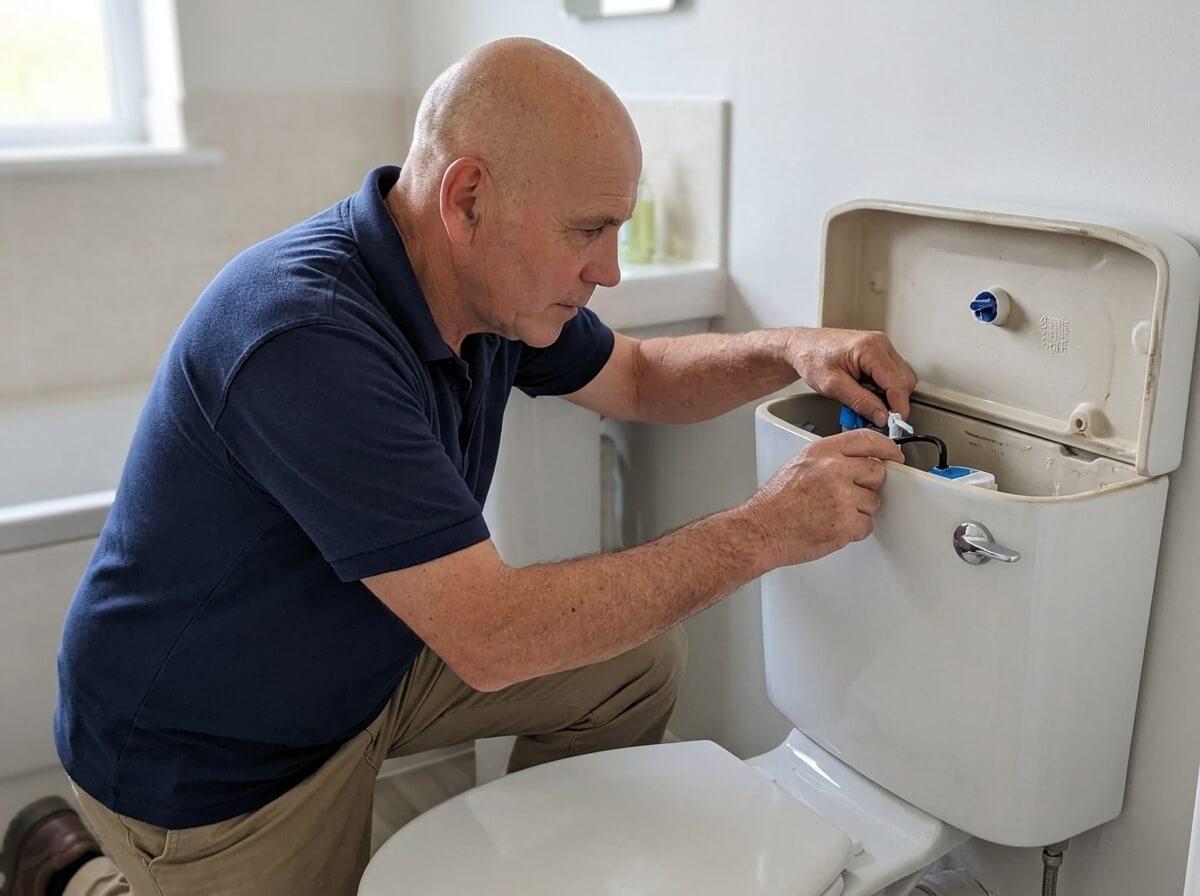
Vitreous china is hard and waterproof, but it is brittle. It copes with weight pressing straight down very well, and with twisting, point loads and sudden temperature changes very badly. These are the causes I see most.
- ●Overtightened bolts. The bolts holding a close coupled cistern to the pan, the screws fixing the cistern to the wall and the screws holding the pan to the floor all go through the china. One more turn “to stop a drip” is enough to start a crack, sometimes one that only shows weeks later.
- ●Something heavy dropped on it. A bottle of bleach, an aerosol, a glass, or the cistern lid itself knocked off while someone is cleaning. Shelves directly above a toilet are a common culprit.
- ●A pan that rocks. If the floor is uneven or the pan screws have worked loose, the pan moves a little every time someone sits down. That flexes the joint with the cistern and works on the foot of the pan until it splits.
- ●Standing on it. Using the toilet as a step to reach a window, a loft hatch or a light bulb puts the whole weight on the rim, which it is not designed for.
- ●Frost and sudden heat. A full cistern or trap in an unheated outside toilet, garage, holiday let or empty house can freeze and split, like a pipe. Pouring a kettle of boiling water into the pan to clear a blockage can crack it the other way. Use hot tap water, never boiling.
- ●Age and small flaws. Occasionally a tiny flaw from the kiln finally gives way after years of filling and emptying. It feels like the toilet cracked on its own, and in a sense it did.
Is a Cracked Toilet Dangerous?
It depends on where the crack is. There are three real risks, and it is worth being clear about each one.
Injury
A pan cracked through the foot, round the floor screws, or right across the bowl can break under someone’s weight. When vitreous china breaks, it leaves edges as sharp as glass at exactly the wrong height. This is rare, but it is the reason I tell people to stop using a pan that rocks, creaks or is cracked anywhere it carries weight. A cracked cistern is not a risk in the same way, but do not lean on it.
Water damage
A cracked cistern refills from the mains every time it drops, so a slow weep can put a surprising amount of water on the floor overnight. Upstairs, it soaks into the floorboards and comes through the ceiling below. Downstairs, it gets under vinyl and laminate and can rot the floor around the toilet for months before anyone notices. If the floor feels soft or spongy round the pan, the leak has been going a while.
Hygiene
A crack in the pan outlet or below the water line leaks dirty water, not clean. Clean it up with gloves and a disinfectant, keep children and pets away from it, and wash hands well afterwards. If you can smell sewage in the bathroom when the toilet has not just been used, our guide to a smell of sewage in the house covers the other likely causes.
Can a Cracked Toilet Be Repaired?
This is the question everyone asks, and I understand why: a tube of epoxy costs a lot less than a new cistern. The honest answer is that a crack in a toilet can be patched for a short time in a few situations, but it cannot be repaired. China does not knit back together. The crack is still there under the patch, and every fill, flush, knock and change in temperature works on it.
| FIX | GOOD FOR | LIMITS |
|---|---|---|
| Turn it off and leave it off | Isolate the cistern and flush it by hand with a bucket of water into the bowl. No leak, and the toilet still works | Only for a cracked cistern. Useless if the pan itself is cracked below the water line |
| Waterproof epoxy or porcelain repair kit | On a clean, completely dry hairline crack on the outside of a cistern above the water line, it can stop a weep for a while | Needs hours to cure with the cistern empty. Does not make the china strong again, and rarely holds below the water line |
| Silicone sealant | Very little. It may slow a weep for a day or two | Silicone does not bond well to glazed china under water and peels off. Never use it to hide a crack in a rented home |
| Waterproof tape | A stopgap on the outside of a cistern while you wait for a plumber | Will not hold back the weight of a full cistern for long. Not for pans |
| Replace the cistern or the pan | The only permanent fix. Done properly, with new washers, bolts and a valve, it lasts for decades | Needs a matching part, or a whole new toilet if the model is discontinued |
If you want to try a temporary patch on a cistern
Only on a hairline crack on the outside of a cistern, above or just at the water line, that you can reach easily. Isolate the water, empty the cistern and dry it completely, ideally overnight. Clean along the crack with a little surgical spirit, roughen the glaze lightly either side with fine sandpaper, then apply a waterproof epoxy putty or a porcelain repair compound, pressing it well in. Leave it to cure for as long as the pack says before refilling, and then check it with a dry tissue every day.
- ✓Treat it as days or weeks, not years. Order the replacement while the patch is holding, not after it fails.
- ✕Do not patch a pan below the water line, or anywhere on the foot or outlet. It carries weight and waste, and a patch hides the problem rather than solving it.
- ✕Do not patch from the inside of a full cistern. The epoxy cannot cure under water, and water pressure pushes it off.
- ✕Do not rely on silicone. It is a sealant for joints, not a glue for cracks, and it does not stick well to glazed china that stays wet.
Replace the Cistern or the Whole Toilet?
If only the cistern is cracked, replacing just the cistern sounds obvious. Sometimes it is. But on a close coupled toilet, where the cistern sits directly on the back of the pan, the two are made as a pair. The bolt holes, the flush valve outlet, the shape of the joint and even the shade of white all have to match.
| SITUATION | USUALLY THE BEST FIX |
|---|---|
| Cracked cistern, toilet under 10 years old, model known | Replace the cistern only. A matching cistern lines up with the pan, flush valve and bolts |
| Cracked cistern, model unknown or discontinued | Replace the whole toilet. A cistern from a different range rarely seals properly on the old pan |
| Cracked pan, cistern fine | A new pan if a matching one is available. Otherwise a new toilet, because the old cistern will not fit a different pan |
| Older toilet with stained, worn or scaled china | Replace the whole toilet. You get a new flush, a lower water use and no mismatched parts |
| Concealed cistern behind a panel or in a vanity unit | The cistern is plastic and rarely cracks. A cracked pan is replaced on its own, keeping the cistern and frame |
| Low level or high level cistern with a flush pipe | Often a straight cistern swap. Old high level cisterns are cast iron or china and may suit a full upgrade |
How to find your toilet’s make and model
With the water off and the lid lifted, look inside the cistern on the back wall and on the underside of the lid for a stamped name, a model number or a date. Some pans have a label or a stamp at the back near the floor. Many Ipswich homes have toilets from the big UK brands, and a lot of their popular ranges have been made for years, so a match is often possible. If there is no marking at all, a photo of the toilet from the front and the side, and the distance from the wall to the centre of the waste, is what a plumber needs.
What a new toilet has to meet
Any new toilet fitted in the UK must comply with the Water Supply (Water Fittings) Regulations 1999, which limit a single flush to a maximum of six litres and require an overflow that warns you when the fill valve fails. If your old toilet uses nine litres or more, a modern dual flush toilet will use noticeably less water, which matters if you are on a meter. The Water Regulations Advisory Scheme lists products that have been tested to meet the regulations, which is worth checking before you buy a cheap toilet online.
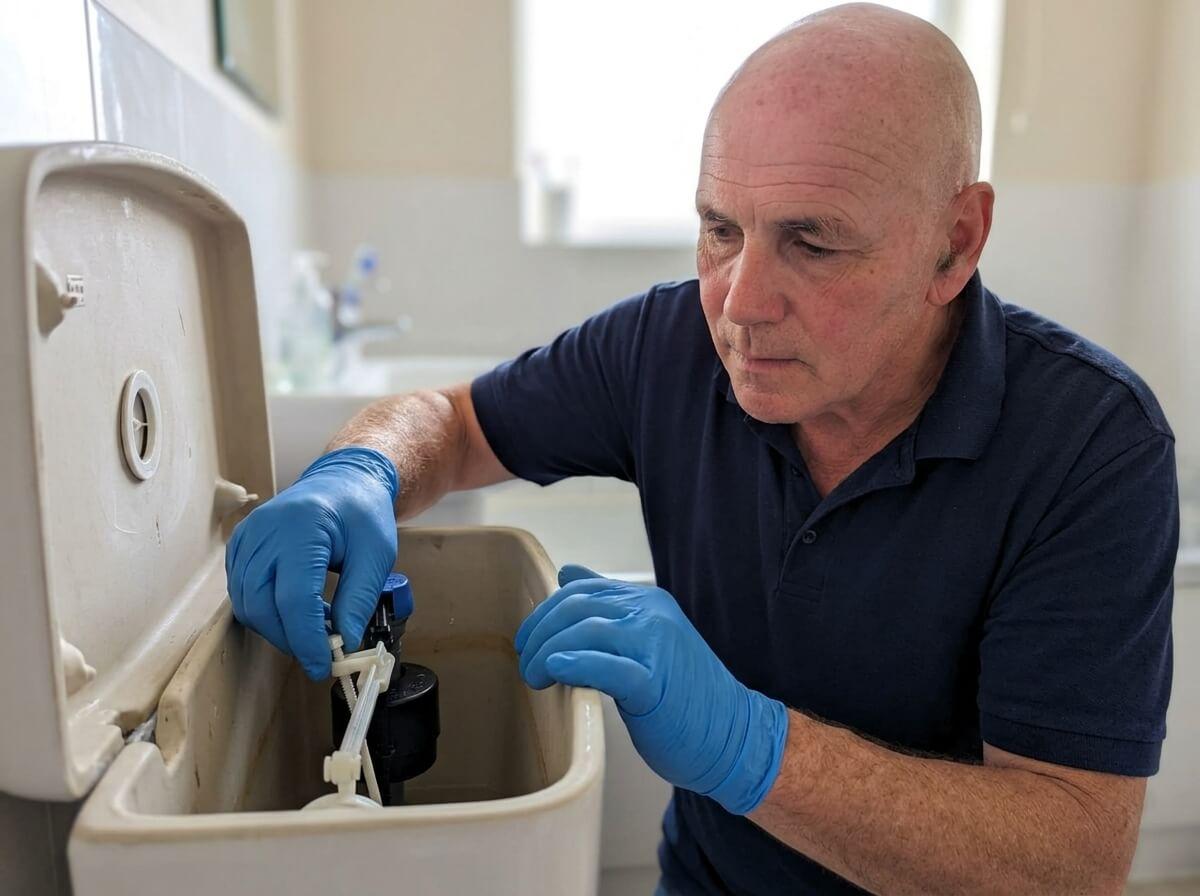
How a Plumber Replaces a Cracked Toilet
Most of the skill in this job is in the small things: not overtightening, getting the pan level and seated properly on the connector, and making sure nothing has been strained. This is how I do it on a typical call.
Make it safe
Isolate the water, empty the cistern and the pan, and check for water that has already got under the floor or through to a ceiling. If there is no isolation valve on the toilet feed, I fit one, so the next problem can be stopped with a screwdriver.
Remove the cracked part carefully
Disconnect the feed and the overflow, undo the bolts, and lift the cistern off, or release the pan from its connector and the floor. Cracked china can break as it is moved, so it comes out in one controlled lift, not in pieces.
Check the floor, the waste and the connector
With the pan out, the floor is checked for rot or softness, the soil pipe for damage, and the pan connector is replaced as a matter of course. Old cement joints into a clay soil pipe are cut out and replaced with a proper connector.
Fit the new cistern or toilet
New doughnut washer, new bolts and seals, tightened evenly until firm and no further. The pan is levelled and fixed so it cannot rock, and the cistern is fixed to the wall where it is designed to be.
Set it up and test it
The water goes back on, the fill valve is set so the cistern stops below the overflow, and the toilet is flushed repeatedly while every joint is checked dry with tissue. Then it is checked again after it has been left full for a while.
Seal and tidy
A neat bead of sanitary silicone round the base where the pan meets the floor, with a small gap left at the back so any future leak shows up rather than soaking the floor unseen. The old toilet is taken away.
A cistern swap is often done in an hour or two once the right cistern is on site. A full toilet replacement usually takes a few hours. Concealed cisterns, back to wall units and awkward old soil pipes take longer. In an emergency, the first visit makes it safe and stops the leak, and the replacement follows as soon as the part is sourced. Either way, I agree a fair price before any work starts.
Is a Cracked Toilet an Emergency?
Not always. What decides it is whether water is escaping, where it is going, and whether you have another toilet in the house.
- ✕Call now: water you cannot stop, water coming through a ceiling or near a light fitting, a pan that has broken, or a cracked pan when it is the only toilet and there are children, older or vulnerable people in the house.
- ✓Same day: the water is off at the isolation valve, the floor is dry, and you can flush with a bucket or use another toilet.
- ✓Book in: a dry hairline crack above the water line, a cracked lid, or crazing you would like checked.
Still not sure? Our guide to what counts as a plumbing emergency walks through it, and our guide to emergency plumber costs explains why a same day visit is usually cheaper than a night call out.
Will Insurance Pay for a Cracked Toilet?
Quite often, yes, and more often than people expect. Many buildings insurance policies include accidental breakage of fixed sanitary ware, which means toilets, cisterns, basins and baths, even if you have not paid for full accidental damage cover. Water damage to floors and ceilings is usually a separate escape of water claim.
- ●What is usually covered: a toilet broken by a sudden accident, such as something dropped on it, and the water damage from a sudden leak.
- ●What is usually not: wear and tear, crazing, a crack that has been leaking slowly for months, and damage from a leak you knew about and left.
- ●Check the excess: for a single cistern, the excess can be close to the cost of the job, so check before you claim.
- ●Keep the evidence: photos of the crack and the damage, the plumber’s invoice, and a note of what happened and when.
Our guide to a burst pipe insurance claim explains how escape of water claims work in more detail.
Renting?
In most tenancies in England, the landlord is responsible for keeping toilets and other sanitary fittings in repair. Tell your landlord or letting agent straight away, in writing, with photos, and turn the water off in the meantime. If the toilet was cracked by something you or a guest did, the landlord can usually recharge the cost, but a crack that is reported quickly is always cheaper for everyone than one that has been leaking into the floor. Shelter’s advice on repairs explains how to report repairs and what to do if they are not done.
How to Stop It Happening Again
Once a new toilet is in, a few simple habits keep it in one piece for decades.
- ✓Keep the cistern lid clear. No bottles, candles or ornaments on top, and no shelf of heavy things directly above the toilet.
- ✓Never overtighten. If a joint drips, the washer is usually the problem, not the bolt. Firm is enough.
- ✓Fix a rocking pan early. If the pan moves when you sit down, get the fixings and the floor looked at before the china gives.
- ✓No boiling water in the pan. Hot tap water is fine for a slow toilet. A kettle of boiling water is not.
- ✓Do not stand on it. Use a step ladder for the window, the loft hatch and the light bulb.
- ✓Protect empty and unheated toilets in winter. Turn off, flush and drain the cistern, and keep a little heat on.
- ✓Make sure there is an isolation valve. A small fitting on the toilet feed means the next problem is stopped in seconds.
Cracked Toilet in Ipswich? Call Philip
I cover Ipswich, Felixstowe, Woodbridge, Kesgrave, Martlesham and the surrounding towns and villages 24 hours a day, usually with you in about 30 minutes for local emergencies. I make it safe, stop the water, and replace the cracked cistern or toilet with a properly fitted one, tested before I leave. If the water has been running into the floor and you are not sure how far it has gone, our leak detection service finds it before it turns into rot and mould. For a cistern that is running or overflowing rather than cracked, see our overflowing cistern repairs, and for a toilet that will not clear, our blocked toilet repair service. For anything else, see all our emergency plumbing services.
Cracked Toilet or Cistern: The Key Points
- ●Turn off the isolation valve on the toilet feed, or the main stopcock, then flush to empty the cistern.
- ●Keep water away from light fittings below, and switch off at the consumer unit if it reaches one.
- ●Do not tighten bolts, lean on a cracked cistern or sit on a pan cracked at the foot, outlet or below the water.
- ●Rule out crazing, condensation and leaking washers with the fingernail, tissue and food colouring tests.
- ●Epoxy can buy a little time on a dry hairline crack in a cistern. It is never a permanent repair.
- ●Cistern only if you can get an exact match. Otherwise, a whole new toilet is usually the better fix.
- ●Check your buildings insurance for accidental breakage of fixed sanitary ware.