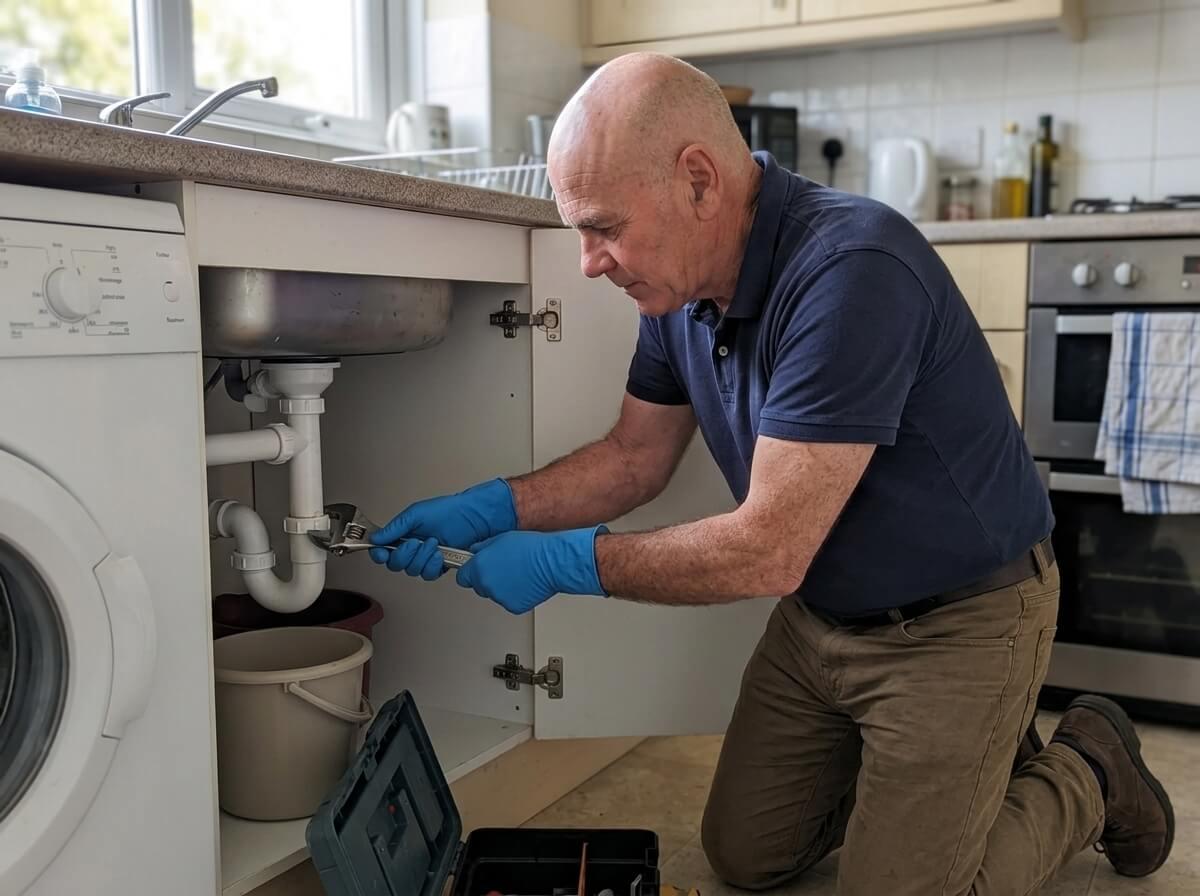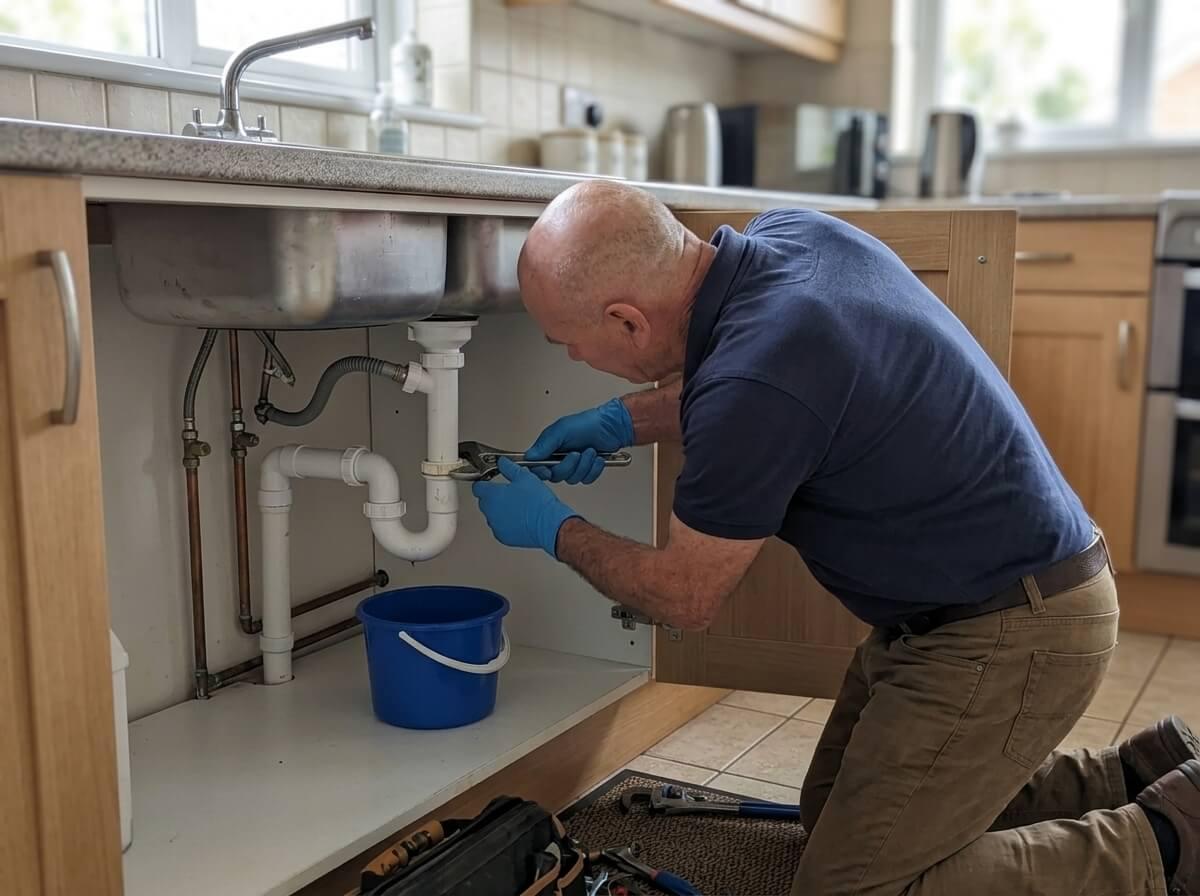
A dishwasher leaking is one of those problems that hides until it is already serious. Most dishwashers are built in behind a door panel and a kickboard, so the water runs underneath the units for days before you see a puddle, notice the floor lifting or smell something damp. By the time it reaches the middle of the kitchen, the chipboard under the cabinets has often had a good soaking.
I have been a plumber in Ipswich for more than forty years, and the dishwashers I am called to are rarely broken. Far more often it is the valve under the sink, a hose that has worked loose, or a sink trap that cannot keep up when the pump empties. Most guides online are written by appliance makers or American repair sites, so they only cover the machine. This one covers both halves: the plumbing your dishwasher connects to and the faults inside it. You will know what to fix yourself, what needs a plumber, and what needs an appliance engineer.
Dishwasher Leaking? Do These 5 Things First
Cancel the programme and switch the dishwasher off
Press cancel or hold the start button to stop the cycle, then switch it off. Unlike a washing machine, you can open a dishwasher door mid-cycle without a flood, because the water sits in the bottom of the tub. Open it slowly and stand back from the steam.
Make the electrics safe
Dishwashers are usually plugged into a socket in the next cupboard or wired to a switched fused spur above the worktop. If water has reached either, or is running across the floor near them, do not touch them. Switch the kitchen circuit off at the consumer unit, or the main switch if you are not sure which one. Only unplug the machine once the floor is dry and the power is off.
Turn off the water to the dishwasher
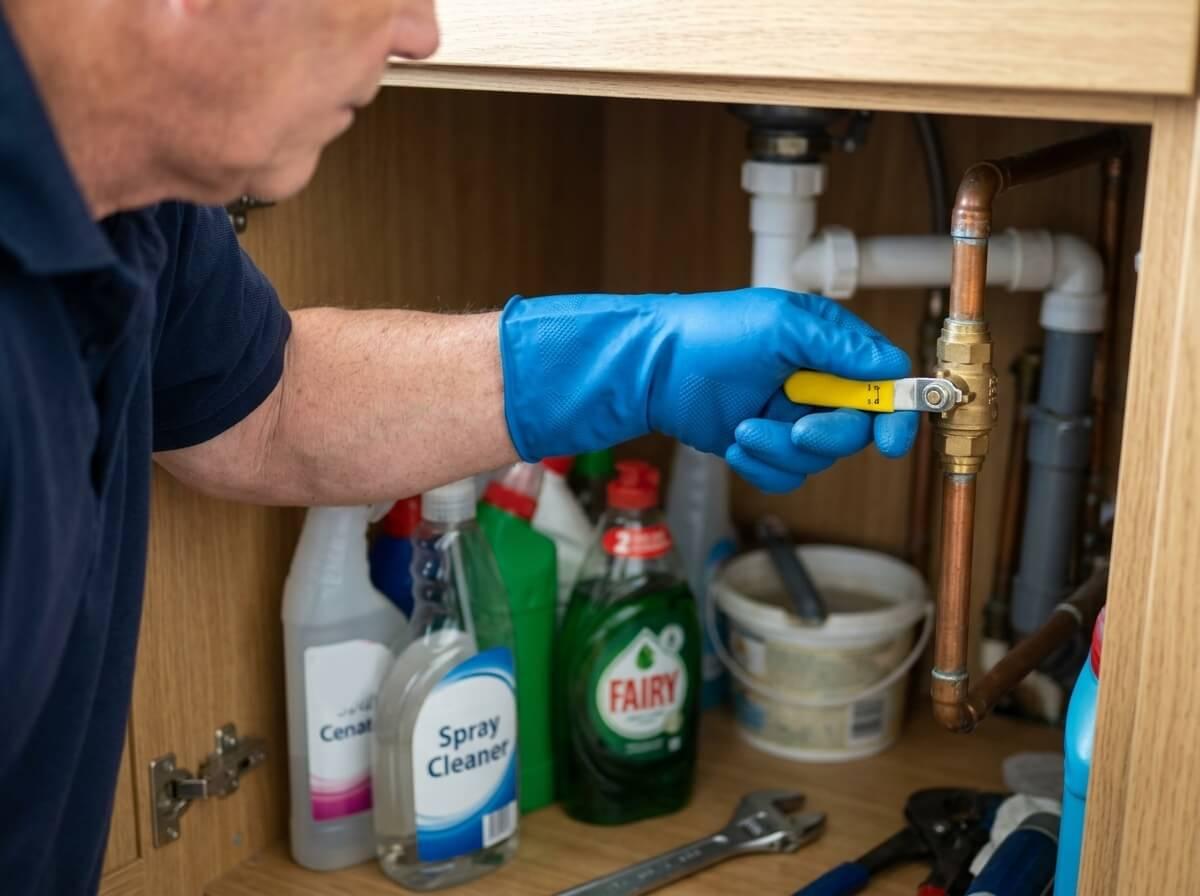
Look in the cupboard under the kitchen sink for a small valve on the pipe that feeds the dishwasher hose. It often has a blue or white lever, or a slot you turn with a screwdriver. Turn it a quarter turn so the lever or slot sits across the pipe. If there is no valve, or it will not move, turn off the main stopcock. My guide on how to find your stopcock shows where to look in most Suffolk homes.
Get the kickboard off and stop the water spreading
Pull or unclip the kickboard (the plinth under the cupboard doors) in front of the dishwasher and the units either side. Mop up what you can reach underneath, and push old towels into the gap. Water under the units soaks into the cabinet bases, the flooring and the wall, so getting air in early really helps. If the kitchen is upstairs or you live in a flat, warn whoever is below.
Take photos before you clear up
A quick photo of the water, the area under the sink and any swollen kickboards or flooring helps if you need to claim on your insurance, tell your landlord, or go back to whoever fitted the dishwasher. It also helps me work out the cause quickly.
How a Dishwasher Is Plumbed In
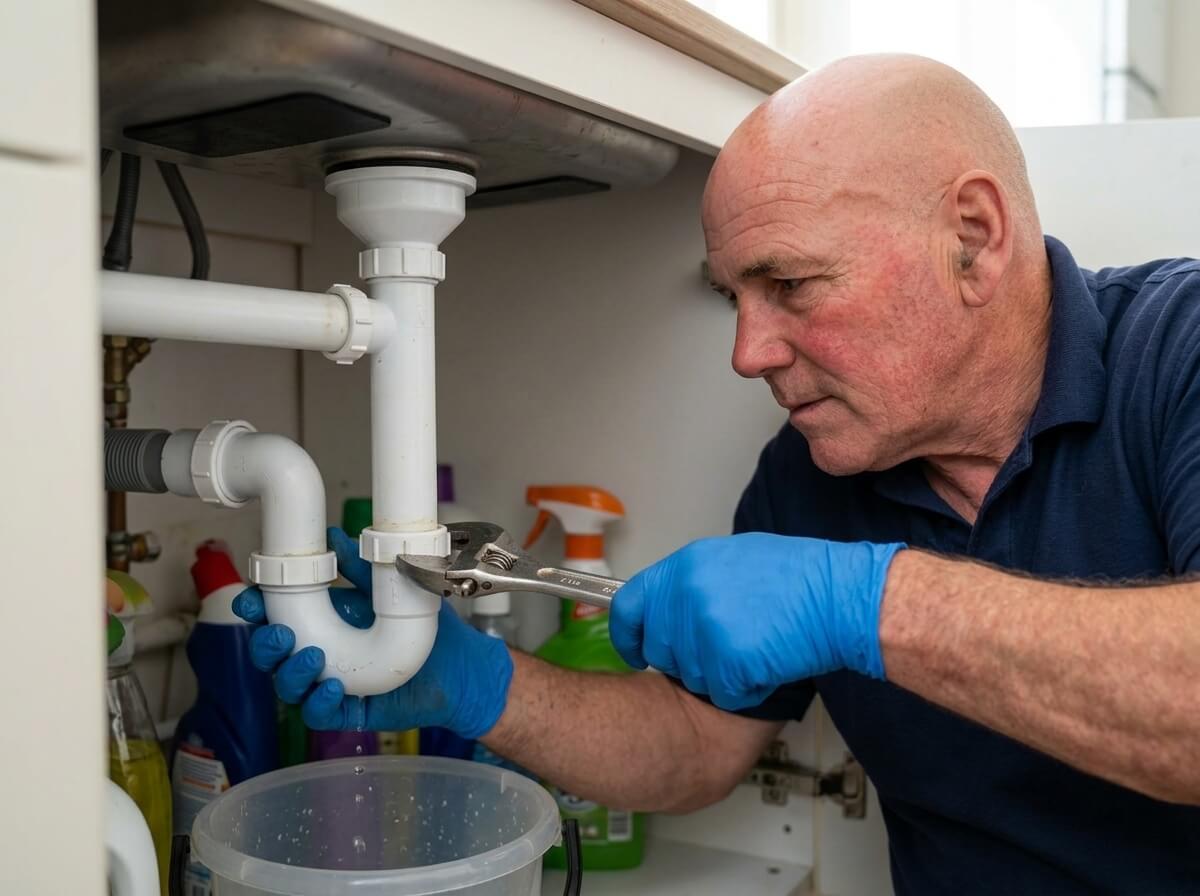
You need to know what is hidden behind the machine before you can find a dishwasher leak. Every dishwasher has two connections to your plumbing, and both of them usually end up in the cupboard under the sink.
The supply: dishwasher valve and inlet hose
Cold water comes from a tee off the kitchen cold pipe to a small appliance valve with a threaded outlet. The inlet hose screws onto it at one end and the back of the dishwasher at the other. Each end has a nut with a flat rubber washer inside, and it is the washer that makes the seal, not how tight the nut is. Many modern machines have a safety hose, sold as Aquastop, Waterstop or similar, with a chunky plastic box at the tap end that shuts the water off if the hose fails. This side is under mains pressure all the time, even when the dishwasher is off.
The drain: hose, loop and sink spigot
The grey ribbed drain hose takes dirty water out. In most UK kitchens it is pushed onto a spigot, a short nozzle on the side of the kitchen sink trap, and held with a clip. Some kitchens have a double appliance trap with two spigots, one for the dishwasher and one for the washing machine, or a standpipe behind the units. The hose should rise in a loop to the underside of the worktop before it drops down to the spigot. That loop stops dirty sink water running back into the dishwasher. The drain side is not under pressure until the pump runs, which is why some leaks only appear at the end of a cycle.
Where Is the Dishwasher Leak Coming From? Find It in 10 Minutes
Where the water shows up is the best clue to where it starts, but water travels. A leak at the back of the machine can run along the floor under the units and come out by the oven. Dry everything you can reach, take the kickboard off, then look again with a torch. A sheet of dry kitchen roll under each joint shows up a drip quickly. Find the row that matches what you can see.
| WHERE THE WATER IS | LIKELY SOURCE | CHECK THIS FIRST |
|---|---|---|
| Water running out from the bottom of the door during the wash | Blocked or stuck spray arms, overloading, a worn door seal, or too much foam | Take out the lower spray arm and clear the holes. Check nothing tall is stopping the arms from turning. |
| A puddle in the bottom of the door or along the door seal | A dirty, twisted or perished door seal, or a door that is not closing square | Wipe the seal and the inner rim. Run a finger round the seal for splits or a section that has come out of its groove. |
| Water under the kickboard, out of sight under the units | Inlet or drain hose behind the machine, or a fault inside the base | Take the kickboard off with a torch. Follow the wet trail back to where it starts. |
| Water in the cupboard under the sink | The dishwasher valve, the drain hose on the sink spigot, or a blocked or loose sink trap | Put dry kitchen roll under each joint, run a short programme and see which one gets wet first. |
| Water on the floor even when the dishwasher is off | The supply side: the valve, the inlet hose nuts, or a split inlet hose | Turn the dishwasher valve off. If the drip stops, it is the hose or its connections. |
| Water only appears when the dishwasher pumps out | The drain side: hose off the spigot, no clip, a blocked trap, or an uncut blanking disc | Watch the sink trap as the machine drains. Water bubbling up in the sink tells you the trap or waste pipe is part blocked. |
| Dirty water sitting in the bottom of the tub after the cycle | A blocked filter, a kinked drain hose, or the sink waste backing up into the machine | Clean the filter in the base of the tub, then check the drain hose is not squashed behind the machine. |
Dishwasher Leaks From the Plumbing: The Ones a Plumber Fixes
These are the leaks I fix most often, and none of them are anything to do with the dishwasher itself. Some are simple enough to sort yourself. Others need the water turned off to the house or new fittings on copper pipe.
A dripping or split inlet hose
Inlet hoses get crushed when the machine is pushed back, bent too tightly against the wall, or simply age and harden. Look for bulges, kinks, cracks and a white crust along the length. A bulging hose is about to burst, so replace it rather than taping it. If the drip is only at one end, the rubber washer in the nut is usually worn, flattened, missing or doubled up after someone has reused an old one. A new washer and the nut done up straight, hand tight plus a quarter turn, often cures it. On a safety hose, the plastic box at the tap end cannot be repaired. If it is cracked or has tripped, the whole hose needs replacing.
A dripping or seized dishwasher valve
The valve under the sink often sits untouched for fifteen or twenty years. The first time someone turns it off in a hurry, the seal round the spindle starts to weep. A drip from the lever or from the joint where the valve meets the copper pipe means the valve needs replacing. It is usually a short job, but the water to the house has to go off and old compression fittings need care. If the valve will not turn at all, leave it alone and use the stopcock. Forcing a seized valve is how a slow drip turns into a burst pipe repair.
Drain hose leaking at the sink spigot
The dishwasher pump pushes water out with real force. If the drain hose is not pushed fully onto the spigot, or there is no clip holding it, water squirts out of the joint every time the machine empties. Push it on as far as it will go and fit a small hose clip or jubilee clip. Then check the spigot itself. Plastic spigots crack, especially if someone has leaned on the hose, and a cracked spigot means a new trap. My leaking under the sink guide covers every other joint in that cupboard.
A blocked sink trap that cannot keep up
This is the most common cause of a dishwasher leaking under the sink that I see, and people almost never suspect it. Fat, coffee grounds and food scraps build up in the sink trap and the waste pipe. The sink still drains, slowly, but when the dishwasher pumps out several litres in a few seconds, the trap cannot take it. Dirty water comes up into the sink, forces its way out of a trap nut, or backs up the hose into the machine. If your sink gurgles or fills when the dishwasher empties, the problem is the drain, not the dishwasher. My kitchen sink unblocking guide shows how to clear the trap safely. If it keeps coming back, the blockage is further down the pipe and our blocked sink service will clear the whole run.
Sharing a trap with the washing machine
When the dishwasher and washing machine both drain into the same sink trap, and both run at once, the trap simply cannot cope. Water from one machine can also be pushed up the hose of the other. If you only get leaks or dirty water in the dishwasher when the washing machine is on, that is your answer. The fix is a properly sized double appliance trap, or a separate standpipe for one of the machines. My guide on a washing machine leaking covers the other half of that set up.
Dirty water running back into the dishwasher
Open the door to find grey water and bits of food in the bottom when you have not run it, or the dishwasher smells of drains? Waste water is running back from the sink. The drain hose must rise to the underside of the worktop before it drops to the spigot. Without that high loop, water siphons back every time you empty the sink. Many spigots and hoses also have a small non-return valve. If it has stuck open, the same thing happens. The Water Supply (Water Fittings) Regulations 1999 exist partly to stop dirty water getting back into clean supplies, so appliances and their connections are meant to be installed to stop backflow.
A hidden leak on the waste pipe or under the floor
If everything under the sink is dry but the floor near the dishwasher keeps getting wet, or there is a stain on the ceiling below, the leak may be on the waste pipe in the wall or on a supply pipe under the floor. These need finding properly before anything is pulled apart. Our leak detection service traces hidden leaks with as little damage to the kitchen as possible.
Leaks From the Dishwasher Itself
These faults are inside the machine. Several are quick to sort yourself. The rest need an appliance engineer, or the manufacturer if it is still under warranty, because taking the machine apart yourself can void the cover. Always switch the dishwasher off at the socket or spur before you start.
Dishwasher leaking from the door
Water out of the front during the wash is nearly always the spray arms, not the seal. A blocked spray arm, or one that catches on a tall pan or a baking tray, fires water sideways at the door instead of up at the dishes. Take the arms out, rinse them, poke the holes clear with a cocktail stick, and make sure they turn freely once loaded. If that does not cure it, look at the door seal. Wipe it and the inner rim of the door, and check for splits or a section that has come out of its groove. Which? notes that the upper seal is usually simple to replace, while the lower door seal usually means removing the door, which is a job for an engineer.
Dishwasher leaking from the bottom
Water from underneath the machine, with the hoses, spigot and door all dry, usually means a leak inside. The common culprits are a worn pump seal, a split sump hose, a leaking heater seal, or a crack in the tub. Most modern dishwashers have a tray in the base with a float switch. When water collects there, the float lifts and the machine stops, runs its drain pump and shows a water or flood error. Bosch, Siemens and Neff machines show E15, for example. Tilting the machine to empty the tray will clear the code, but the leak that filled the tray is still there, so it will come back.
The wrong detergent or too much rinse aid
If foam is pouring out of the door, someone has put washing up liquid in the dispenser or rinsed the dishes in it and loaded them soapy. It foams so much that suds force their way past the seals. Leave the door open, scoop out the foam, add a splash of cooking oil to the bottom to knock it back, and run a rinse with nothing in it. Overfilling the rinse aid, or a rinse aid cap that is not closed properly, can also leave a puddle at the front.
A blocked filter
The filter in the bottom of the tub catches food. When it clogs, water cannot reach the pump quickly enough, sits in the tub and can slop out of the door, and the machine often finishes with dirty water in the base. Twist it out, rinse it under the tap, and scrub the mesh with an old toothbrush. Once a week is about right for most households.
The dishwasher is not level
A dishwasher that leans forward lets water run to the door. It is surprisingly common after a new floor is laid or when the feet have been wound down to squeeze it under a lower worktop. Put a spirit level across the front and side of the tub and adjust the feet so it sits level, with a very slight tilt back if anything.
Dishwasher Leak Finder: Who Fixes It and How Urgent Is It?
When someone rings me about a leaking dishwasher, my first questions are where the water is and when it appears. Find the row that matches. The last two columns tell you who usually fixes it and how quickly it needs doing.
| WHAT IS HAPPENING | LIKELY CAUSE | WHO FIXES IT | URGENCY |
|---|---|---|---|
| Water spraying or pouring from behind the units | A burst or split inlet hose, or a hose that has come off the valve. It is on mains pressure and will not stop by itself. | Usually a plumber | Act today |
| Slow drip from the valve under the sink | A worn spindle seal on the dishwasher valve, often after it has been turned for the first time in years. | Usually a plumber | Within days |
| Drip at the end of the inlet hose | A missing, flattened or doubled up rubber washer in the hose nut, or a nut that was cross threaded. | Often a DIY fix | Within days |
| Water round the sink spigot as it drains | Drain hose not pushed fully on, no hose clip, or a cracked spigot. | Often a DIY fix | Within days |
| Sink fills with dirty water when the dishwasher empties | The sink trap or waste pipe is part blocked with fat and food. The pump is faster than the drain. | Usually a plumber | Within days |
| New dishwasher or new sink, and it will not drain at all | The plastic blanking disc inside the spigot was never cut out. | Often a DIY fix | Within days |
| Water out of the door during the wash | Spray arm blocked or catching on a tall pan, overloading, or a worn upper door seal. | Often a DIY fix | Fix when you can |
| Foam pouring out of the door | Washing up liquid in the dispenser, or a rinse aid spill. Not a fault with the machine. | Often a DIY fix | Fix when you can |
| Water underneath and a flood or water error code | Water in the base tray has lifted the float switch. A leak inside the machine: pump seal, sump, internal hose or heater seal. | Appliance engineer | Within days |
| Damp ceiling below a dishwasher upstairs or in a flat | Any of the above, or a hidden leak on the waste pipe under the floor. | Usually a plumber | Act today |
| Water near the plug, socket or fused spur | Any leak that has spread. The cause can wait. The electrics cannot. | Usually a plumber | Act today |
Plumber or Appliance Engineer? Who to Call
Most people ring the wrong one first, and it is not their fault. Nobody explains where one job stops and the other starts. The simple rule: a plumber looks after everything up to the back of the dishwasher, and an appliance engineer looks after everything inside it.
- ●Call a plumber for: the dishwasher valve, the inlet and drain hoses and their connections, the sink trap and spigot, shared or double appliance traps, non-return valves and the high loop, a blocked sink or waste pipe, water through a ceiling, hidden leaks, and anything that means turning the water off to the house.
- ●Call an appliance engineer for: the pump and its seals, the door seals and hinges, the spray arms if they are broken, the inlet valve inside the machine, the float switch and base tray, the heater, the tub, and any electrical fault or error code.
- ●Call the manufacturer or retailer first if: the dishwasher is under warranty, under an extended guarantee, or was fitted by the retailer in the last few months.
If water is pouring out and you cannot stop it, or you have no idea which side the fault is on, ring a plumber. I can make it safe, tell you honestly whether it is the plumbing or the machine, fix the plumbing side there and then, and leave the dishwasher isolated and safe if it needs an engineer.
Water Sitting in the Bottom of the Dishwasher?
Standing water in the base after a cycle is a drainage problem, and it often goes hand in hand with a leak. With the power off at the socket or spur, put towels down and scoop most of the water out with a cup into a bowl, then soak up the rest with a sponge. Take out the filter and clean it. Then run the kitchen tap for a minute. If the sink drains slowly or gurgles, the sink trap or waste is the problem, not the dishwasher. If the sink drains freely, check the drain hose behind the machine is not kinked or crushed. If all of that is clear and it still will not drain, the drain pump is likely to be blocked or failed, which is an appliance job.
Is a Leaking Dishwasher an Emergency?
A small puddle from the door after one wash can wait until you have a free evening. These cannot. Call a plumber straight away, day or night, if:
- ●Water is spraying or pouring from a hose or the valve and you cannot turn it off.
- ●The dishwasher valve or the stopcock is seized and the water will not stop.
- ●Water has reached a socket, plug or fused spur, or is running towards the consumer unit.
- ●The kitchen is upstairs or in a flat and water is coming through the ceiling below.
- ●Dirty water is coming up the kitchen sink and other plugholes in the house are slow too.
- ●Water has spread under the units, the flooring or into another room.
If you are not sure, my guide to what counts as a plumbing emergency has a simple three-question test. Water and electrics in the same room always counts. Electrical Safety First advises switching off at the consumer unit only if it is safe to reach and dry, and having the electrics checked by a registered electrician if they have been wet.
The Hidden Damage: Floors, Kickboards and Kitchen Units
The leak itself is often cheap to fix. The damage it leaves is not. Kitchen carcasses and kickboards are made of chipboard or MDF, and once they soak up water they swell, flake and never go back. Laminate and engineered wood floors cup and lift at the joints. Water that gets under vinyl can sit there for months.
- ●Look for: kickboards that have swollen at the bottom edge, cabinet bases that feel soft, floor joints that have risen, a musty smell from under the units, and black spots on the back of the plinth.
- ●Dry it out properly: keep the kickboards off, run a fan or a dehumidifier, and keep the heating on. Do not refit plinths or pull the dishwasher back in until everything underneath is dry to the touch.
- ●Check the next room: if the kitchen backs onto a hallway or lounge, check the skirting and floor on the other side of the wall too.
If the floor keeps getting wet after the dishwasher is fixed, the leak may be somewhere else. My guide on a water leak under the floor explains the signs and how we find it.
What Not to Do
- ✕Do not touch the plug, socket or spur while standing in water. Switch off at the consumer unit first.
- ✕Do not keep running it to see if it happens again. Every cycle pushes more water under the units.
- ✕Do not tape up a split or bulging inlet hose. It is on mains pressure. Replace it.
- ✕Do not overtighten hose nuts with grips. Plastic nuts crack and washers distort. Hand tight plus a quarter turn is plenty.
- ✕Do not pour chemical drain cleaner into the sink to cure a dishwasher leak. It sits in the trap, attacks the seals and can be pumped back into the dishwasher.
- ✕Do not put washing up liquid in the dishwasher. Even a squirt fills the kitchen with foam.
- ✕Do not tip the machine to clear a flood error and carry on. The water in the base came from a leak that is still there.
- ✕Do not take the machine apart if it is under warranty. Ring the manufacturer or retailer first.
Insurance, Warranty, Renting and Who Pays
Home insurance
Most UK buildings insurance covers sudden escape of water from fixed appliances, including dishwashers, so the damage to floors and units from a burst hose is often covered. The repair to the dishwasher or the failed hose usually is not, and slow leaks that have been going on for weeks are often refused as wear and tear. Photograph the damage, keep the failed hose or part, and get an itemised invoice that states the cause. My burst pipe insurance claim guide explains what insurers look for, and Citizens Advice has free help if a claim is disputed.
A new dishwasher that leaks
If the dishwasher is new and the retailer installed it, ring them first. Under the Consumer Rights Act 2015, a fault that shows up in the first six months is generally assumed to have been there from the start, unless the retailer can show otherwise. If it was fitted by a kitchen fitter, go back to them about the connections. A missed blanking disc or a reused washer is their job to put right.
Renting
If the dishwasher came with the property, it is usually the landlord's responsibility to repair, along with the pipes and the sink waste. Tell your landlord or letting agent in writing the same day, with photos, and turn the dishwasher valve off until it is fixed. If the dishwasher is yours, the machine is your responsibility, but the plumbing it connects to is still the landlord's.
How to Stop Your Dishwasher Leaking Again
A few minutes every month saves you from the slow leak nobody notices until the floor lifts.
- ✓Clean the filter weekly. Rinse it and scrub the mesh. It keeps water moving to the pump.
- ✓Wipe the door seal and inner rim. A damp cloth once a week stops food and grease breaking the seal down.
- ✓Check the spray arms turn freely. Spin them by hand after loading, especially with tall pans or trays in.
- ✓Look under the sink once a month. A sheet of kitchen roll under the valve and spigot shows up a slow drip before it does damage.
- ✓Replace old inlet hoses. If yours is hard, cracked or more than about ten years old, fit a new one. A safety hose costs little more.
- ✓Keep the sink trap clear. No fat, coffee grounds or food scraps down the sink. Scrape plates into the bin. My guide on why a sink keeps blocking explains why.
- ✓Turn the valve off when you go away. A quarter turn before a holiday means a hose cannot burst while the house is empty.
- ✓Fit a cheap water leak alarm. A battery leak detector on the floor under the sink or behind the kickboard beeps the moment it gets wet.
- ✓Do not run it while you are out or asleep. If something does let go, you want to be there to turn it off.
Leaking Dishwasher in Ipswich? Call Philip
A leaking dishwasher feels like an appliance problem, but more often than not the fault is in the plumbing behind it. The main things to remember:
- ●Cancel the cycle, make the electrics safe, and turn off the dishwasher valve under the sink or the stopcock.
- ●Get the kickboard off. The water you cannot see does the most damage.
- ●Use the fill, wash, drain test to tell a supply leak from a drain leak or a machine fault.
- ●Hoses, valves, traps, spigots and waste pipes are a plumber's job. Pumps, seals and error codes are an engineer's.
- ●If the sink fills when the dishwasher empties, clear the drain rather than replace the dishwasher.
I cover Ipswich, Felixstowe, Woodbridge, Kesgrave, Stowmarket and the villages around them, 24 hours a day, and usually arrive within about 30 minutes for an emergency. You get a fair price agreed before any work starts. If you would like a plumber to sort it, get in touch for a free, no-obligation quote or ring me now. If you would rather check who you are letting into your home, the WaterSafe scheme lists approved plumbers across the UK.