It always seems to happen in October. The heating goes on for the first time in months, everything warms up and expands, and a day later there is a dark patch on the carpet under the living room radiator, a drip from the valve, or a boiler showing 0.3 bar and refusing to fire. Sometimes the first sign is a brown stain on the ceiling below an upstairs bedroom.
I have been plumbing in Ipswich for more than forty years, and leaking radiators are one of the most common calls I get once the weather turns. The good news is that most of them are not the radiator at all, they are the valves and joints on either end, and many can be stopped in a few minutes with the right valve turned the right way. This guide shows you how to make it safe, how to isolate the radiator, how to find the leak, what you can sensibly fix yourself, and how to tell a ten minute repair from a radiator that has rusted through.
Radiator Leaking? Do These 5 Things First
Turn the heating off
Switch the heating off at the boiler controls or the programmer, so the pump stops pushing water round the system and out of the leak. Let the radiator cool for half an hour if you can. Hot heating water can scald, and a cold radiator is much easier to work on. If water is near a socket, a plug or the boiler’s wiring, switch that circuit off at the consumer unit first.
Catch the water and protect the floor
Slide a baking tray, roasting tin or shallow bowl under the drip and put old towels round it. Heating water is often black with sludge and will stain carpets and grout, so roll back rugs and move anything you care about. If the radiator is upstairs, check the ceiling of the room below. If it is wet or bulging, follow the water through the ceiling guide.
Close the valve at each end of the radiator
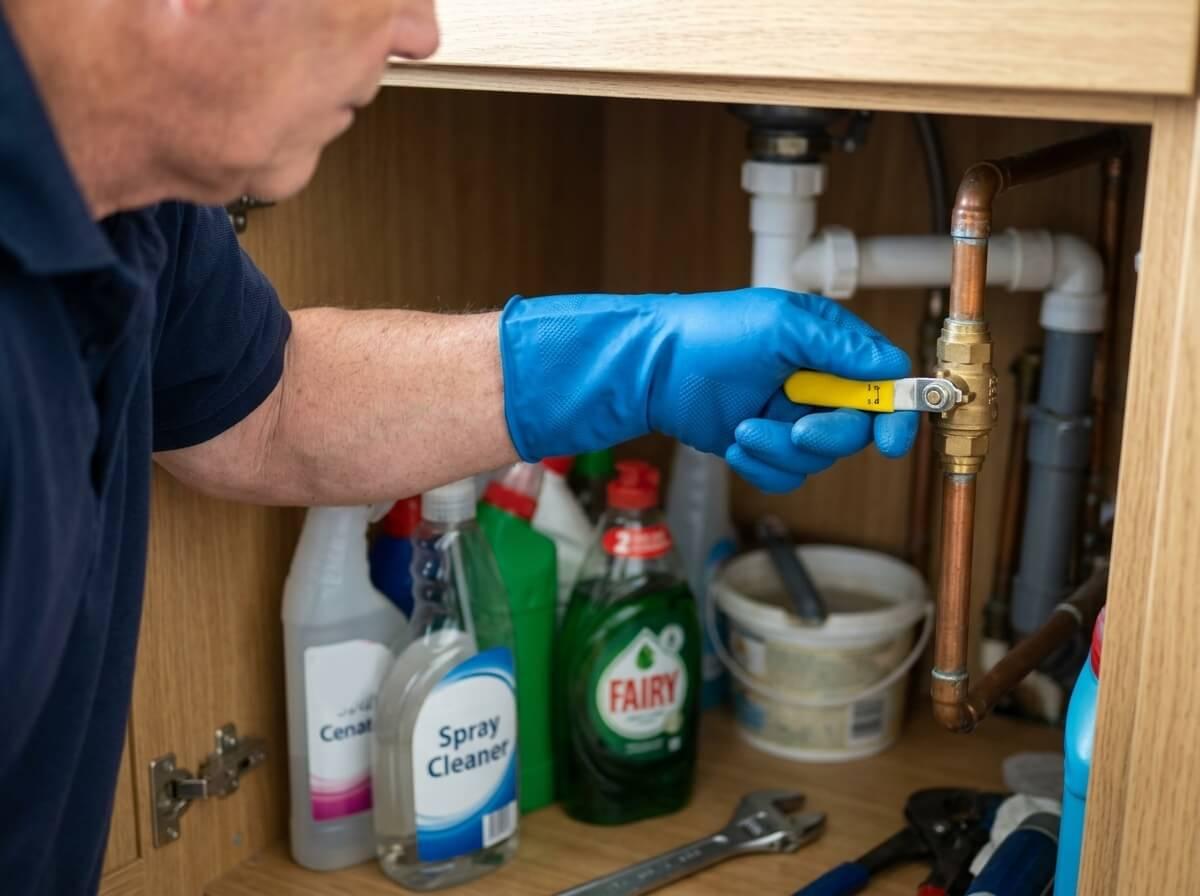
Turn the thermostatic valve (the one with numbers, usually 0 to 5 or a snowflake to 5) or the wheelhead valve fully clockwise by hand. On the other end, pull off the plastic cap of the lockshield valve and turn the spindle underneath clockwise with a small spanner or a radiator key, counting the turns as you go. Write the number down, because it is needed to rebalance the radiator later. With both valves shut, the radiator is cut off from the rest of the system and most leaks slow to a stop.
If it is still leaking, find the leak on the pipe side
If water keeps coming after both valves are shut, the leak is on the pipe side of a valve, or on the pipework itself, and the only way to stop it is to drain that part of the heating. On a sealed system the leak will slow as the pressure drops. On an open vented system with a small tank in the loft, tie the ball valve in that tank up to a piece of wood across the top so it stops refilling. If it is spraying or you cannot keep up with it, call a plumber now.
Check the boiler pressure, then find the leak
Look at the pressure gauge on a combi or system boiler. If it has dropped below about 1 bar, do not top it up yet: you will only push more water out of the leak. Once the radiator is isolated and the dripping has stopped, dry everything and use the leak finder below to work out exactly where it is coming from.
Sealed or Open Vented? Know Your Heating System
What a leak does, and how you refill the heating afterwards, depends on which type of system you have. A quick look at the boiler and in the loft will tell you.
| SYSTEM TYPE | HOW TO SPOT IT | WHAT A LEAK DOES | HOW IT REFILLS |
|---|---|---|---|
| Sealed (pressurised) | A combi or system boiler with a pressure gauge on the front or underneath, and no small tank in the loft feeding the heating. | The pressure gauge falls as water escapes. Below about 0.5 to 0.8 bar the boiler locks out and the heating stops. | Through the filling loop under the boiler, back to about 1 to 1.5 bar when cold, once the leak is fixed or isolated. |
| Open vented (gravity fed) | A regular boiler with a hot water cylinder, and a small feed and expansion tank in the loft beside the big cold water tank. | The loft tank tops the heating up automatically, so the leak can keep going quietly for days and the heating keeps working. | Automatically, through the ball valve in the small loft tank. To stop it feeding a bad leak, tie up the ball valve or close its supply. |
Most Ipswich homes that have had a new boiler in the last fifteen years or so have a sealed system with a combi or system boiler. Plenty of older terraces and semis still have an open vented system with a regular boiler, a hot water cylinder and two tanks in the loft. An open vented leak is the one to watch: because the loft tank quietly refills it, a small drip under the floor can go unnoticed for weeks while it rots the boards and the ceiling below. If the leak turns out to be on the cylinder rather than a radiator, see the leaking hot water cylinder guide.
Where Is the Water Coming From? Leak Finder
When somebody rings me about a leaking radiator, the first thing I ask is where exactly the water is. Find the row that matches what you can see. The last two columns show whether it is usually a repair or a new radiator, and how quickly it needs dealing with.
| WHERE THE WATER IS | LIKELY CAUSE | REPAIR? | URGENCY |
|---|---|---|---|
| Drips from the nut between the valve and the radiator | A loose union nut, or a worn seal on the radiator tail behind it. The most common radiator leak of all. | Usually repairable | Within days |
| Drips from the nut where the pipe goes into the bottom of the valve | A loose or tired compression joint, often after the radiator has been taken off for decorating. | Usually repairable | Within days |
| Weeping from just under the valve head, worse when it is turned | The gland packing round the valve spindle has dried out. Common on old valves and lockshields. | Usually repairable | Book in, not urgent |
| Water at the top corner, round the little square bleed screw | The bleed valve is not fully closed, its seat is worn, or the thread in the radiator is weeping. | Usually repairable | Within days |
| A crusty, rusty or green spot on the radiator body, usually along the bottom | A pinhole where sludge has settled and corroded the steel from the inside. It will only get worse. | Usually a new radiator | Act today |
| Water weeping along a seam, weld or the folded top edge | The radiator panel itself has failed. It cannot be repaired reliably. | Usually a new radiator | Act today |
| Water on the floor below the radiator, all the fittings dry | A leak on the pipe under the floorboards, or water tracking along the pipe from higher up. | Needs checking | Act today |
| Water spraying from a pipe or a valve that has come apart | A split pipe, a failed fitting or a valve that has been knocked or frozen. | Usually repairable | Act today |
| Boiler pressure keeps dropping, no water anywhere you can see | A hidden leak under a floor or behind a wall, or the boiler's pressure relief valve letting by to the pipe outside. | Needs checking | Within days |
| Beads of water on the pipes or valve that wipe off and come back slowly | Condensation on cold pipework, usually when the heating has just gone off in a cold, damp room. | Needs checking | Book in, not urgent |
How to Find Exactly Where a Radiator Is Leaking
Water runs along the bottom of a radiator and down the pipes before it drips, so the wet patch is often at the opposite end to the leak. This is how I track it down, and you can do the same with a torch and a roll of kitchen paper or toilet roll.
Dry everything completely
With the heating off, wipe the radiator, both valves, the nuts and the pipes down to the floor until they are bone dry. Lay a dry sheet of kitchen paper on the floor under each valve so fresh drips show up straight away.
Wrap tissue round each joint
Wrap a strip of toilet roll round each fitting in turn: the union nut between valve and radiator, the nut where the pipe enters the valve, the spindle under the valve head, and the bleed screw at the top corner. The one that goes dark first is your leak.
Run your hand along the bottom edge
Feel along the underside of the radiator and down the back with a dry tissue. A pinhole often shows as a crusty brown or green spot, a blister in the paint, or a damp line along the bottom seam.
Turn the heating on briefly if you need to
Some joints only leak when they are hot and expanded, or only when the pump is running. If everything stays dry cold, open the valves, run the heating for ten minutes with a tissue on each joint, and watch closely. Turn it off again as soon as you see it.
Look below the floor if the fittings are dry
If the radiator and valves are dry but the floor keeps getting wet, the leak is probably on the pipe under the floorboards. Lift the board nearest the pipes if you can do it safely, or call in leak detection before the joists and ceiling below are damaged.
Radiator Valve Leaking? How to Fix It
Most radiator leaks I am called to are at one of the two valves. There are three places a valve can leak, and each one is fixed differently.
Leaking from the union nut (valve to radiator)
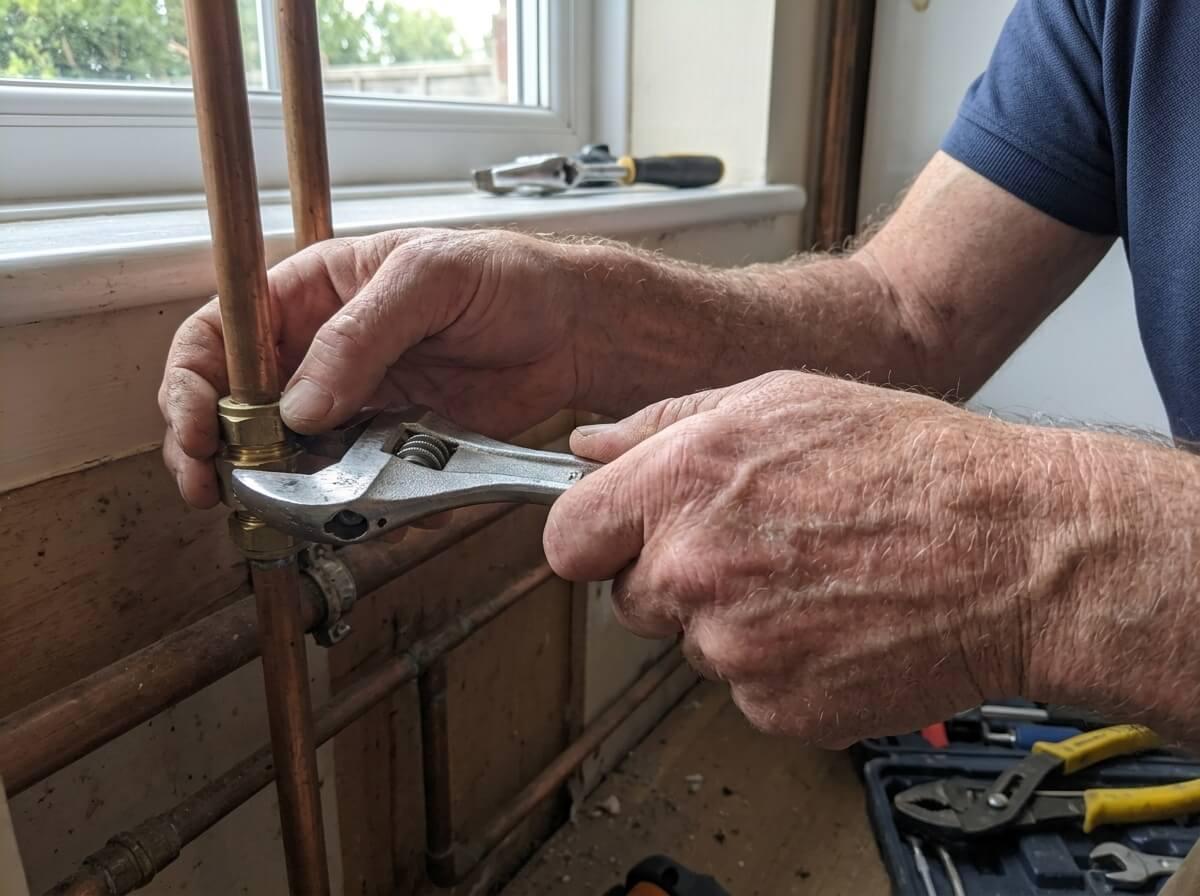
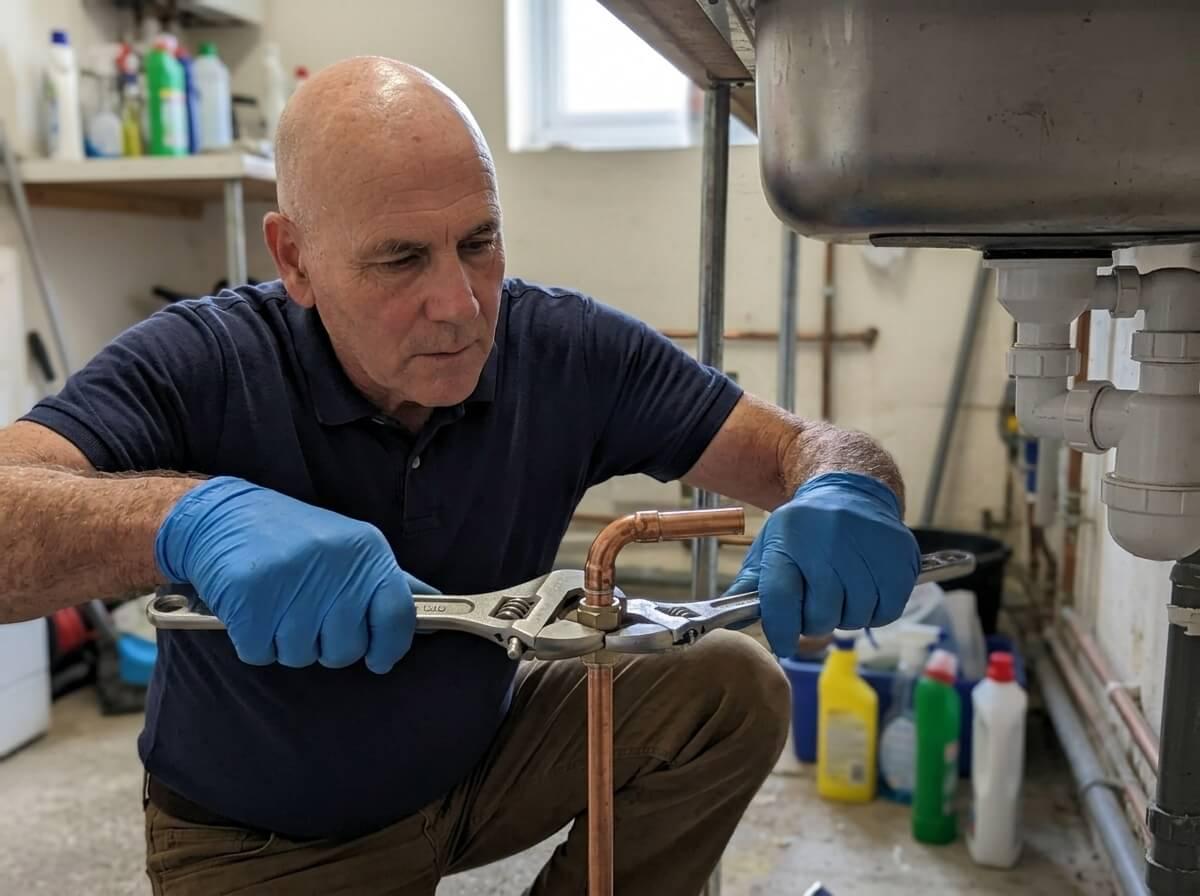
The big nut between the valve and the radiator is called the union nut, and it screws onto the radiator tail, a short threaded fitting screwed into the radiator itself. If it is weeping, hold the valve body still with one spanner and give the union nut an eighth to a quarter of a turn clockwise with another. If that stops it, you are done. If it does not, the seal on the tail has failed. That means isolating the radiator, draining it into a tray, undoing the union, and either re-sealing the tail with PTFE tape or a jointing compound, or fitting a new tail. It is a straightforward job, but a messy one with black water.
Leaking from the pipe nut (pipe into valve)
The smaller nut at the bottom of the valve, where the copper pipe comes up from the floor, is a compression joint: the nut squeezes a brass ring called an olive onto the pipe. Again, hold the valve still and nip the nut up an eighth of a turn at a time. Do not crank it. An overtightened olive distorts and leaks worse. If a gentle tighten does not cure it, the olive needs replacing, and because this joint is on the pipe side of the valve, closing the valve will not stop it. That part of the system has to be drained down first.
Leaking from the spindle (under the valve head)
A weep from under the head of a wheelhead or lockshield valve, often only when it is turned, is the gland packing round the spindle. Pull off the head or cap and you will usually see a small hexagonal gland nut. A quarter turn clockwise on that nut, holding the valve body still, squeezes the packing and often stops the drip. If it keeps weeping, a few turns of PTFE tape wound round the spindle under the gland nut is the old plumber’s fix, but on a valve that old it is usually better value to replace it.
Leaking from the bleed screw
If the water is coming from the small square bleed screw at the top corner, first make sure it is fully closed, turning it clockwise with a radiator key, firmly but not hard. If it still drips, the seat is worn or there is dirt in it. With the radiator isolated and the pressure off, the bleed screw can be unscrewed and replaced, and if the thread in the radiator is weeping, the whole bleed valve can be renewed. A radiator that needs bleeding every week is a sign that air or gas is getting in, which often points to corrosion inside the system.
Leaking From the Radiator Body? It Needs Replacing
If the water is coming from the radiator itself, a pinhole along the bottom, a weep from a seam, or a rusty blister in the paint, the steel has corroded through from the inside. Over the years, the water in a heating system reacts with the steel and forms a black sludge called magnetite. It settles in the bottom of radiators, holds moisture against the metal, and eats through it. One pinhole usually means the rest of that radiator is thin too.
You can buy epoxy putty and leak sealer, and they can buy you a day or two while a replacement is arranged. They are not a repair. Isolate the radiator, and if it keeps weeping even with both valves shut, drain it as shown below. A like for like replacement of the same size and output is usually a quick job, and it is worth having the rest of the system cleaned and treated at the same time so the next radiator does not go the same way.
How to Drain a Single Radiator
To remake a joint, replace a valve or take a leaking radiator off the wall, you only need to drain that one radiator, not the whole system. Here is how I do it.
Heating off, radiator cold
Switch the heating off and wait until the radiator is cool to touch. Draining a hot radiator means hot, black water over your hands and floor.
Close both valves
Close the thermostatic or wheelhead valve fully, using the decorator’s cap on a thermostatic valve, and close the lockshield, counting and writing down the number of turns.
Protect the floor and get containers ready
Lay plenty of old towels, then a shallow roasting tin or tray under the valve end you are opening. A standard radiator holds somewhere between about 5 and 15 litres, so have a bucket nearby to empty the tray into.
Crack the union nut, then open the bleed screw
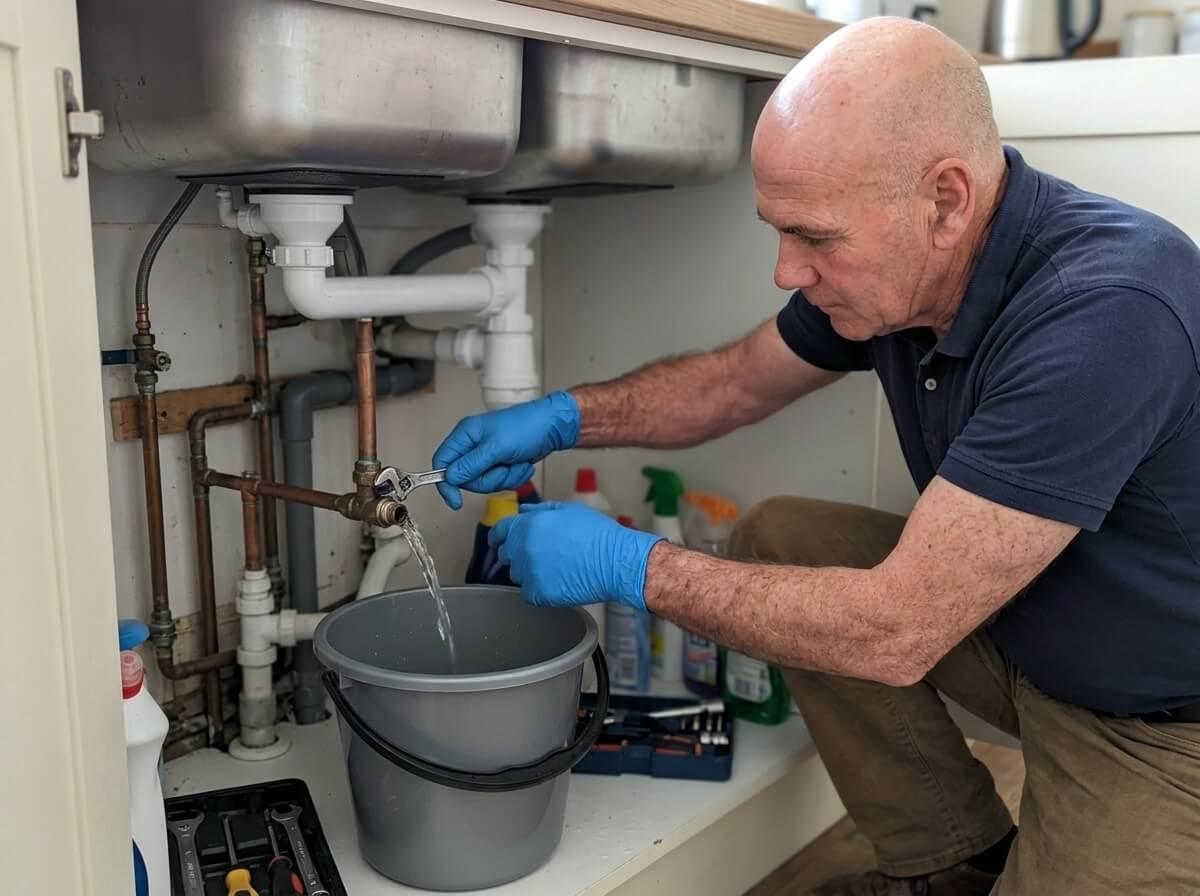
Hold the valve body with one spanner and slowly loosen the union nut between the valve and the radiator with another, just enough for water to start running into the tray. Then open the bleed screw at the top with a radiator key to let air in, and the water will drain steadily. Close the bleed screw to slow it down if the tray is filling too fast.
Refill, bleed and top up the pressure
Once the repair is done, tighten the union, open the valves back up (the lockshield by the same number of turns you counted), bleed the radiator until water comes out, and check the boiler pressure. Top it up if it is needed, as shown below.
Radiator Leaking and Boiler Losing Pressure
On a sealed system, the boiler gauge is the best leak detector in the house. When the heating is cold, it should normally read somewhere around 1 to 1.5 bar, rising a little when it is hot. If it keeps falling, water is escaping from the system somewhere, and a leaking radiator, valve or pipe is the most common reason. Below about 0.5 to 0.8 bar, most boilers lock out and show a low pressure fault.
- ●Fix or isolate the leak first. Topping up a system that is still leaking just pushes more water onto the floor.
- ●Then top up through the filling loop. This is a short braided hose or a built in key under the boiler with a valve at each end, or a single lever on some models. With the heating cold, open the valves slowly, watch the gauge rise to about 1 to 1.5 bar, and close them again. Your boiler manual shows exactly where yours is.
- ●Reset the boiler. Most boilers need the reset button pressing once the pressure is back up.
- ●Watch the gauge for a few days. If it falls again with no drip you can see, the leak is hidden, under a floor, behind a wall, or at the pressure relief valve, which drips through a small copper pipe outside the house near the boiler.
For more on what you can and cannot run while the heating or water is off, see can I use my boiler if the water is off. If water is dripping from inside the boiler casing itself, switch the boiler off, do not take the cover off, and call a boiler engineer. If you can see water on the floor but cannot find where it is coming from, the signs of a hidden water leak guide will help you narrow it down.
Is a Leaking Radiator an Emergency?
A slow drip that has stopped once both valves are shut, or that you can catch in a tray, can usually wait until the morning. Call a plumber straight away, day or night, if:
- ●Water is spraying or running and closing both radiator valves does not stop it.
- ●A pipe has split or a valve has come apart, for example after it was knocked, or after a frost.
- ●Water is coming through the ceiling below, or soaking into the floorboards.
- ●Water is near sockets, plugs or the boiler’s wiring. Switch that circuit off at the consumer unit and keep clear.
- ●The boiler has lost pressure and you cannot isolate the leak, so you cannot get the heating back on.
- ●Someone vulnerable needs the heating, for example a young baby, someone unwell or an elderly relative on a cold night.
If you are not sure whether it can wait, ring me and describe what you can see. I will tell you honestly whether you need me tonight or whether it is safe to leave until the morning. You can see what affects the price in the emergency plumber cost guide.
Why Radiators Start Leaking
- ●Heating going on after the summer. Pipes and fittings expand as they heat up and contract as they cool. Joints that have dried out over the summer often start weeping in the first few weeks of autumn.
- ●Internal corrosion. Without enough corrosion inhibitor in the water, the steel slowly rusts from the inside, sludge builds up in the bottom, and eventually a pinhole appears.
- ●Disturbed fittings. Taking a radiator off to decorate, a vacuum cleaner or furniture knocking a valve, or someone forcing a seized valve can all loosen a joint.
- ●Worn valves. Valve spindles and their packing wear out, especially on old wheelhead and lockshield valves that have been in for decades.
- ●High pressure. A sealed system overfilled above about 2.5 bar, or a failed expansion vessel, puts extra strain on every joint and can make the pressure relief valve discharge.
- ●Frost. A radiator or pipe in an unheated room, garage or extension can freeze and split. The frozen pipes guide covers what to do.
What Not to Do
- ✕Do not leave the heating running. The pump will keep pushing water out of the leak, the boiler will lose pressure, and you will spread the damage further.
- ✕Do not top up the pressure before the leak is stopped. Every top up goes straight out of the hole and dilutes the inhibitor that protects the rest of the system.
- ✕Do not overtighten nuts. A gentle nip is all a compression nut needs. Heaving on it with one spanner distorts the olive, twists the pipe, and can crack the valve or loosen the tail in the radiator.
- ✕Do not force a seized valve. An old valve that will not turn can snap at the spindle and leave you with a worse leak. Close the valve at the other end and call a plumber.
- ✕Do not drain the whole system in the dark. It is rarely needed for a single radiator, and on an open vented system you need to stop the loft tank refilling first.
- ✕Do not ignore a slow drip. It rots floorboards and carpets without you seeing it, and on a corroding radiator a weep becomes a split.
Repair or Replace the Radiator?
Once I have found the leak, the decision is usually straightforward, and I will always tell you honestly which one you need.
When a repair is enough
Leaking union nuts, radiator tails, compression joints, valve spindles and bleed screws can all be repaired, usually in a single visit and often in under an hour. If the valves are old and stiff, it is often worth replacing them while the radiator is drained, so you can isolate it properly next time.
When it needs a new radiator
Water from the body, a seam or a pinhole, rusty blisters in the paint, or a radiator that needs bleeding all the time and keeps producing black water all mean the steel has had it. Most steel panel radiators last somewhere around 15 to 20 years or more, depending on how well the system water has been looked after. A like for like replacement is a quick job, and it is a good moment to choose a more efficient radiator, or one that suits the room better.
Treat the cause, not just the leak
If one radiator has rusted through, the others are often not far behind. Cleaning the system, refilling it with the right amount of inhibitor, and fitting a magnetic filter near the boiler helps protect the rest of the radiators and the boiler itself. Either way, you will get a fair price agreed before any work starts.
Will Home Insurance Pay for It?
Usually for the damage, and usually not for the radiator. Most buildings and contents policies cover escape of water from a central heating system: wet ceilings, floorboards, carpets and belongings. What they normally exclude is the radiator or valve itself when it has simply worn out or corroded, along with wear and tear and any leak you knew about and left. Some policies and home emergency covers do include repairing the fault, so it is worth checking.
Take photos before anything is moved, keep the old valve or radiator until the claim is settled, and ask your plumber for written findings saying where the leak was and what caused it. If you can, ring your insurer before any big repair, and keep receipts for anything you buy to dry the place out.
Who Pays in a Rented Home?
In England, landlords must keep the installations for space heating and heating water in repair, under section 11 of the Landlord and Tenant Act 1985, and that includes radiators, radiator valves and the heating pipework. As a tenant, your job is to report the leak straight away, by phone and in writing with photos, and to turn the heating off and close the two radiator valves if it is safe to do so. If your landlord or letting agent has given you an emergency plumber to call, use them first.
How to Stop Radiators Leaking Again
- ●Turn every valve twice a year. Open and close each radiator valve once in spring and once in autumn so they do not seize, and so you know they work.
- ●Check the pressure when the heating goes on. A sealed system that holds steady at about 1 to 1.5 bar cold is a healthy one. One that needs topping up regularly has a leak somewhere.
- ●Look after the system water. Inhibitor protects the steel inside your radiators. Have it checked when the boiler is serviced, and topped up after any draining.
- ●Fit a magnetic filter. It catches the black sludge before it settles in radiators and the boiler, and it is cleaned out at each service.
- ●Take care when decorating. If a radiator comes off the wall, have the joints checked when it goes back on, and do not let anyone force the valves.
- ●Protect radiators in cold rooms. Keep the frost setting on in rooms you do not use, and keep heating on low in very cold weather if a radiator is in an outbuilding or extension.
Leaking Radiator in Ipswich? Call Philip
If your radiator is leaking, turn the heating off, close the valve at each end, catch what you can, and call me. I will make it safe, find exactly where the water is coming from, and tell you straight whether it is a nut, a valve or a radiator that has rusted through. Most repairs are done on the first visit, and if you need a new radiator or valve, you will get a clear, fair price agreed before I start.
I cover Ipswich, Felixstowe, Woodbridge, Kesgrave, Stowmarket and the surrounding towns, and I answer the phone myself, 24 hours a day, seven days a week, on 07977 857224. If the boiler keeps losing pressure and you cannot see where the water is going, our leak detection service will find it. For a split or burst heating pipe, see burst pipe repair, or everything else on the emergency plumbing services page.